. 2012:887:135-48.
doi: 10.1007/978-1-61779-860-3_13.

Methods to validate tooth-supporting regenerative therapies

Affiliations

Methods to validate tooth-supporting regenerative therapies

Miguel Padial-Molina et al. Methods Mol Biol. 2012.

Abstract

In humans, microbially induced inflammatory periodontal diseases are the primary initiators that disrupt the functional and structural integrity of the periodontium (i.e., the alveolar bone, the periodontal ligament, and the cementum). The reestablishment of its original structure, properties, and function constitutes a significant challenge in the development of new therapies to regenerate tooth-supporting defects. Preclinical models represent an important in vivo tool to critically evaluate and analyze the key aspects of novel regenerative therapies, including (1) safety, (2) effectiveness, (3) practicality, and (4) functional and structural stability over time. Therefore, these models provide foundational data that supports the clinical validation and the development of novel innovative regenerative periodontal technologies. Steps are provided on the use of the root fenestration animal model for the proper evaluation of periodontal outcome measures using the following parameters: descriptive histology, histomorphometry, immunostaining techniques, three-dimensional imaging, electron microscopy, gene expression analyses, and safety assessments. These methods will prepare investigators and assist them in identifying the key end points that can then be adapted to later stage human clinical trials.


Figures
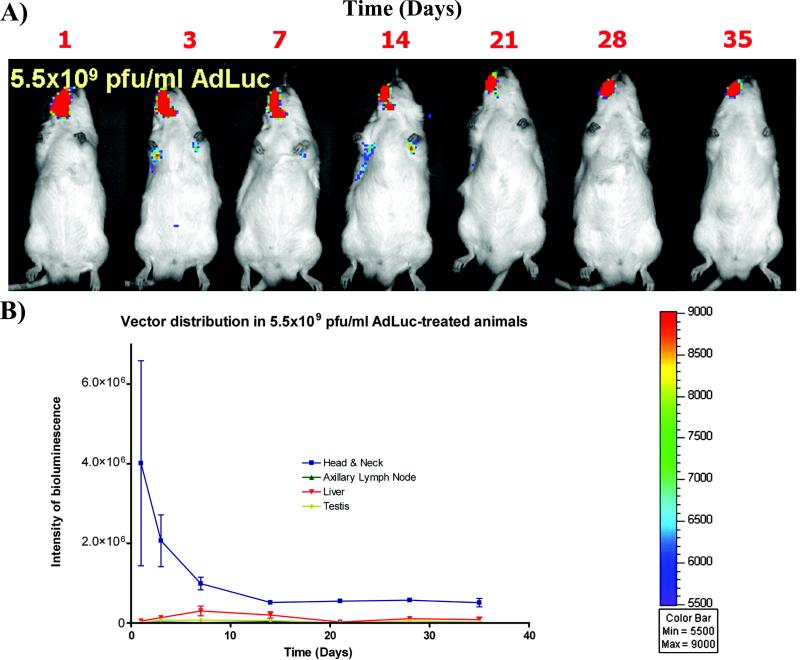
Figure 1
Figure 1
The safety incorporation and processing of biologics is accurately monitored in the rat fenestration animal models as shown by the vector transduction efficiency and systemic distribution by bioluminescence. After the surgery on the right side, most of the luciferin signal is restricted to the alveolar bone defect region. However, a significant vector expression can be also noticed in distant organs, with maximum expression at day 14, followed by a decrease in vector expression in the head and neck region over time as well as in the maxillary area. Reproduced with permission from (12).
Figure 2
Figure 2
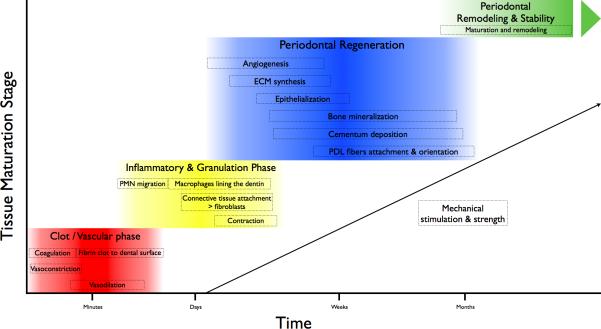
Phases during periodontal healing and regeneration. Periodontal regeneration requires different processes in a sequential manner. After the initial coagulation phase, inflammatory reaction and granulation tissue formation events, progenitor cells involved in multi-tissue regeneration are locally recruited and mediate the bioavailability of important growth factors. As the healing progresses, mechanical stimuli increase and promote an organized ECM synthesis as well as cementum and bone formation and maturation. Once those structures are established, PDL fibers are organized and oriented. Progressively, the tissues mature and ultimately increase its mechanical strength. Remodeling processes continue in the regenerated periodontium as an essential mechanism that monitors the adaptation potential to the challenging local and systemic environment.
Figure 3
Figure 3
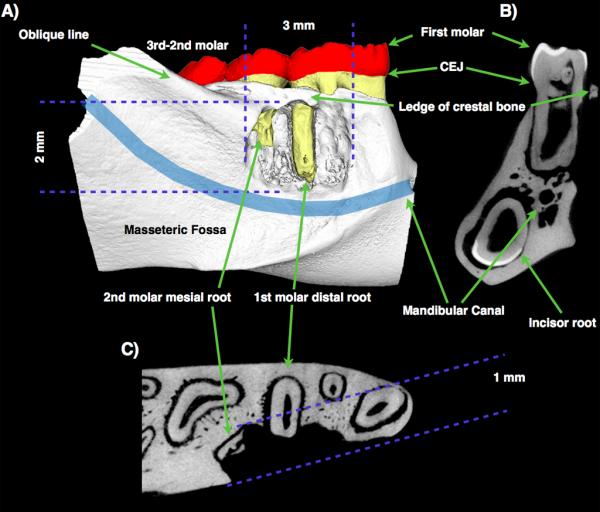
μ-CT 3D reconstruction (A) and 2D sections (B: coronal; C: transversal) of a rat fenestration defect. Location, characteristics, and anatomical landmarks from different views are shown (18 × 18 × 18 μm3 voxel size).

References

    1. Bartold PM, Narayanan AS. Molecular and cell biology of healthy and diseased periodontal tissues. Periodontol 2000. 2006;40:29–49. - PubMed
    1. Rios HF, Ma D, Xie Y, Giannobile WV, Bonewald LF, Conway SJ, Feng JQ. Periostin is essential for the integrity and function of the periodontal ligament during occlusal loading in mice. J Periodontol. 2008;79:1480–1490. - PMC - PubMed
    1. Bartold PM, Shi S, Gronthos S. Stem cells and periodontal regeneration. Periodontol 2000. 2006;40:164–172. - PubMed
    1. Rios HF, Lin Z, Oh B, Park CH, Giannobile WV. Cell- and gene-based therapeutic strategies for periodontal regenerative medicine. J Periodontol. 2011;82:1223–1237. - PMC - PubMed
    1. Park CH, Rios HF, Jin Q, Bland ME, Flanagan CL, Hollister SJ, Giannobile WV. Biomimetic hybrid scaffolds for engineering human tooth-ligament interfaces. Biomaterials. 2010;31:5945–5952. - PMC - PubMed

Publication types

LinkOut - more resources