Determination of tobacco smoke exposure by plasma cotinine levels in infants and children attending urban public hospital clinics
- PMID: 22566513
- PMCID: PMC3997061
- DOI: 10.1001/archpediatrics.2012.170
Determination of tobacco smoke exposure by plasma cotinine levels in infants and children attending urban public hospital clinics
Erratum in
- JAMA Pediatr. 2014 Aug;168(8):779
Abstract
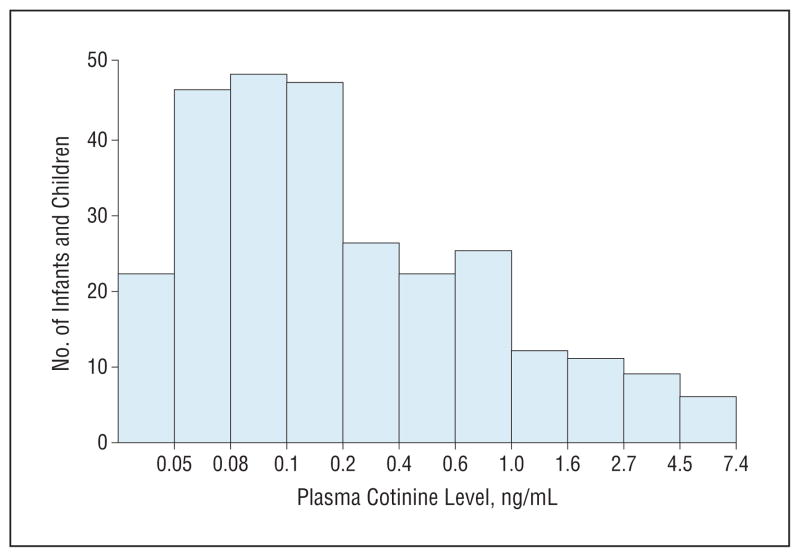
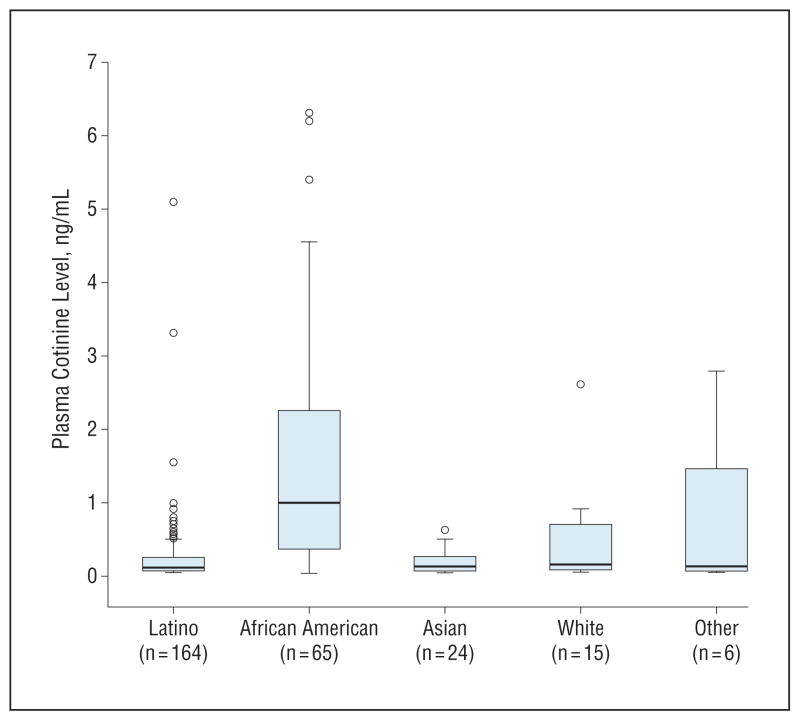
OBJECTIVE To determine the prevalence of secondhand smoke (SHS) exposure among infants and young children who received preventive care at pediatric preventative care clinics associated with an urban public hospital. Cotinine, a metabolite of nicotine, has been used to study SHS exposure in population-based studies of children 3 years of age or older. DESIGN Retrospective study using a convenience sample. SETTING Urban county pediatric primary care clinics in San Francisco, California. PARTICIPANTS A total of 496 infants and children (mean [SD] age, 2.4 [1.9] years). INTERVENTIONS Discarded plasma samples (which were routinely collected for lead screening) were tested, and medical records were reviewed, for SHS exposure. MAIN OUTCOME MEASURE Secondhand smoke exposure based on cotinine plasma level and history of exposure in the medical record. RESULTS Thirteen percent of parents reported that their child was exposed to SHS, yet biochemical testing detected cotinine in 55% of samples, at a geometric mean (SD) of 0.23 (3.55) ng/mL. There were no significant sex or age differences. African American children had much higher mean cotinine levels than did Latino children (multiplicative factor change in cotinine, 6.01 ng/ml [95% Cl, 4.49-8.05 ng/ml] [correction]. CONCLUSION In a city with a low smoking rate (12%) and public smoking bans, we documented 55% exposure among infants and young children, using a plasma biomarker, compared with 13% exposure reported by parents. Because SHS is associated with significant respiratory diseases and parents underreport exposure, routine biochemical screening should be considered as a tool to identify and reduce SHS exposure.
Figures
References
-
- US Dept of Health and Human Services. The Health Consequences of Involuntary Exposure to Tobacco Smoke: A Report of the Surgeon General. Washington, DC: Office of the Surgeon General; 2006. Respiratory effects in children from exposure to secondhand smoke; pp. 257–420.
-
- US Dept of Health and Human Services. Children and Secondhand Smoke Exposure: A Report of the Surgeon General. Washington, DC: Office of the Surgeon General; 2007.
-
- Dove MS, Dockery DW, Connolly GN. Smoke-free air laws and secondhand smoke exposure among nonsmoking youth. Pediatrics. 2010;126(1):80–87. - PubMed
-
- Akhtar PC, Haw SJ, Currie DB, Zachary R, Currie CE. Smoking restrictions in the home and secondhand smoke exposure among primary schoolchildren before and after introduction of the Scottish smoke-free legislation. Tob Control. 2009;18 (5):409–415. - PubMed
-
- Benowitz NL. Cotinine as a biomarker of environmental tobacco smoke exposure. Epidemiol Rev. 1996;18(2):188–204. - PubMed