Association between common variants near the melanocortin 4 receptor gene and severe antipsychotic drug-induced weight gain
- PMID: 22566560
- PMCID: PMC4166499
- DOI: 10.1001/archgenpsychiatry.2012.191
Association between common variants near the melanocortin 4 receptor gene and severe antipsychotic drug-induced weight gain
Abstract
Context: Second-generation antipsychotics (SGAs) are increasingly used in the treatment of many psychotic and nonpsychotic disorders. Unfortunately, SGAs are often associated with substantial weight gain, with no means to predict which patients are at greatest risk.
Objective: To identify single-nucleotide polymorphisms associated with antipsychotic drug–induced weight gain.
Design: Pharmacogenetic association study.
Setting: The discovery cohort was from a US general psychiatric hospital. Three additional cohorts were from psychiatric hospitals in the United States and Germany and from a European antipsychotic drug trial.
Participants: The discovery cohort consisted of 139 pediatric patients undergoing first exposure to SGAs. The 3 additional cohorts consisted of 73, 40, and 92 subjects.
Intervention: Patients in the discovery cohort were treated with SGAs for 12 weeks. Additional cohorts were treated for 6 and 12 weeks.
Main outcome measures: We conducted a genomewide association study assessing weight gain associated with 12 weeks of SGA treatment in patients undergoing first exposure to antipsychotic drugs. We next genotyped 3 independent cohorts of subjects assessed for antipsychotic drug-induced weight gain.
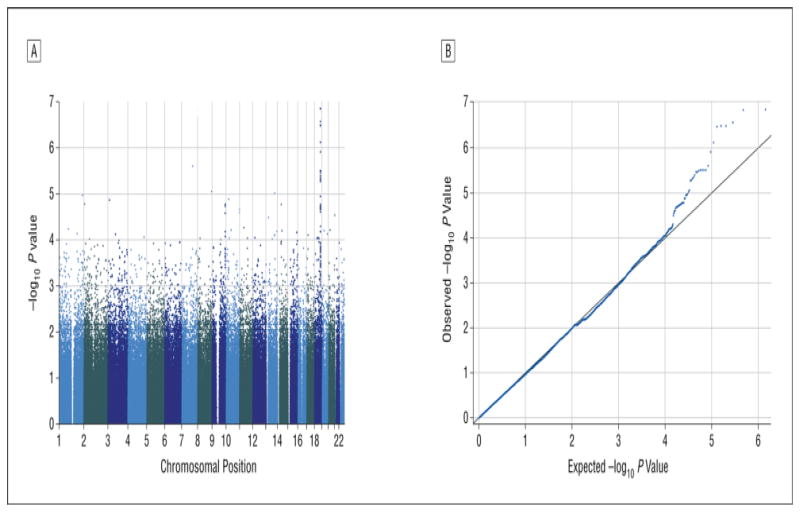
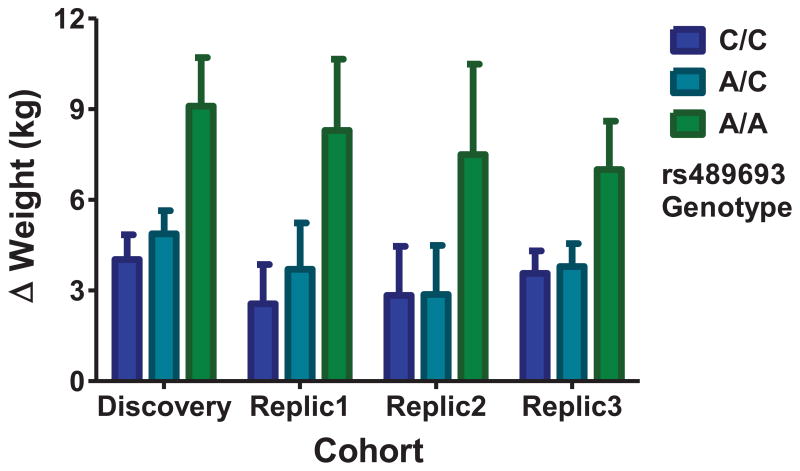
Results: Our genome-wide association study yielded 20 single-nucleotide polymorphisms at a single locus exceeding a statistical threshold of P<10(-5). This locus, near the melanocortin 4 receptor (MC4R) gene, overlaps a region previously identified by large-scale genome-wide association studies of obesity in the general population. Effects were recessive, with minor allele homozygotes gaining extreme amounts of weight during the 12-week trial. These results were replicated in 3 additional cohorts, with rs489693 demonstrating consistent recessive effects; meta-analysis revealed a genome-wide significant effect (P=5.59 X 10 (-12). Moreover, we observed consistent effects on related metabolic indices, including triglyceride, leptin, and insulin levels.
Conclusions: These data implicate MC4R in extreme SGA-induced weight gain and related metabolic disturbances. A priori identification of high-risk subjects could lead to alternative treatment strategies in this population.
Figures
References
-
- De Hert M, Dekker JM, Wood D, Kahl KG, Holt RI, Möller HJ. Cardiovascular disease and diabetes in people with severe mental illness position statement from the European Psychiatric Association (EPA), supported by the European Association for the Study of Diabetes (EASD) and the European Society of Cardiology (ESC) Eur Psychiatry. 2009;24:412–24. - PubMed
-
- Tiihonen J, Lonnquist J, Wahlbeck K, et al. 11-year follow-up of motality in patients with schizophrenia: a population-based cohort study (FIN11 study) Lancet. 2009;374:620–7. - PubMed
-
- Sikich L, Frazier JA, McClellan J, et al. Double-blind comparison of first- and second-generation antipsychotics in early-onset schizophrenia and schizo-affective disorder: findings from the treatment of early-onset schizophrenia spectrum disorders (TEOSS) study. Am J Psychiatry. 2008;165:1420–31. - PubMed
Publication types
MeSH terms
Substances
Grants and funding
LinkOut - more resources
Full Text Sources
Other Literature Sources
Medical
Molecular Biology Databases