Review
. 2012 Jun 21;119(25):5980-8.
doi: 10.1182/blood-2012-02-392506. Epub 2012 May 7.

How I treat pediatric acute myeloid leukemia

Affiliations
Review

How I treat pediatric acute myeloid leukemia

Jeffrey E Rubnitz. Blood. .

Abstract

Acute myeloid leukemia is a heterogeneous disease that accounts for approximately 20% of acute leukemias in children and adolescents. Despite the lack of targeted therapy for most subtypes and a dearth of new agents, survival rates have reached approximately 60% for children treated on clinical trials in developed countries. Most of the advances have been accomplished by better risk classification, the implementation of excellent supportive care measures, adaptation of therapy on the basis of each patient's response to therapy, and improvements in allogeneic hematopoietic stem cell transplantation. However, it is unlikely that further gains can be made through these measures alone. In this regard, high-resolution, genome-wide analyses have led to greater understanding of the pathogenesis of this disease and the identification of molecular abnormalities that are potential targets of new therapies. The development of molecularly targeted agents, some of which are already in clinical trials, holds great promise for the future.


Figures
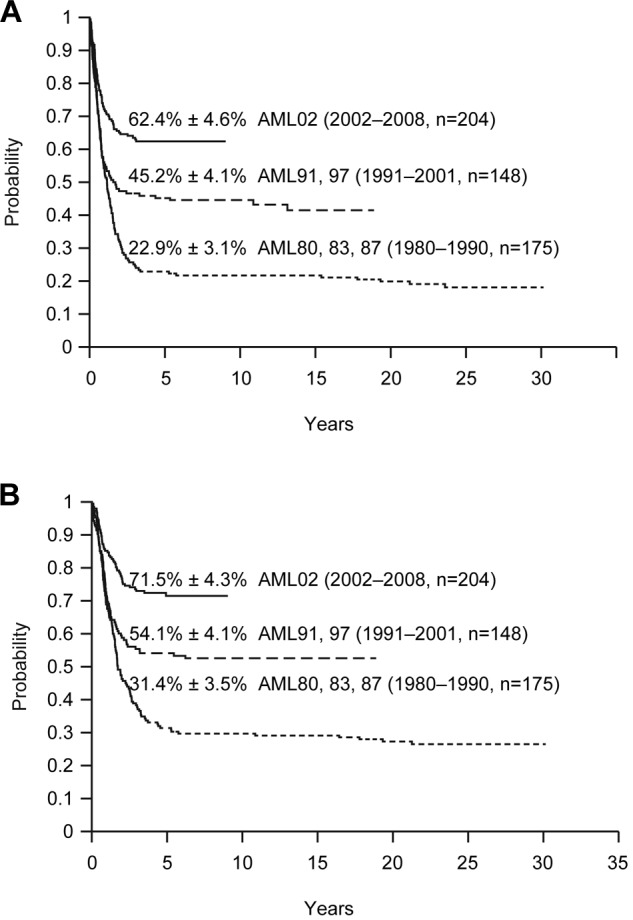
Figure 1
Figure 1
Survival of patients with de novo AML treated on St Jude trials. (A) EFS and (B) OS of patients with de novo AML (excluding those with Down syndrome or APL) treated on St Jude trials during the years indicated. AML02 was multi-institutional, whereas earlier studies were single institution.
Figure 2
Figure 2
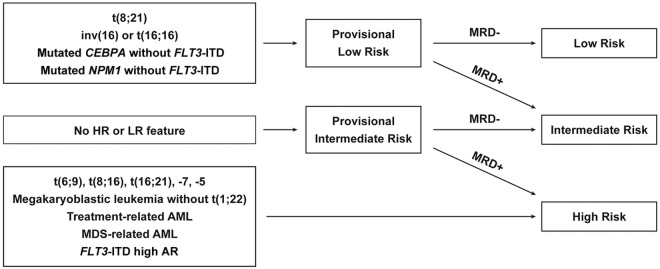
Risk classification of patients with AML. Risk classification scheme based on features at diagnosis and the presence of MRD. LR indicates low-risk; HR, high-risk; and AR, allelic ratio. Patients with t(8;21), inv(16), or t(16;16) are considered to be provisional LR regardless of other genetic alterations. Patients with NPM1 mutations or biallelic CEBPA mutations are provisional LR, except in the presence of FLT3-ITD. Provisional LR patients are moved to the intermediate-risk group if they are MRD-positive after one course of induction therapy. HR patients include those with any of the features indicated in the box on the lower left, regardless of response to therapy. Patients who lack LR and HR features are provisionally classified as intermediate risk but are moved to the HR group if they have a poor response to therapy as assessed by MRD.

References

    1. Vardiman JW, Thiele J, Arber DA, et al. The 2008 revision of the World Health Organization (WHO) classification of myeloid neoplasms and acute leukemia: rationale and important changes. Blood. 2009;114(5):937–951. - PubMed
    1. Lane SW, Scadden DT, Gilliland DG. The leukemic stem cell niche: current concepts and therapeutic opportunities. Blood. 2009;114(6):1150–1157. - PMC - PubMed
    1. Jordan CT, Guzman ML, Noble M. Cancer stem cells. N Engl J Med. 2006;355(12):1253–1261. - PubMed

    1. Pui CH, Carroll WL, Meshinchi S, Arceci RJ. Biology, risk stratification, and therapy of pediatric acute leukemias: an update. J Clin Oncol. 2011;29(5):551–565. - PMC - PubMed
    1. Radtke I, Mullighan CG, Ishii M, et al. Genomic analysis reveals few genetic alterations in pediatric acute myeloid leukemia. Proc Natl Acad Sci U S A. 2009;106(31):12944–12949. - PMC - PubMed