. 2012 May 22;109(21):8212-7.
doi: 10.1073/pnas.1206062109. Epub 2012 May 7.

A cluster of cooperating tumor-suppressor gene candidates in chromosomal deletions

Affiliations

A cluster of cooperating tumor-suppressor gene candidates in chromosomal deletions

Wen Xue et al. Proc Natl Acad Sci U S A. .

Abstract

The large chromosomal deletions frequently observed in cancer genomes are often thought to arise as a "two-hit" mechanism in the process of tumor-suppressor gene (TSG) inactivation. Using a murine model system of hepatocellular carcinoma (HCC) and in vivo RNAi, we test an alternative hypothesis, that such deletions can arise from selective pressure to attenuate the activity of multiple genes. By targeting the mouse orthologs of genes frequently deleted on human 8p22 and adjacent regions, which are lost in approximately half of several other major epithelial cancers, we provide evidence suggesting that multiple genes on chromosome 8p can cooperatively inhibit tumorigenesis in mice, and that their cosuppression can synergistically promote tumor growth. In addition, in human HCC patients, the combined down-regulation of functionally validated 8p TSGs is associated with poor survival, in contrast to the down-regulation of any individual gene. Our data imply that large cancer-associated deletions can produce phenotypes distinct from those arising through loss of a single TSG, and as such should be considered and studied as distinct mutational events.


Conflict of interest statement

The authors declare no conflict of interest.

Figures
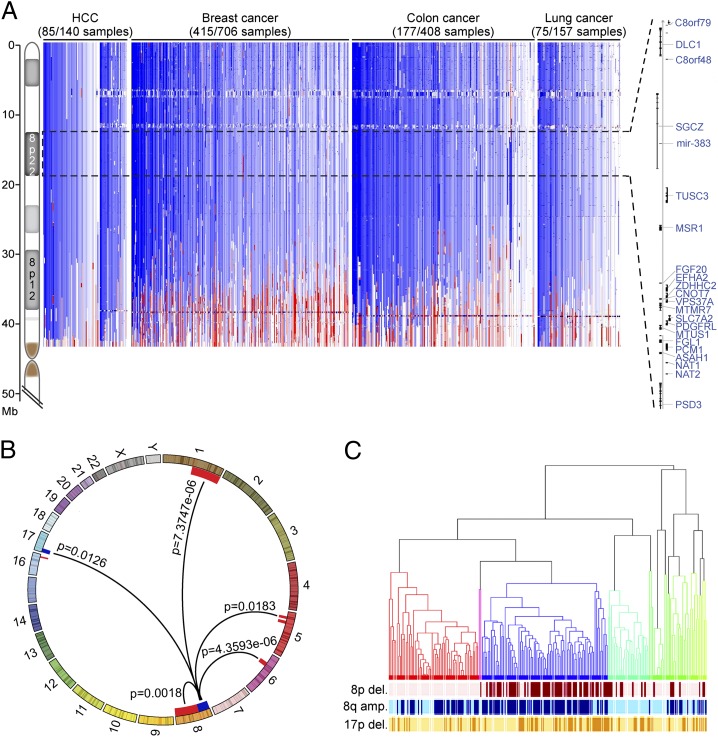
Fig. 1.
Fig. 1.
Chromosome 8p deletion characteristics and co-occurring genomic aberrations. (A) Size and extent of chromosome 8p deletions (in blue) and amplifications (in red) from individual HCCs, breast cancers, colon cancers, and lung adenocarcinomas based on aCGH data analysis (Materials and Methods). The 8p22 cytoband is highlighted by a dashed line, with the organization of the 8p22 genes indicated on the right. (B) Chromosome 8p deletions co-occur with genomic aberrations in HCC, including amplifications (red) of 1q, 5p, 6p, and 8q and deletions (blue) of 17p. Fisher’s exact test was used for statistical calculations. (C) Unsupervised hierarchical clustering of genomic aberrations indicates 12 groups within the HCC dataset (n = 197). Occurrence of 8p deletion (dark red), 8q amplification (dark blue), and 17p deletion (dark orange) within the individual samples is highlighted below the dendrogram.
Fig. 2.
Fig. 2.
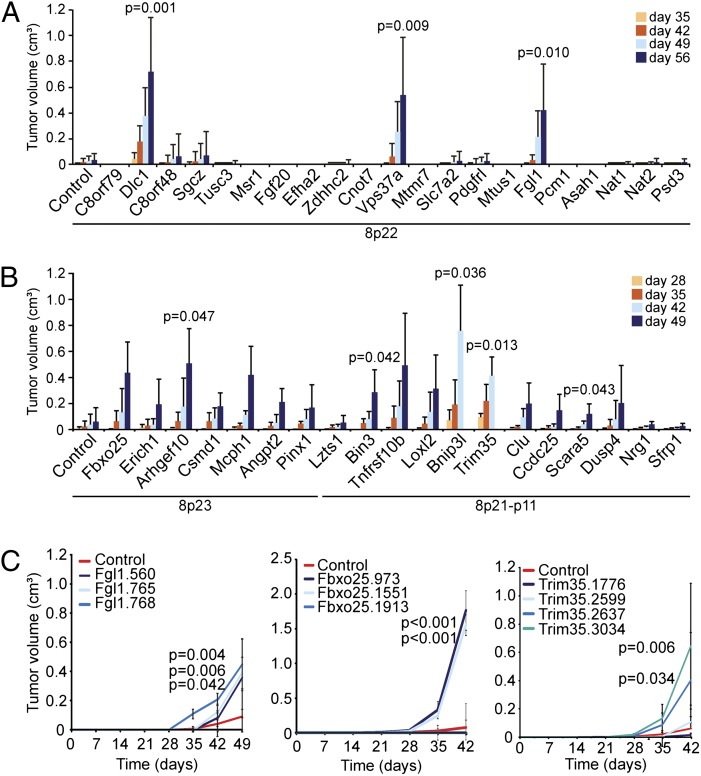
Chromosome 8p deletions target multiple TSGs. (A and B) Average volume of tumors derived from s.c. injected p53−/−;Myc immortalized liver cells infected with indicated shRNA pools. Error bars denote SD (n = 6). The Student t test comparing normalized samples at the time when mice were killed relative to controls was used for statistical calculations. (C) Average tumor volumes of s.c. injected p53−/−;Myc immortalized liver cells infected with indicated individual shRNAs. Error bars denote SD (n = 8). The Student t test comparing normalized samples at day 42 relative to control was used to calculate P values.
Fig. 3.
Fig. 3.
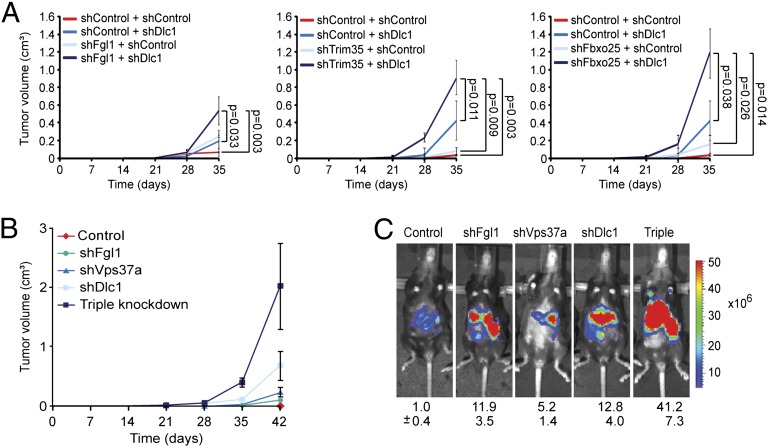
Cooperativity of 8p TSGs. (A) Average tumor volumes (n = 4) of s.c. injected p53−/−;Myc immortalized liver cells infected or coinfected with indicated shRNAs. Hairpins targeting Renilla served as controls. Error bars denote SD. Significance was calculated using the Student t test comparing normalized samples on day 35 relative to controls. (B) Average tumor volumes of s.c. injected p53−/−;Myc immortalized liver cells infected with indicated single shRNAs or coinfected with all three shRNAs (Fgl1, Vps37a, and Dlc1). Error bars denote SD (n = 4). Of note, given the experimental organization, the individual contribution of each TSGs in the triple-gene knockdown could not be determined. (C) Representative bioluminescence images from five mice with in situ liver tumors from intrasplenically injected p53−/−;Myc liver progenitor cells infected with indicated single shRNAs or triple-infected with Fgl1, Vps37a, and Dlc1 shRNAs. Numbers shown indicate mean ± SD intensities of luciferase signals (n = 5).
Fig. 4.
Fig. 4.
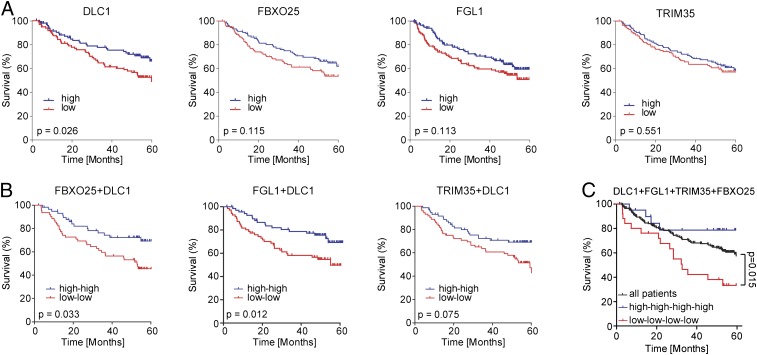
Association of survival and 8p gene expression in patients with HCC. (A and B) Survival curves comparing high and low expression of indicated single genes (A) and combinations of two genes (B). (C) Survival association in patients with HCC (n = 192) for the entire cohort (all patients, black line) versus combined low expression (red line) or high expression (blue line) of DLC1, FGL1, TRIM35, and FBXO25. Statistical testing was performed as described previously (24).

Comment in

References

    1. Baker SJ, et al. Chromosome 17 deletions and p53 gene mutations in colorectal carcinomas. Science. 1989;244:217–221. - PubMed
    1. Birnbaum D, et al. Chromosome arm 8p and cancer: A fragile hypothesis. Lancet Oncol. 2003;4:639–642. - PubMed
    1. Xue W, et al. DLC1 is a chromosome 8p tumor suppressor whose loss promotes hepatocellular carcinoma. Genes Dev. 2008;22:1439–1444. - PMC - PubMed
    1. El Gammal AT, et al. Chromosome 8p deletions and 8q gains are associated with tumor progression and poor prognosis in prostate cancer. Clin Cancer Res. 2010;16:56–64. - PubMed
    1. Cooke SL, et al. High-resolution array CGH clarifies events occurring on 8p in carcinogenesis. BMC Cancer. 2008;8:288. - PMC - PubMed

Publication types

MeSH terms

Supplementary concepts