. 2012 Mar 12:3:20.
doi: 10.3389/fimmu.2012.00020. eCollection 2012.

SOCS, Inflammation, and Autoimmunity

Affiliations

SOCS, Inflammation, and Autoimmunity

Akihiko Yoshimura et al. Front Immunol. .

Abstract

Cytokines play essential roles in innate and adaptive immunity. However, excess cytokines or dysregulation of cytokine signaling will cause a variety of diseases, including allergies, autoimmune diseases, inflammation, and cancer. Most cytokines utilize the so-called Janus kinase-signal transducers and activators of transcription pathway. This pathway is negatively regulated by various mechanisms including suppressors of cytokine signaling (SOCS) proteins. SOCS proteins bind to JAK or cytokine receptors, thereby suppressing further signaling events. Especially, suppressor of cytokine signaling-1 (SOCS1) and SOCS3 are strong inhibitors of JAKs, because these two contain kinase inhibitory region at the N-terminus. Studies using conditional knockout mice have shown that SOCS proteins are key physiological as well as pathological regulators of immune homeostasis. Recent studies have also demonstrated that SOCS1 and SOCS3 are important regulators of helper T cell differentiation and functions. This review focuses on the roles of SOCS1 and SOCS3 in T cell mediated inflammatory diseases.

Keywords: STAT; cytokine; helper T cell; immunity; signal transduction.


Figures
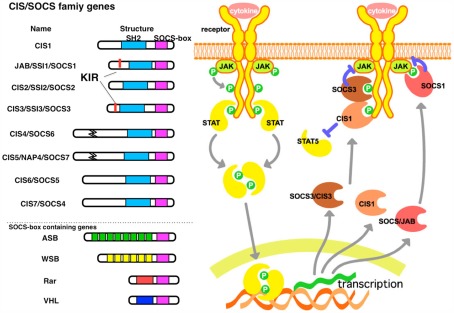
Figure 1
Figure 1
The structure and function of SOCS proteins. (left) Schematic structure of the CIS/SOCS family proteins. The SOCS box is conserved in all CIS/SOCS family proteins. SOCS1 and SOCS3 contain a unique kinase inhibitory region (KIR) immediately upstream of the central SH2 domain, which is proposed to function as a pseudosubstrate. Other SOCS box-containing proteins are illustrated. (right) Mechanism of suppression by CIS, SOCS1, and SOCS3. All of these are induced by cytokine stimulation. CIS binds to the STAT5 activating receptors, thereby suppressing further activation of STAT5 and inducing degradation of the receptor. SOCS1 binds to JAKs, and SOCS3 binds to the receptor through the SH2 domain, but both inhibit JAK activity through KIR. These complexes may be degraded by ubiquitination and proteasomal degradation recruited through the SOCS box.
Figure 2
Figure 2
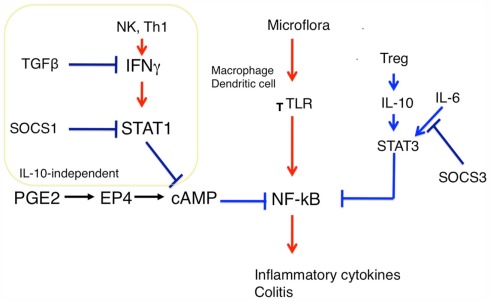
Role of SOCS1 and PGE2 in macrophage/dendritic cell activation. Treg/IL-10/STAT3 and PGE2/cAMP are two independent anti-inflammatory mechanisms, although precise molecular mechanisms have not been clarified yet. SOCS1 is involved in the cAMP suppression system but not in the IL-10 system. SOCS1 prevents the breakdown of cAMP-mediated TLR signaling by suppressing STAT1. On the other hand, SOCS3 may keep proper TLR signaling by inhibiting IL-6-mediated STAT3 activation. SOCS3 has no effect on IL-10 mediated anti-inflammatory effect.
Figure 3
Figure 3
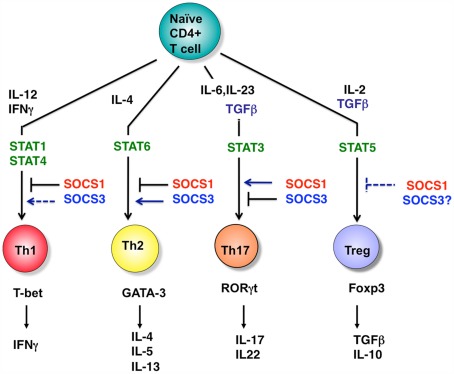
Role of STATs and SOCS proteins in helper T cell differentiation. T cell differentiation from naïve cells into the various functional subtypes (e.g., Th1, Th2, Th17, and Treg cells) primarily depends on the action of cytokines as indicated. SOCS1 and SOCS3 regulate the cytokine pathways indicated, and thereby dictate CD4+ T cell differentiation. Note that SOCS3 inhibits Th1 through overexpression by suppressing IL-12 mediated STAT4 activation. However, SOCS3 deletion also inhibits Th1 by promoting the production of IL-10 and TGF-β. In Tregs, SOCS1 deletion promotes Treg expansion; however, these are functionally impaired. Thus, SOCS1 negatively regulates the Treg number, but is necessary for the function of Tregs. The role of SOCS3 in Tregs has not yet been clarified. For Th17, RORγt induction by TGF-β has been demonstrated to be independent of Smad2/3/4.
Figure 4
Figure 4
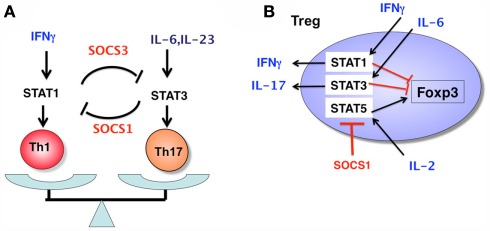
Role of SOCS1 and SOCS3 in Th1/Th17 balance (A) and in nTreg integrity (B). In Th1 conditions, activated STAT1 induces SOCS3 expression, which in turn inhibits STAT3 activity, thereby suppressing Th17 development. In Th17 conditions, SOCS1 is highly expressed and inhibits IFNγ-mediated Th1 development. In nTregs, the SOCS1 level is constantly high, and suppresses STAT1, STAT3, and STAT5 in inflammatory conditions (high levels of cytokines such as IL-2, IL-6, and IFNγ). The higher activation of STAT5 results in an increase in the number of Tregs, because STAT5 directly upregulates Foxp3 expression. The higher activation of STAT1 and STAT3 induces loss of Foxp3 expression by unknown mechanisms and promotes IFNγ and IL-17 production, respectively. Thus, SOCS1 is a “guardian” of Tregs.

References

    1. Adamson A. S., Collins K., Laurence A., O’Shea J. J. (2009). The Current STATus of lymphocyte signaling: new roles for old players. Curr. Opin. Immunol. 21, 161–166 10.1016/j.coi.2009.03.013 - DOI - PMC - PubMed
    1. Alexander W. S., Starr R., Fenner J. E., Scott C. L., Handman E., Sprigg N. S., Corbin J. E., Cornish A. L., Darwiche R., Owczarek C. M., Kay T. W., Nicola N. A., Hertzog P. J., Metcalf D., Hilton D. J. (1999). SOCS1 is a critical inhibitor of interferon gamma signaling and prevents the potentially fatal neonatal actions of this cytokine. Cell 98, 597–608 10.1016/S0092-8674(00)80047-1 - DOI - PubMed
    1. Bhattacharyya S., Zhao Y., Kay T. W., Muglia L. J. (2011). Glucocorticoids target suppressor of cytokine signaling 1 (SOCS1) and type 1 interferons to regulate Toll-like receptor-induced STAT1 activation. Proc. Natl. Acad. Sci. U.S.A. 108, 9554–9559 10.1073/pnas.1017296108 - DOI - PMC - PubMed
    1. Bjorbak C., Lavery H. J., Bates S. H., Olson R. K., Davis S. M., Flier J. S., Myers M. G., Jr. (2000). SOCS3 mediates feedback inhibition of the leptin receptor via Tyr985. J. Biol. Chem. 275, 40649–40657 10.1074/jbc.M007577200 - DOI - PubMed
    1. Cacalano N. A., Sanden D., Johnston J. A. (2001). Tyrosine-phosphorylated SOCS-3 inhibits STAT activation but binds to p120 RasGAP and activates Ras. Nat. Cell Biol. 3, 460–465 10.1038/35074525 - DOI - PubMed

LinkOut - more resources