


doi: 10.1155/2012/170173.
Epub 2012 Jan 29.
Control of Transcriptional Elongation by RNA Polymerase II: A Retrospective
Affiliations
- PMID: 22567377
- PMCID: PMC3335475
- DOI: 10.1155/2012/170173
Item in Clipboard
Control of Transcriptional Elongation by RNA Polymerase II: A Retrospective
Genet Res Int.
2012.
Abstract
The origins of our current understanding of control of transcription elongation lie in pioneering experiments that mapped RNA polymerase II on viral and cellular genes. These studies first uncovered the surprising excess of polymerase molecules that we now know to be situated at the at the 5' ends of most genes in multicellular organisms. The pileup of pol II near transcription start sites reflects a ubiquitous bottle-neck that limits elongation right at the start of the transcription elongation. Subsequent seminal work identified conserved protein factors that positively and negatively control the flux of polymerase through this bottle-neck, and make a major contribution to control of gene expression.
Figures
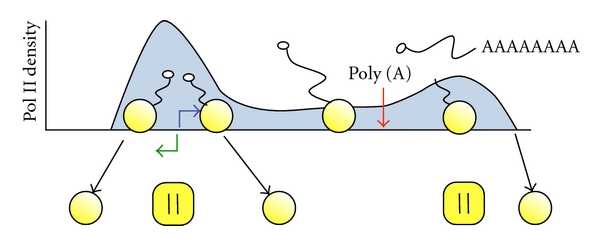
RNA pol II density profile across a typical metazoan protein-coding gene. Elevated density around the transcription start site (TSS) results from promoter-proximal pausing and possibly premature termination of transcription. Blue and green arrows denote divergent transcription from the TSS. A second peak of pol II accumulation downstream of the poly (A) site precedes termination coupled to cleavage/polyadenylation. Black arrows denote termination of transcription with eviction of pol II (yellow circles) from the DNA template downstream of the poly (A) site (red arrow) and possibly also in the promoter-proximal region. The mRNA cap structure is denoted by a white circle.
References
-
- Hay N, Skolnik-David H, Aloni Y. Attenuation in the control of SV40 gene expression. Cell. 1982;29(1):183–193. - PubMed
-
- Skarnes WC, Tessier DC, Acheson NH. RNA polymerases stall and/or prematurely terminate nearby both early and late promoters on polyomavirus DNA. Journal of Molecular Biology. 1988;203(1):153–171. - PubMed
Grants and funding
LinkOut - more resources
Full Text Sources
