


Aging and dry eye disease
- PMID: 22569356
- PMCID: PMC3368077
- DOI: 10.1016/j.exger.2012.03.020
Aging and dry eye disease
Abstract
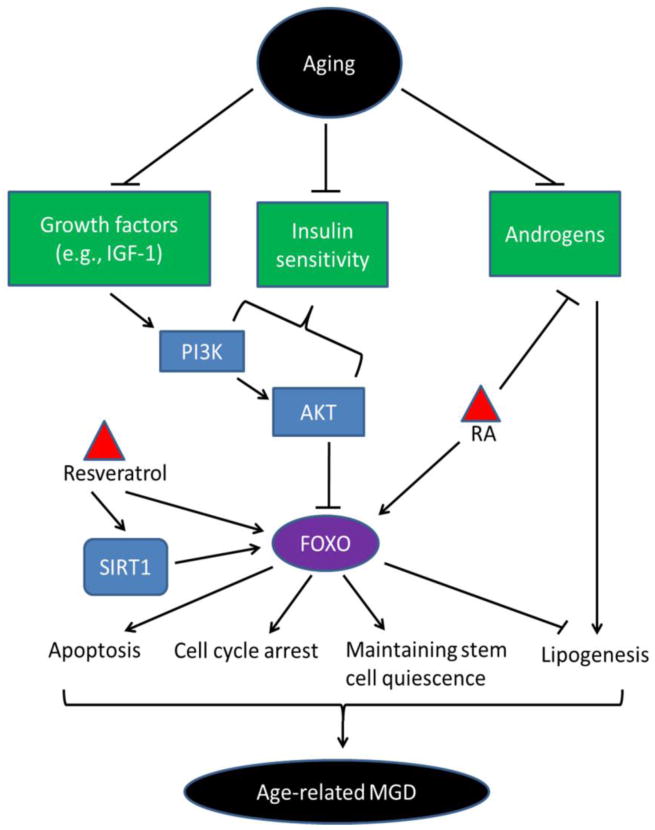
Dry eye disease is a prevalent eye disorder that in particular affects the elderly population. One of the major causes of dry eye, meibomian gland dysfunction (MGD), shows increased prevalence with aging. MGD is caused by hyperkeratinization of the ductal epithelium of meibomian gland and reduced quantity and/or quality of meibum, the holocrine product that stabilizes and prevents the evaporation of the tear film. Of note, retinoids which are used in current anti-aging cosmetics may promote the development of MGD and dry eye disease. In this review, we will discuss the possible mechanisms of age-related MGD.
Copyright © 2012 Elsevier Inc. All rights reserved.
Conflict of interest statement
Figures
References
-
- The definition and classification of dry eye disease: report of the Definition and Classification Subcommittee of the International Dry Eye WorkShop (2007) The ocular surface. 2007;5:75–92. - PubMed
-
- Arita R, Itoh K, Inoue K, Amano S. Noncontact infrared meibography to document age-related changes of the meibomian glands in a normal population. Ophthalmology. 2008;115:911–915. - PubMed
-
- Armoni M, Harel C, Karni S, Chen H, Bar-Yoseph F, Ver MR, Quon MJ, Karnieli E. FOXO1 epresses peroxisome proliferator-activated receptor-gamma1 and -gamma2 gene promoters in primary adipocytes. A novel paradigm to increase insulin sensitivity. The Journal of biological hemistry. 2006;281:19881–19891. - PubMed
-
- Baur JA, Sinclair DA. Therapeutic potential of resveratrol: the in vivo evidence. Nature reviews Drug discovery. 2006;5:493–506. - PubMed
Publication types
MeSH terms
Substances
Grants and funding
LinkOut - more resources
Full Text Sources
Medical
