


Tumor characteristics and survival analysis of incidental versus suspected gallbladder carcinoma
- PMID: 22570074
- PMCID: PMC3781928
- DOI: 10.1007/s11605-012-1901-y
Tumor characteristics and survival analysis of incidental versus suspected gallbladder carcinoma
Abstract
Introduction: Over half of all gallbladder carcinoma (GBC) is discovered incidentally after cholecystectomy for benign disease. There are scant data comparing presentation and outcome for patients with incidental versus suspected GBC. The goal of this study is to determine the clinical differences between these two entities.
Study design: Patients with GBC were identified retrospectively from records at academic healthcare institutions in Temuco, Chile; Atlanta, GA; and Rochester, MN between 1984 and 2008. Overall survival was compared for patients with and without preoperative suspicion using Kaplan-Meier curves and a multivariate Cox proportional hazards model.
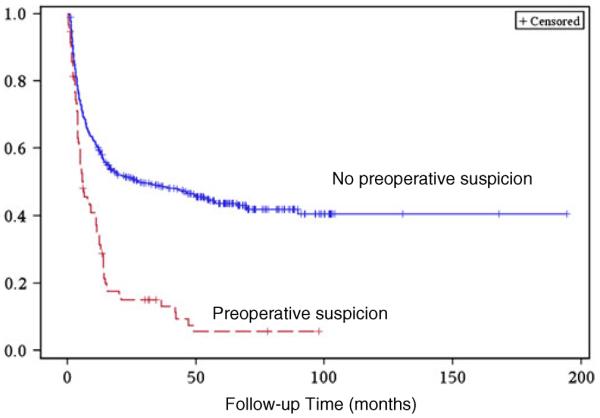
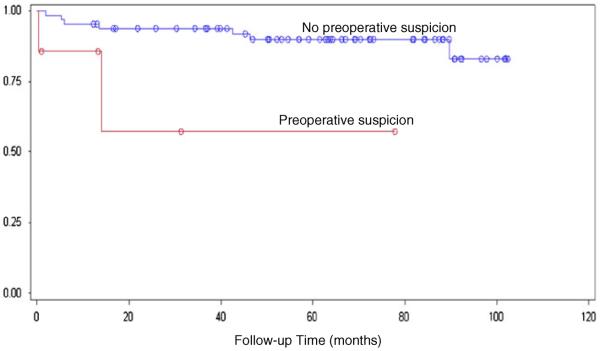
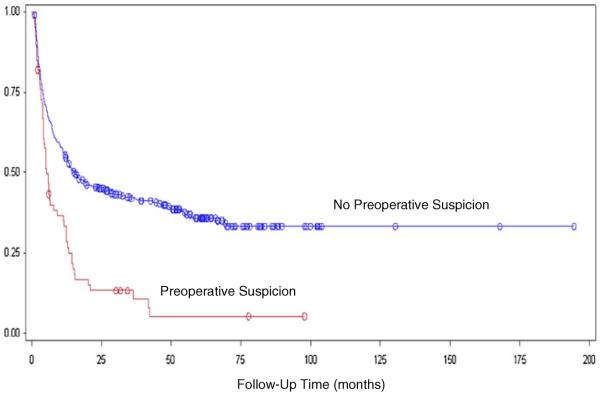
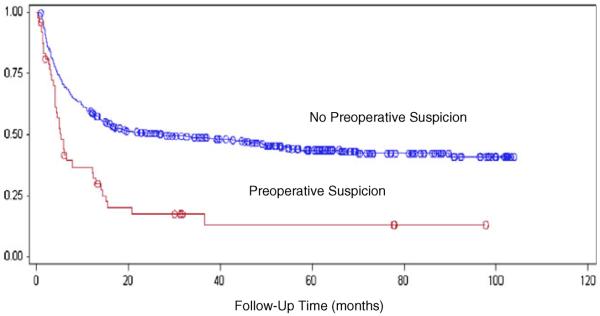
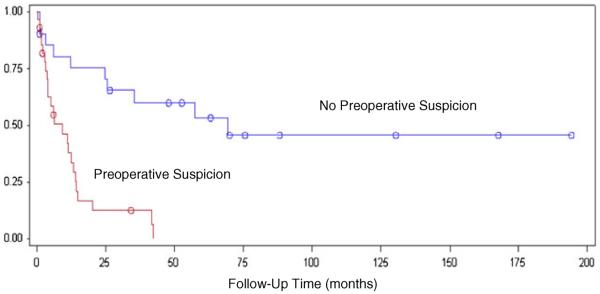
Results: Of 571 patients, 128 (22.4%) had preoperative suspicion of malignancy, and 443 (77.6 %) were discovered incidentally. Incidental tumors were of lower stage, better differentiated, and with lower rates of metastases. Median survival for incidentally discovered GBC was 32.3 versus 5.8 months for suspected GBC (p<0.0001). In a Cox proportional hazards model controlling for operation extent, T stage, differentiation, and other factors, preoperative suspicion remains a strong risk factor (odds ratio, 2.0; confidence interval, 1.5-2.9; p<0.0001).
Conclusions: Tumor characteristics differed significantly between patients with incidentally discovered versus preoperatively suspected GBC. Incidental GBC has a significantly better median survival.
Figures
References
-
- Oddsdottir M PT, Hunter JG. In: Chapter 32. Gallbladder and the Extrahepatic Biliary System (Chapter), in Schwartz's Principles of Surgery. Brunicardi FC AD, Billiar TR, Dunn DL, Hunter JG, Matthews JB, Pollock RE, editors. 2009.
-
- Frauenschuh D GR, Kraas E. How to proceed in patients with carcinoma detected after laparoscopic cholecystectomy. Langenbeck's Archives of Surgery. 2000;385:495–500. - PubMed
-
- Bazoua G HN, Lazim T. Do we need histology for a normal-looking gallbladder? Journal of Hepatobiliary and Pancreatic Surgery. 2007;14:564–568. - PubMed
-
- Goldin RD RJ. Gallbladder cancer: a morphological and molecular update. Histopathology. 2009;55:218–229. - PubMed
Publication types
MeSH terms
Grants and funding
LinkOut - more resources
Full Text Sources
Medical
