. 2012 May-Jun;3(3):168-71.
doi: 10.4161/bbug.19543. Epub 2012 May 1.

The Saccharomyces cerevisiae SCRaMbLE system and genome minimization

Affiliations

The Saccharomyces cerevisiae SCRaMbLE system and genome minimization

Jessica Dymond et al. Bioeng Bugs. 2012 May-Jun.

Abstract

We have recently reported the first partially synthetic eukaryotic genome. Saccharomyces cerevisiae chromosomes synIXR and semi-synVIL are fully synthetic versions of the right arm of chromosome IX and the telomeric segment of the left arm of chromosome VI, respectively, and represent the beginning of the synthetic yeast genome project, Sc2.0, that progressively replaces native yeast DNA with synthetic sequences. We have designed synthetic chromosome sequences according to principles specifying a wild-type phenotype, highly stable genome, and maintenance of genetic flexibility. Although other synthetic genome projects exist, the Sc2.0 approach is unique in that we have implemented design specifications predicted to generate a wild-type phenotype until induction of "SCRaMbLE," an inducible evolution system that generates significant genetic diversity. Here we further explore the significance of Sc2.0 and show how SCRaMbLE can serve as a genome minimization tool.


Figures
None
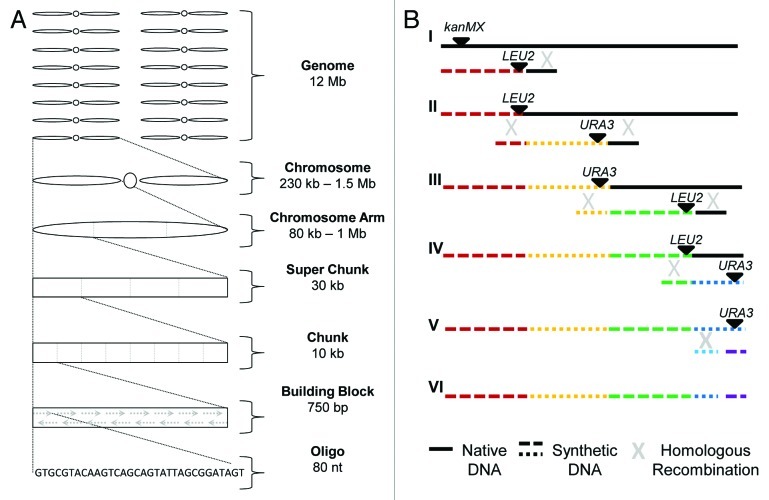
Figure 1. Genome modularity and integration of synthetic DNA. (A) The yeast genome is subdivided into increasingly smaller segments to facilitate construction and assembly of the synthetic Sc2.0 genome (not to scale). The assembly pipeline may be entered from multiple points. The assembly technique utilized by Build-a-Genome students begins at the bottom of the assembly pipeline, constructing building blocks from oligos. Commercially synthesized DNAs used to construct semi-synVIL were obtained as chunks, and assembled into a super chunk prior to integration in the yeast genome. SynIXR entered the pipeline as a chromosome arm. (B) Synthetic DNA is iteratively integrated into the yeast genome to replace native DNA (not to scale). The native chromosome, marked with kanMX, is targeted for replacement by integration of synthetic DNA, marked with LEU2. An “endcap” directs homologous recombination to the region/s flanking the synthetic sequence. The resulting Leu+ G418S semi-synthetic chromosome is then targeted for replacement by integration of a URA3-marked synthetic DNA fragment (II). Iterative transformations with synthetic DNA fragments alternately marked with LEU2 and URA3 sequentially replace the native DNA (III-IV). The final URA3 marker is replaced by transformation with synthetic sequence lacking the URA3 gene and subsequent selection on 5-FOA (V) to generate the complete unmarked synthetic chromosome.
None
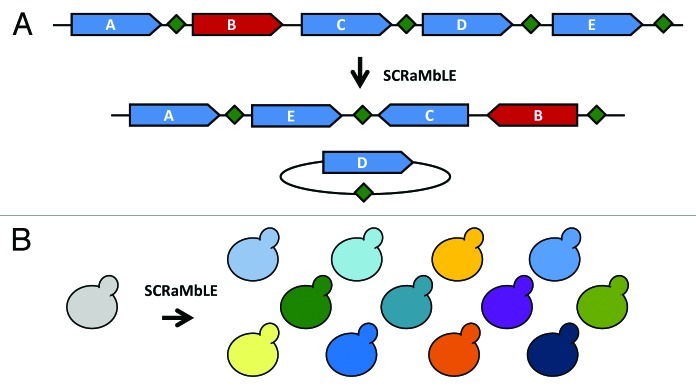
Figure 2. SCRaMbLE restructures the synthetic genome. (A) LoxPsym sites (green diamonds) are inserted in the 3′UTR of each non-essential gene (blue arrows); essential genes (red arrow) do not have an associated loxPsym site. The symmetry of loxPsym sites permits both translocations/inversions and deletions at each site. Complex rearrangements result from induction of SCRaMbLE. In the example shown, genes “B” and “C” are inverted, “E” has been excised and reintegrated, and “D” has been lost from the SCRaMbLEd chromosome. (B) Induction of SCRaMbLE in a synthetic strain (gray) results in a significant increase in genetic diversity (colors). Following selection for a desired phenotype, which can range from simple viability to increased ability to produce a desirable substance, genome content and structure of SCRaMbLEd strains can be analyzed by PCRTag analysis, comparative genome hybridization (CGH), molecular karyotyping and/or whole-genome sequencing.

References

    1. Agarwal KL, Büchi H, Caruthers MH, Gupta N, Khorana HG, Kleppe K, et al. Total synthesis of the gene for an alanine transfer ribonucleic acid from yeast. Nature. 1970;227:27–34. doi: 10.1038/227027a0. - DOI - PubMed
    1. Khorana HG, Agarwal KL, Besmer P, Büchi H, Caruthers MH, Cashion PJ, et al. Total synthesis of the structural gene for the precursor of a tyrosine suppressor transfer RNA from Escherichia coli. 1. General introduction. J Biol Chem. 1976;251:565–70. - PubMed
    1. Cello J, Paul AV, Wimmer E. Chemical synthesis of poliovirus cDNA: generation of infectious virus in the absence of natural template. Science. 2002;297:1016–8. doi: 10.1126/science.1072266. - DOI - PubMed
    1. Smith HO, Hutchison CA, 3rd, Pfannkoch C, Venter JC. Generating a synthetic genome by whole genome assembly: phiX174 bacteriophage from synthetic oligonucleotides. Proc Natl Acad Sci U S A. 2003;100:15440–5. doi: 10.1073/pnas.2237126100. - DOI - PMC - PubMed
    1. Gibson DG, Benders GA, Andrews-Pfannkoch C, Denisova EA, Baden-Tillson H, Zaveri J, et al. Complete chemical synthesis, assembly, and cloning of a Mycoplasma genitalium genome. Science. 2008;319:1215–20. doi: 10.1126/science.1151721. - DOI - PubMed

MeSH terms

LinkOut - more resources