


Perceptual learning evidence for tuning to spectrotemporal modulation in the human auditory system
- PMID: 22573676
- PMCID: PMC3519395
- DOI: 10.1523/JNEUROSCI.5732-11.2012
Perceptual learning evidence for tuning to spectrotemporal modulation in the human auditory system
Abstract
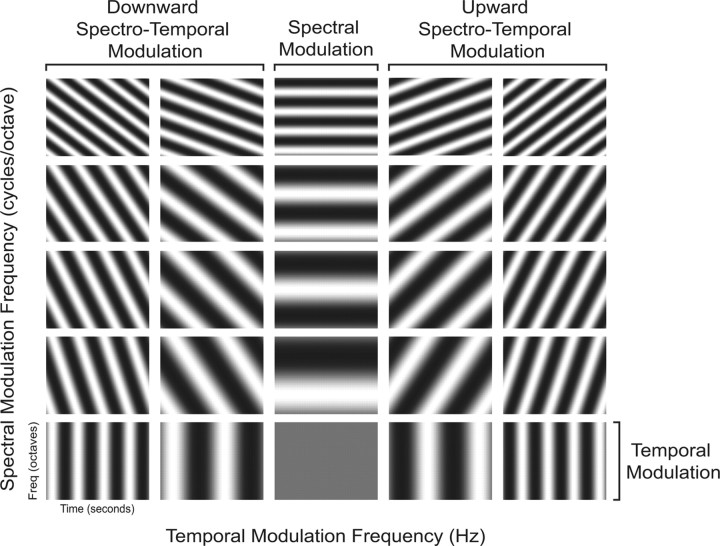
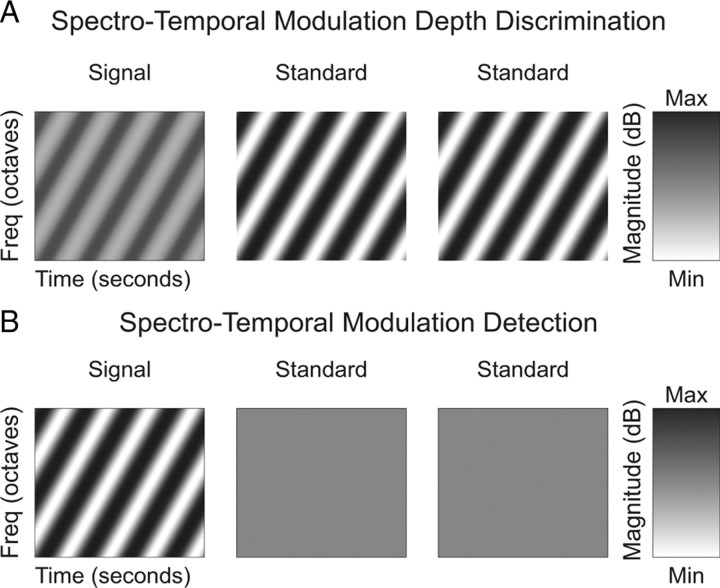
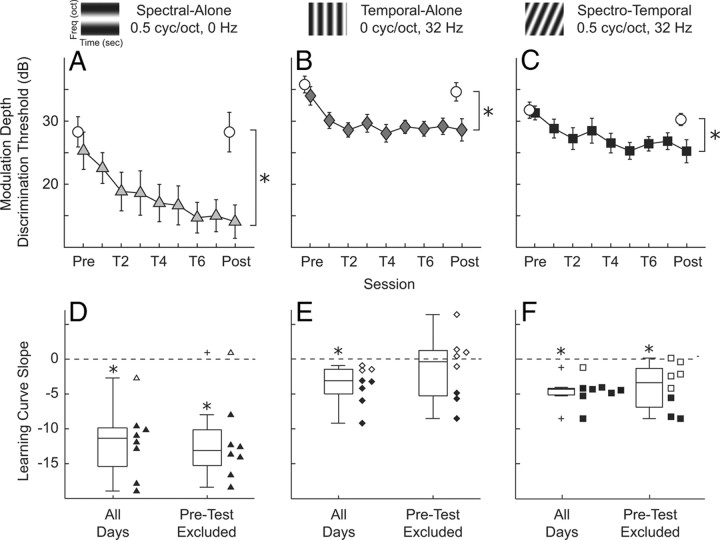
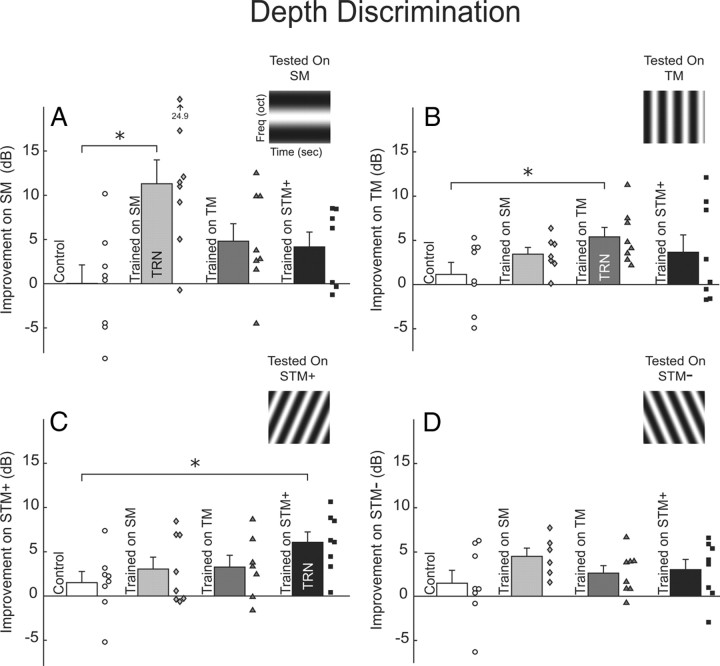
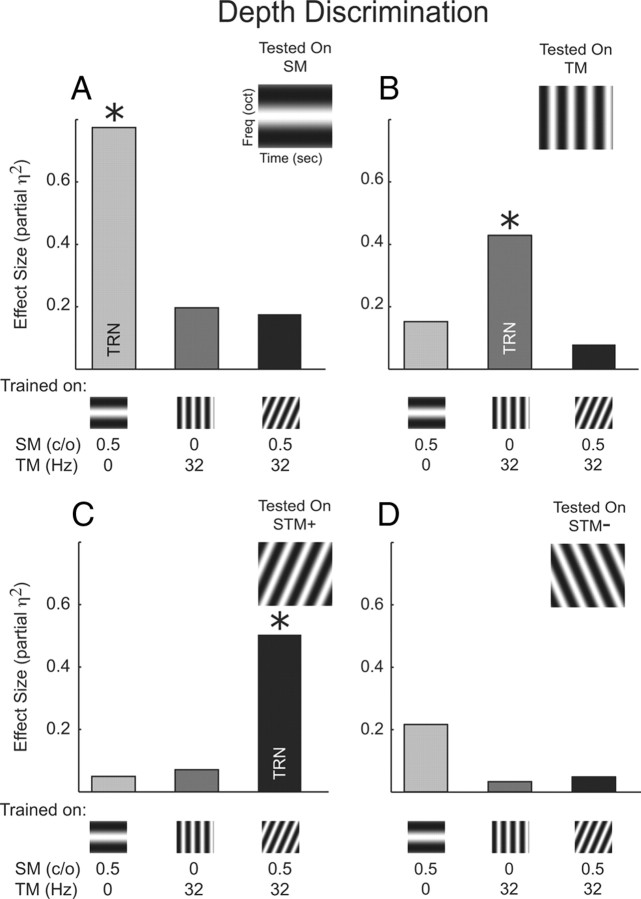
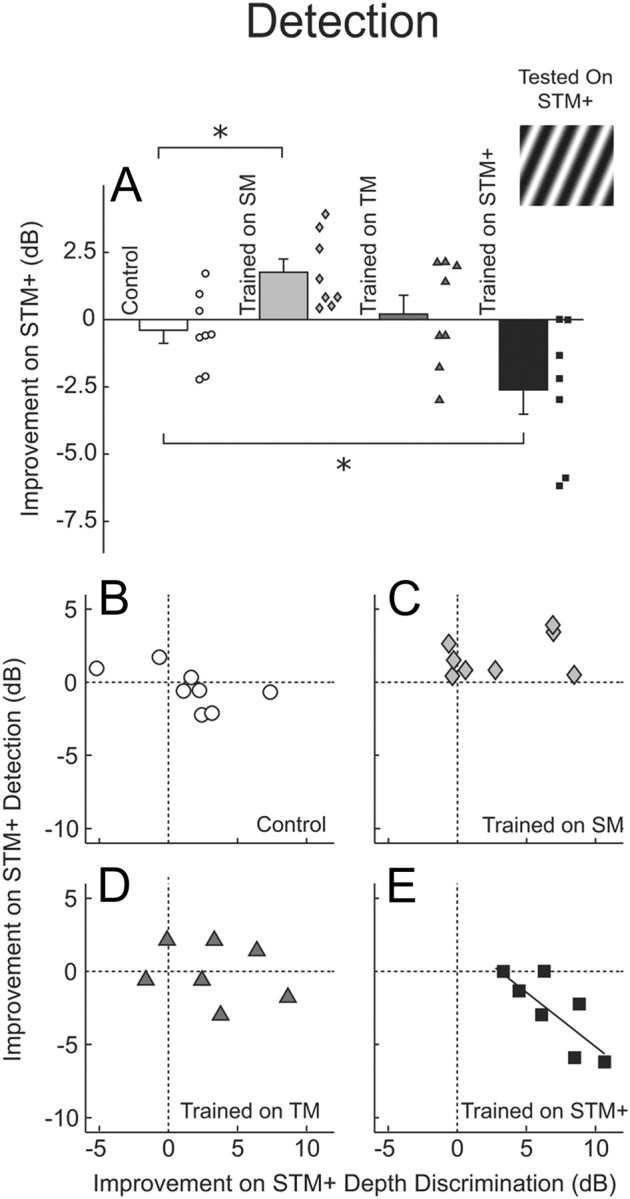
Natural sounds are characterized by complex patterns of sound intensity distributed across both frequency (spectral modulation) and time (temporal modulation). Perception of these patterns has been proposed to depend on a bank of modulation filters, each tuned to a unique combination of a spectral and a temporal modulation frequency. There is considerable physiological evidence for such combined spectrotemporal tuning. However, direct behavioral evidence is lacking. Here we examined the processing of spectrotemporal modulation behaviorally using a perceptual-learning paradigm. We trained human listeners for ∼1 h/d for 7 d to discriminate the depth of spectral (0.5 cyc/oct; 0 Hz), temporal (0 cyc/oct; 32 Hz), or upward spectrotemporal (0.5 cyc/oct; 32 Hz) modulation. Each trained group learned more on their respective trained condition than did controls who received no training. Critically, this depth-discrimination learning did not generalize to the trained stimuli of the other groups or to downward spectrotemporal (0.5 cyc/oct; -32 Hz) modulation. Learning on discrimination also led to worsening on modulation detection, but only when the same spectrotemporal modulation was used for both tasks. Thus, these influences of training were specific to the trained combination of spectral and temporal modulation frequencies, even when the trained and untrained stimuli had one modulation frequency in common. This specificity indicates that training modified circuitry that had combined spectrotemporal tuning, and therefore that circuits with such tuning can influence perception. These results are consistent with the possibility that the auditory system analyzes sounds through filters tuned to combined spectrotemporal modulation.
Figures
References
-
- Ahissar M, Hochstein S. The reverse hierarchy theory of visual perceptual learning. Trends Cogn Sci. 2004;8:457–464. - PubMed
-
- ANSI. American national standards specification for audiometers. New York: American National Standards Institute; 2004.
-
- Bacon SP, Grantham DW. Modulation masking: effects of modulation frequency, depth, and phase. J Acoust Soc Am. 1989;85:2575–2580. - PubMed
-
- Bregman A. Auditory scene analysis: the perceptual organization of sound. Cambridge, MA: MIT; 1990.
-
- Carlyon RP, Shamma S. An account of monaural phase sensitivity. J Acoust Soc Am. 2003;114:333–348. - PubMed
Publication types
MeSH terms
Grants and funding
LinkOut - more resources
Full Text Sources
Medical
