


Hybrids of a genetically engineered antibody and a carbon nanotube transistor for detection of prostate cancer biomarkers
- PMID: 22575126
- PMCID: PMC3383883
- DOI: 10.1021/nn300819s
Hybrids of a genetically engineered antibody and a carbon nanotube transistor for detection of prostate cancer biomarkers
Abstract
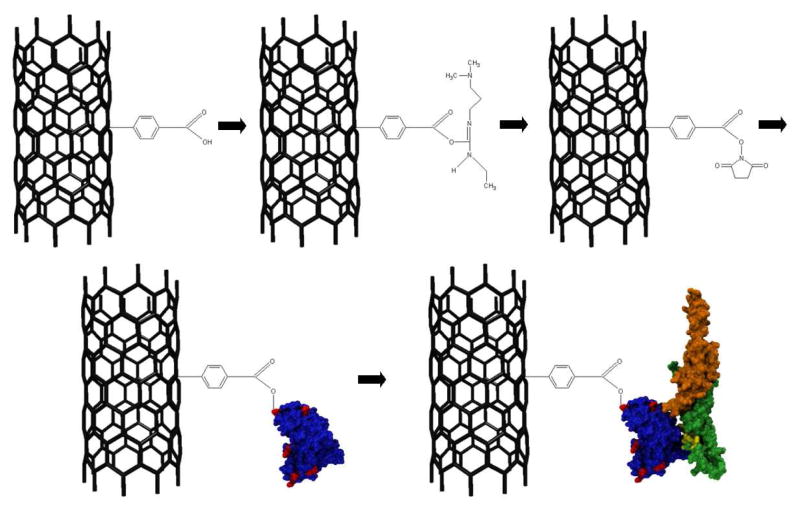
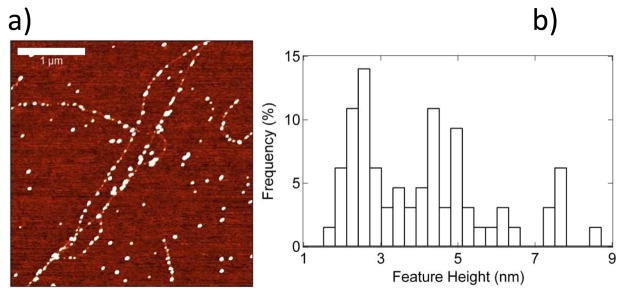
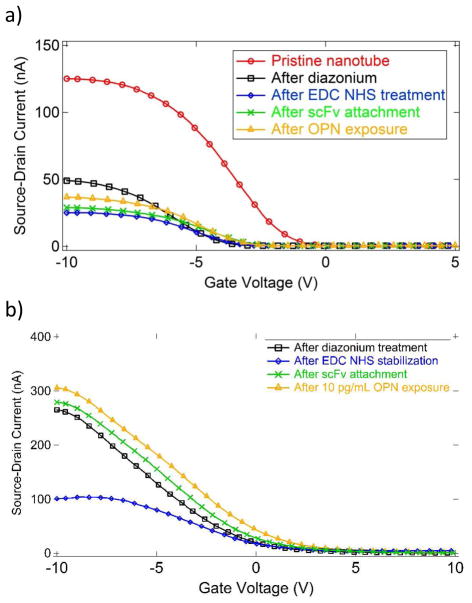
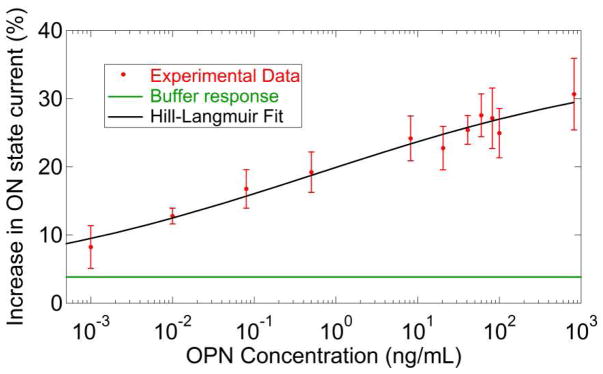
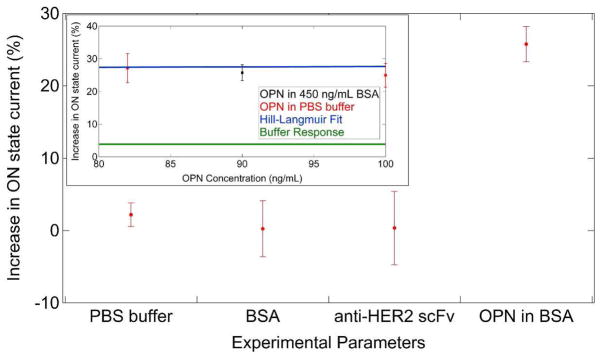
We developed a novel detection method for osteopontin (OPN), a new biomarker for prostate cancer, by attaching a genetically engineered single-chain variable fragment (scFv) protein with high binding affinity for OPN to a carbon nanotube field-effect transistor (NT-FET). Chemical functionalization using diazonium salts is used to covalently attach scFv to NT-FETs, as confirmed by atomic force microscopy, while preserving the activity of the biological binding site for OPN. Electron transport measurements indicate that functionalized NT-FET may be used to detect the binding of OPN to the complementary scFv protein. A concentration-dependent increase in the source-drain current is observed in the regime of clinical significance, with a detection limit of approximately 30 fM. The scFv-NT hybrid devices exhibit selectivity for OPN over other control proteins. These devices respond to the presence of OPN in a background of concentrated bovine serum albumin, without loss of signal. On the basis of these observations, the detection mechanism is attributed to changes in scattering at scFv protein-occupied defect sites on the carbon nanotube sidewall. The functionalization procedure described here is expected to be generalizable to any antibody containing an accessible amine group and to result in biosensors appropriate for detection of corresponding complementary proteins at fM concentrations.
Figures
References
-
- Group, U. S. C. S. W; C. f. D. C. a. P. a. N. C. I. United States Cancer Statistics: 1999–2007 Incidence and Mortality Web-Based Report. U.S. Department of Health and Human Services; Atlanta: 2010.
-
- Thompson IM, Pauler DK, Goodman PJ, Tangen CM, Lucia MS, Parnes HL, Minasian LM, Ford LG, Lippman SM, Crawford ED, et al. Prevalence of Prostate Cancer among Men with a Prostate-Specific Antigen Level <= 4.0 Ng Per Milliliter. N Engl J Med. 2004;350:2239–2246. - PubMed
-
- Smith DS, Humphrey PA, Catalona WJ. The Early Detection of Prostate Carcinoma with Prostate Specific Antigen - The Washington University Experience. Cancer. 1997;80:1852–1856. - PubMed
-
- Fedarko NS, Jain A, Karadag A, Van Eman MR, Fisher LW. Elevated Serum Bone Sialoprotein and Osteopontin in Colon, Breast, Prostate, and Lung Cancer. Clinical Cancer Research. 2001;7:4060–4066. - PubMed
-
- Sodek J, Ganss B, McKee MD. Osteoponitn. Critical Reviews in Oral Biology and Medicine. 2000;11:279–303. - PubMed
Publication types
MeSH terms
Substances
Grants and funding
LinkOut - more resources
Full Text Sources
Other Literature Sources
Medical
Research Materials
