Comparative Study
. 2013 Aug;35(4):1287-98.
doi: 10.1007/s11357-012-9420-z. Epub 2012 May 11.

Specific saccade deficits in patients with Alzheimer's disease at mild to moderate stage and in patients with amnestic mild cognitive impairment

Affiliations
Comparative Study

Specific saccade deficits in patients with Alzheimer's disease at mild to moderate stage and in patients with amnestic mild cognitive impairment

Qing Yang et al. Age (Dordr). 2013 Aug.

Abstract

Saccadic impairment in Alzheimer's disease (AD) was found in horizontal saccades. The present study extends investigation to vertical saccades in a large number of subjects, including AD and amnestic mild cognitive impairment (aMCI). We examined both horizontal and vertical saccades in 30 healthy elderly, 18 aMCI, and 25 AD. Two tasks were used: gap (fixation target extinguishes prior to target onset) and overlap (fixation stays on after target onset). Eye movements were recorded with the Eyeseecam system. (1) Robust gap effect (shorter latencies in gap than in overlap) exists for AD and aMCI patients as for healthy elderly; (2) abnormal long latency of saccades in gap and overlap tasks for AD relative to healthy elderly and aMCI patients; (3) longer latency for aMCI patients than for healthy elderly for the overlap task; (4) significant correlation between scores of Mini-Mental State Examination (MMSE) and latencies of saccades considering the AD group only; (5) higher coefficient of variation in latency for AD patients than for healthy elderly and for aMCI patients; (6) variability of accuracy and speed is abnormally higher in AD patients than in aMCI and healthy elderly. Abnormalities of latency and latency-accuracy-speed variability reflect deficits of cerebral areas involved in the triggering and execution of saccades; latency of saccades can be used as follow-up test for aMCI and AD patients with its significant correlation with the changes of MMSE scores.


Figures
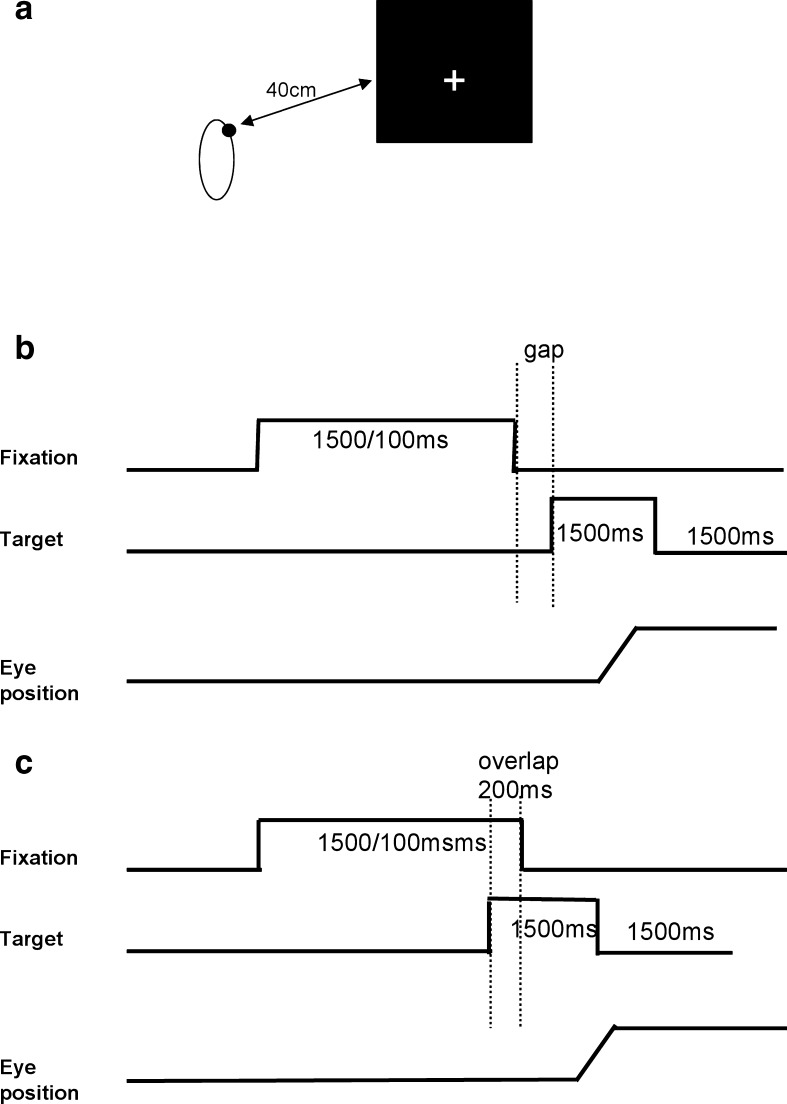
Fig. 1
Fig. 1
Experimental design. a Spatial arrangement. Five white luminous ‘plus signs’ were used on a black computer screen at 57 cm from the subject, one at the center of the screen; the others at an eccentricity of ±10° horizontally or vertically. b, c Temporal arrangement. Each trial started by lighting one central ‘plus’ during approximately 1,500–2,000 ms as fixation. For the gap task, between the fixation offset and the target onset, there was a gap of 200 ms (b); for the overlap task, the fixation stays on 200 ms after the target onset (c). The target, one of the eccentric ‘+’, appears for 1,500 ms
Fig. 2
Fig. 2
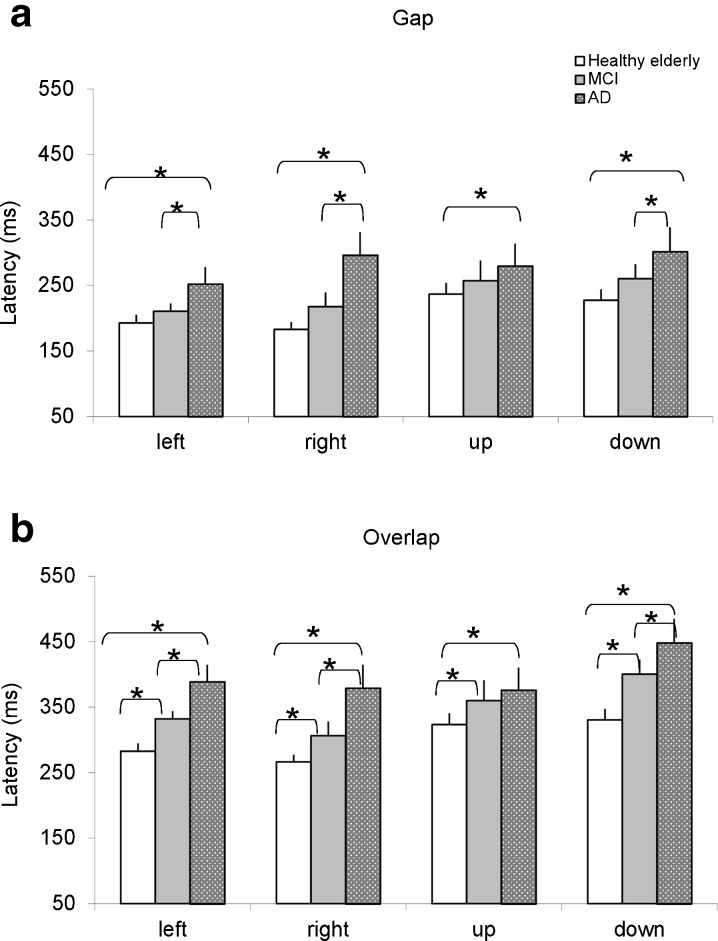
Group mean latency of saccades with standard error for leftward, rightward, upward, and downward saccades in healthy elderly, MCI, and AD in conditions gap (a) and overlap (b, c); asterisks indicate significant difference (p < 0.05)
Fig. 3
Fig. 3
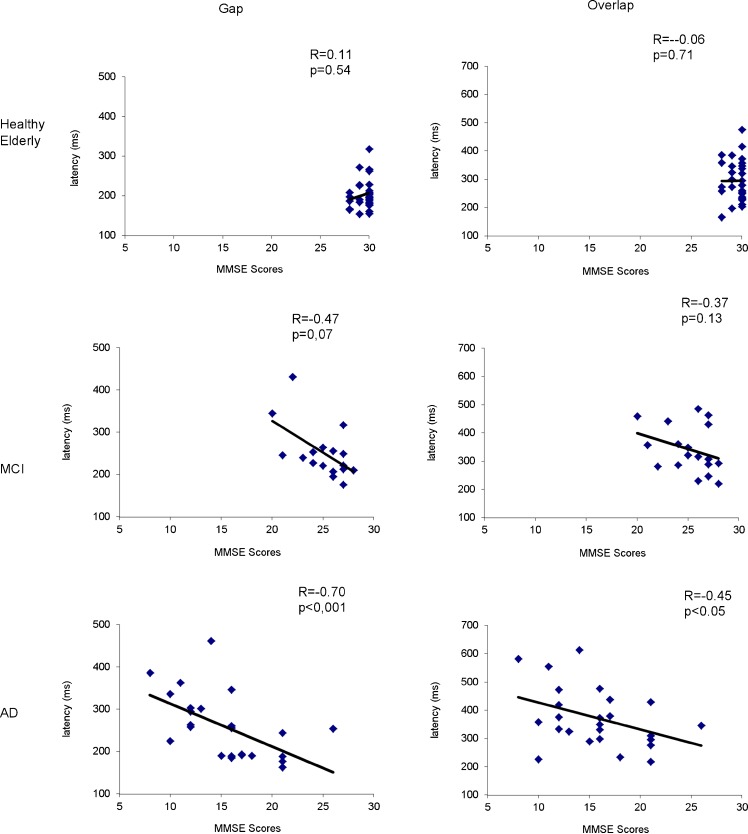
Correlation between MMSE scores and latencies of saccades in conditions gap and overlap for three groups of subjects, healthy elderly, aMCI, and AD; p < 0.05 indicates significant correlation, i.e., the lower the MMSE scores, the longer latencies of saccades are
Fig. 4
Fig. 4
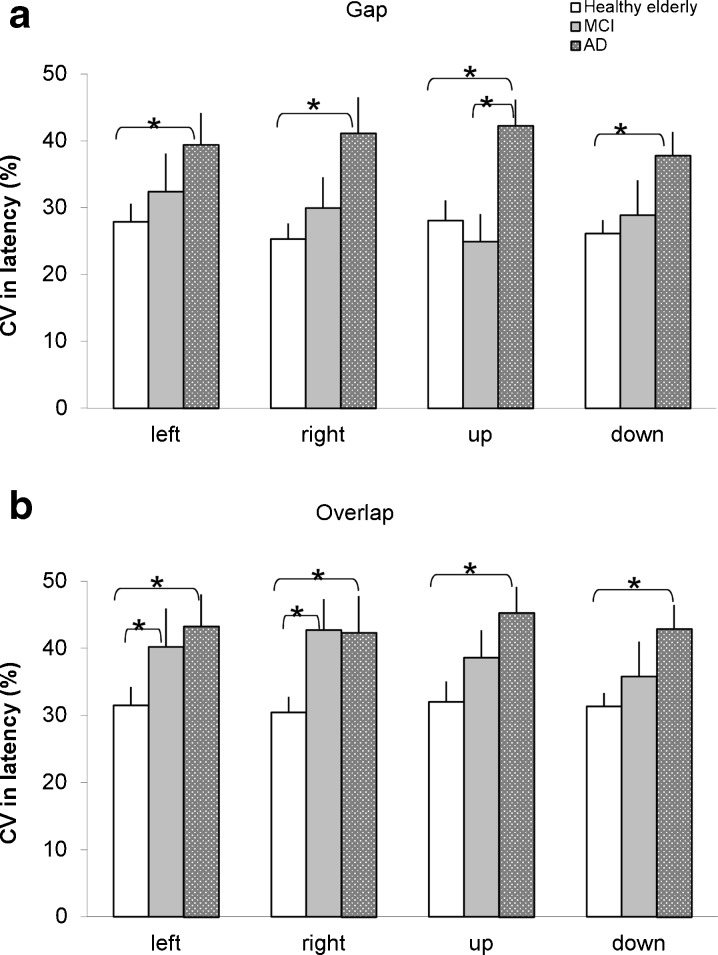
Group mean coefficient of variation (CV) in saccade latency for both horizontal and vertical saccades in healthy elderly, MCI, and AD patients under conditions gap (a) and overlap (b). Asterisks indicate significant difference (p < 0.05)
Fig. 5
Fig. 5
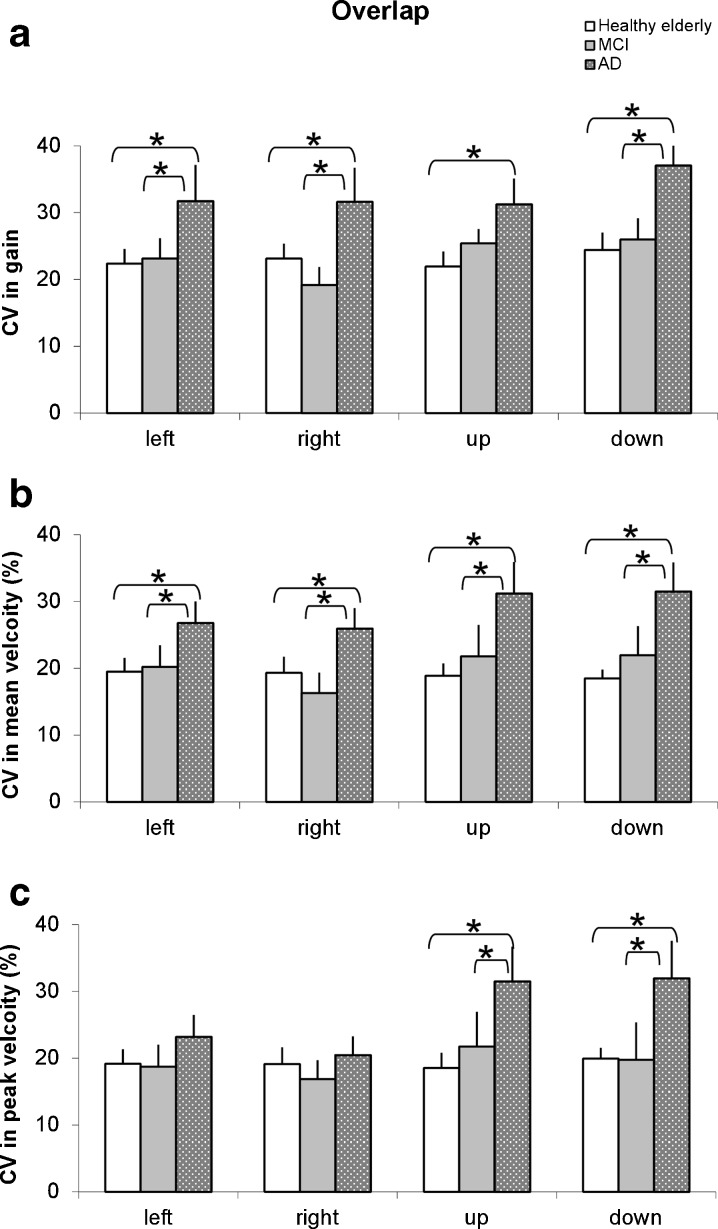
Group mean coefficient of variation (CV) in saccade gain (a), mean velocity (b), and peak velocity (c) for both horizontal and vertical saccades in healthy elderly, MCI, and AD patients under the overlap condition. Asterisks indicate significant difference (p < 0.05)

References

    1. Abel LA, Unverzagt F, Yee RD. Effects of stimulus predictability and interstimulus gap on saccades in Alzheimer's disease. Dement Geriatr Cogn Disord. 2002;13(4):235–243. doi: 10.1159/000057702. - DOI - PubMed
    1. Andersen RA, Mountcastle VB. The influence of the angle of gaze upon the excitability of the light-sensitive neurons of the posterior parietal cortex. J Neurosci. 1983;3(3):532–548. - PMC - PubMed
    1. Bizzi E. Discharge of frontal eye field neurons during saccadic and following eye movements in unanesthetized monkeys. Exp Brain Res. 1968;6(1):69–80. doi: 10.1007/BF00235447. - DOI - PubMed
    1. Boxer AL, Garbutt S, Rankin KP, Hellmuth J, Neuhaus J, Miller BL, Lisberger SG. Medial versus lateral frontal lobe contributions to voluntary saccade control as revealed by the study of patients with frontal lobe degeneration. J Neurosci. 2006;26(23):6354–6363. doi: 10.1523/JNEUROSCI.0549-06.2006. - DOI - PMC - PubMed
    1. Boxer AL, Geschwind MD, Belfor N, Gorno-Tempini ML, Schauer GF, Miller BL, Weiner MW, Rosen HJ. Patterns of brain atrophy that differentiate corticobasal degeneration syndrome from progressive supranuclear palsy. Arch Neurol. 2006;63(1):81–86. doi: 10.1001/archneur.63.1.81. - DOI - PubMed

Publication types

MeSH terms