


Normal fasting plasma glucose and risk of prediabetes and type 2 diabetes: the Isfahan Diabetes Prevention Study
- PMID: 22580730
- PMCID: PMC3359693
- DOI: 10.1900/RDS.2011.8.490
Normal fasting plasma glucose and risk of prediabetes and type 2 diabetes: the Isfahan Diabetes Prevention Study
Abstract
Aim: To determine the association of fasting plasma glucose (FPG) level within normal range and the risk of prediabetes and type 2 diabetes in an Iranian population.
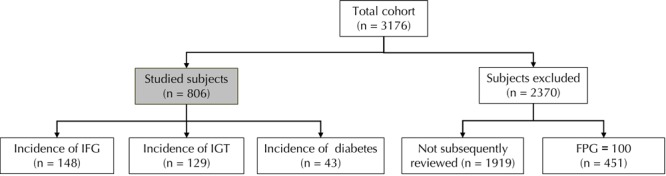
Methods: A total of 806 first-degree relatives (FDRs) of patients with type 2 diabetes who had FPG levels less than 5.6 mmol/l (100 mg/dl) in 2003 to 2005, and who did not have diabetes or impaired fasting glucose (IFG), were followed through 2010 for the occurrence of prediabetes or type 2 diabetes. At baseline and through follow-ups, participants underwent a standard 75 g 2-hour oral glucose tolerance test (OGTT).
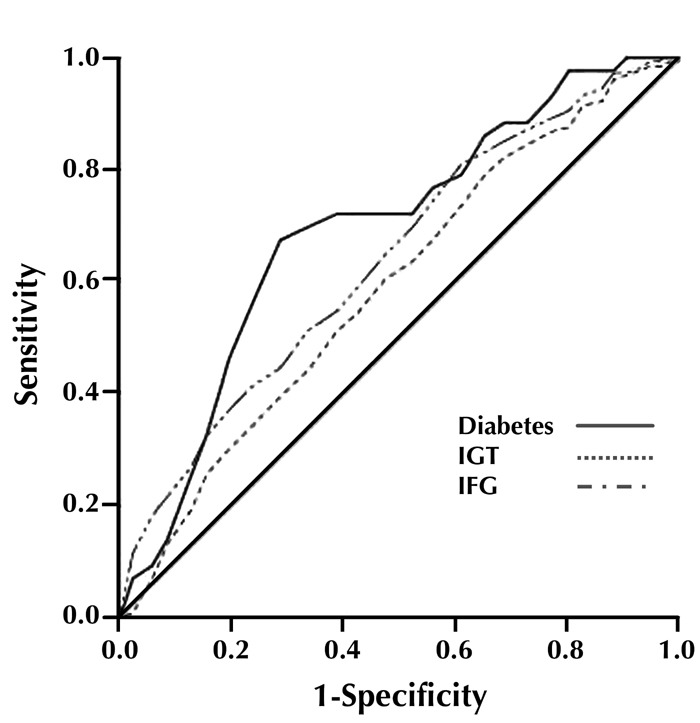
Results: The incidence of type 2 diabetes, impaired glucose tolerance (IGT), and IFG was 9.6 (95% confidence interval (CI): 6.8-12.4), 28.7 (23.8-33.6), and 33.0 (27.7-38.2) per 1,000 person-years based on 4,489 person-years of follow-up, respectively. FPG was associated with the incidence of diabetes, IGT, and IFG. The multivariate-adjusted hazard ratios (95% CI) for diabetes, IGT, and IFG were 1.36 (1.01-1.84), 1.45 (1.10-1.91) and 1.31 (1.00-1.71), for the highest quintile of FPG compared with the lowest quintile, respectively.
Conclusions: An increase in FPG in the normal range is associated with an increase in the incidence of IGT, IFG, and type 2 diabetes. These results prove FPG in the normal range to be useful in identifying apparently healthy FDRs of patients with type 2 diabetes at risk of developing prediabetes and diabetes.
Figures
References
-
- Shaw JE, Zimmet PZ, de Courten M, Dowse GK, Chitson P, Gareeboo H, Hemraj F, Fareed D, Tuomilehto J, Alberti KG. Impaired fasting glucose or impaired glucose tolerance. What best predicts future diabetes in Mauritius? Diabetes Care. 1999;22(3):399–402. - PubMed
-
- Unwin N, Shaw J, Zimmet P, Alberti KG. Impaired glucose tolerance and impaired fasting glycemia: the current status on definition and intervention. Diabet Med. 2002;19:708–723. - PubMed
-
- Gerstein HC, Santaguida P, Raina P, Morrison KM, Balion C, Hunt D, Yazdi H, Booker L. Annual incidence and relative risk of diabetes in people with various categories of dysglycemia: a systematic overview and meta-analysis of prospective studies. Diabetes Res Clin Pract. 2007;78(3):305–312. - PubMed
-
- Janghorbani M, Amini M. Progression to impaired glucose metabolism in first-degree relatives of patients with type 2 diabetes in Isfahan, Iran. Diabetes Metab Res Rev. 2009;25:748–755. - PubMed
Publication types
MeSH terms
Substances
LinkOut - more resources
Full Text Sources
Medical