


Elevated prevalence of 35-44 FMR1 trinucleotide repeats in women with diminished ovarian reserve
- PMID: 22581803
- PMCID: PMC4051402
- DOI: 10.1177/1933719112446074
Elevated prevalence of 35-44 FMR1 trinucleotide repeats in women with diminished ovarian reserve
Abstract
Introduction: Fragile X premutations are associated with primary ovarian insufficiency when the patient presents with amenorrhea, but the fragile X mental retardation 1 (FMR1) CGG repeat count among cycling women with low ovarian reserve (diminished ovarian reserve [DOR]) is not yet established.
Patients and methods: Sixty-two infertile DOR patients were recruited from 4 US private and academic fertility centers.
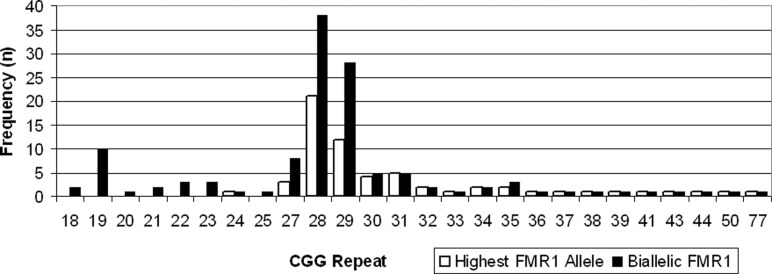
Results: The prevalence of 35-44 FMR1 CGG repeats was 14.5%. Compared with the general female population estimate from the literature, infertile women with DOR were more likely to have 35-44 FMR1 CGG repeats (14.5% and 3.9%, respectively, P = .0003). Similar findings were noted by 5-repeat bandwidth: 35-39 CGG repeats (9.7% DOR vs 3.2% comparison, P = .012) or 40-44 CGG repeats (4.8% DOR vs 0.7% comparison, P = .024).
Conclusions: These data suggest that CGG repeats of 35-44 may be markedly overrepresented in women with DOR, whereas the current FMR1 reference range indicates that there is no clinical phenotype with <45 CGG repeats.
Conflict of interest statement
Figures
References
-
- McConkie-Rosell A, Abrams L, Finucane B, et al. Recommendations from multi-disciplinary focus groups on cascade testing and genetic counseling for fragile X-associated disorders. J Genet Couns. 2007;16(5):593–606 - PubMed
-
- Nelson LM, Bakalov VK. Mechanisms of follicular dysfunction in 46, XX spontaneous premature ovarian failure. Endocrinol Metab Clin North Am. 2003;32(3):613–637 - PubMed
-
- Speroff L, Fritz MA. Clinical Gynecologic Endocrinology and Infertility. 7 ed Philadelphia: Lippincott Williams & Wilkins; 2005
-
- Scott RT, Jr, , Hofmann GE. Prognostic assessment of ovarian reserve. Fertil Steril. 1995;63(1):1–11 - PubMed
-
- Levi AJ, Raynault MF, Bergh PA, Drews MR, Miller BT, Scott RT., Jr Reproductive outcome in patients with diminished ovarian reserve. Fertil Steril. 2001;76(4):666–669 - PubMed
Publication types
MeSH terms
Substances
Grants and funding
LinkOut - more resources
Full Text Sources
Medical
