. 2012 Jul;23(7):1190-7.
doi: 10.1681/ASN.2011101006. Epub 2012 May 10.

Calcium deficiency reduces circulating levels of FGF23

Affiliations

Calcium deficiency reduces circulating levels of FGF23

María E Rodriguez-Ortiz et al. J Am Soc Nephrol. 2012 Jul.

Abstract

Fibroblast growth factor (FGF) 23 inhibits calcitriol production, which could exacerbate calcium deficiency or hypocalcemia unless calcium itself modulates FGF23 in this setting. In Wistar rats with normal renal function fed a diet low in both calcium and vitamin D, the resulting hypocalcemia was associated with low FGF23 despite high parathyroid hormone (PTH) and high calcitriol levels. FGF23 correlated positively with calcium and negatively with PTH. Addition of high dietary phosphorus to this diet increased FGF23 except in rats with hypocalcemia despite high PTH levels. In parathyroidectomized rats, an increase in dietary calcium for 10 days increased serum calcium, with an associated increase in FGF23, decrease in calcitriol, and no change in phosphorus. Also in parathyroidectomized rats, FGF23 increased significantly 6 hours after administration of calcium gluconate. Taken together, these results suggest that hypocalcemia reduces the circulating concentrations of FGF23. This decrease in FGF23 could be a response to avoid a subsequent reduction in calcitriol, which could exacerbate hypocalcemia.


Figures
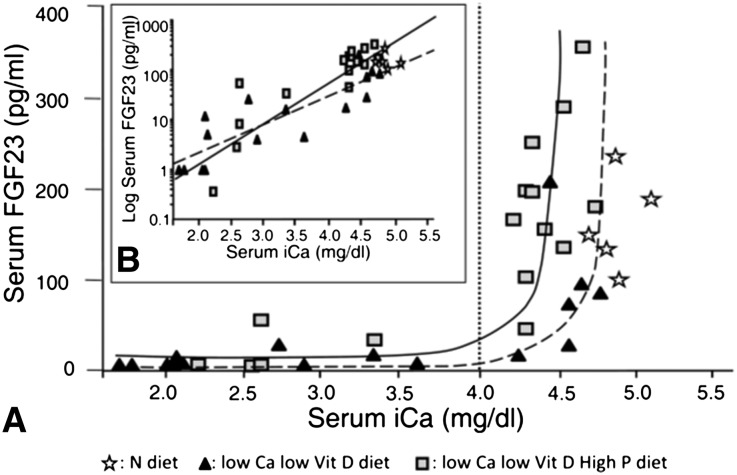
Figure 1.
Figure 1.
PTH does not appear to stimulate FGF23 in the presence of hypocalcemia. FGF23 remains low when calcium is <4.0 mg/dl and increases steeply when calcium rises through the physiologic range. (A) The relationship between serum FGF23 concentration and serum ionized calcium is shown in three groups of rats on different diets: (1) controls fed a normal diet; (2) low calcium, low vitamin D (LCa-LD diet); and (3) low calcium, high phosphorus, low vitamin D (LCa-HP-LD diet). Rats were maintained on this diet for 6 weeks. The vertical dotted line at ionized calcium (iCa) = 4 mg/dl represents the approximate threshold concentration of calcium that allows an increase in FGF23. (B) Inset shows the relationship between log-transformed serum FGF23 concentration and serum ionized calcium in the same groups of rats shown in A. Normal diet: r2=0.07, P=0.66; LCa-LD diet (dotted line): r2=0.73, P<0.001; LCa-HP-LD diet (continuous line): r2=0.77, P<0.001.
Figure 2.
Figure 2.
Serum phosphorus (P) concentration is inversely correlated with serum ionized calcium (iCa) in rats fed a low-calcium diet. The relationship between serum phosphorus concentration and serum ionized calcium is shown in three groups of rats fed different diets: (1) controls fed a normal diet; (2) low calcium, low vitamin D (LCa-LD diet); and (3) low calcium, high phosphorus, low vitamin D (LCa-HP-LD diet). Rats were maintained on this diet for 6 weeks. r2=0.41, P=0.24 for normal diet; r2=0.73, P<0.001 for LCa-LD diet (dotted line); and r2=0.51, P<0.002 for LCa-HP-LD diet (continuous line).
Figure 3.
Figure 3.
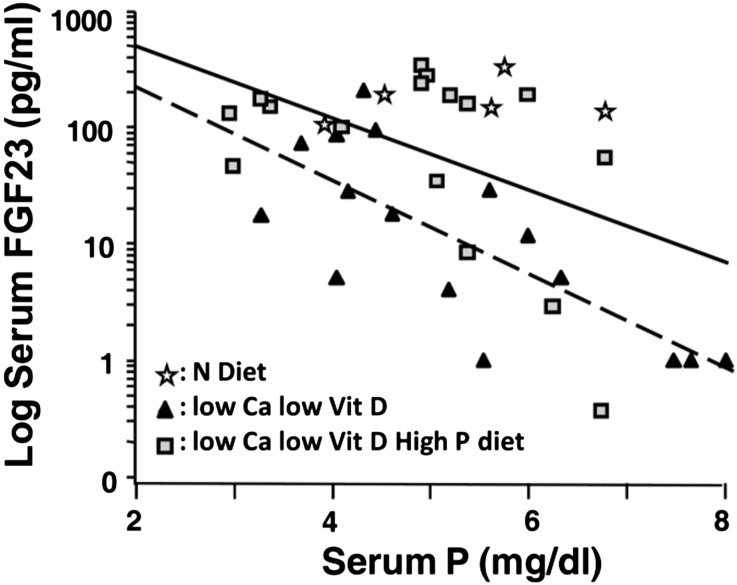
The direct association between FGF23 and phosphorus (P) does not occur in the presence of hypocalcemia. The relationship between serum log-transformed FGF23 concentration and serum phosphorus is shown in three groups of rats fed different diets: (1) controls fed a normal (N) diet; (2) low calcium (Ca), low vitamin D (Vit D) (LCa-LD diet); and (3) low calcium, high phosphorus, low vitamin D (LCa-HP-LD diet). Rats were maintained on this diet for 6 weeks. r2=0.06, P=0.68 for normal diet; r2=0.54, P=0.001 for LCa-LD diet (dotted line); and r2=0.23, P=0.06 for LCa-HP-LD diet (continuous line).
Figure 4.
Figure 4.
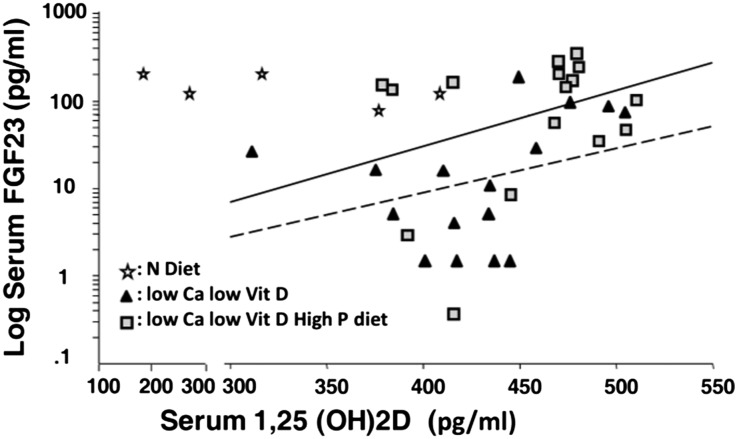
Elevated calcitriol stimulates FGF23 only when serum calcium is not low. The relationship between serum log-transformed FGF23 concentration and serum calcitriol concentration is shown in three groups of rats fed different diets: (1) controls fed a normal (N) diet; (2) low calcium (Ca), low vitamin D (Vit D) (LCa-LD diet); and (3) low calcium, high phosphorus, low vitamin D (LCa-HP-LD diet). Rats were maintained on this diet for 6 weeks. r2=0.14, P=0.53 for normal diet; r2=0.11, P=0.21 for LCa-LD diet (dotted line); and r2=0.11, P=0.21 for LCa-HP-LD diet (continuous line).
Figure 5.
Figure 5.
FGF23 levels are normal or increased only if the PTH concentration is <700 pg/ml (which matches with a serum calcium [Ca] >4.0 mg/dl). (A) The relationship between serum FGF23 concentration and serum PTH concentration is shown in three groups of rats fed different diets: (1) controls fed a normal diet; (2) low calcium, low vitamin D (LCa-LD diet); and (3) low calcium, high phosphorus, low vitamin D (Vit D) (LCa-HP-LD diet). Rats were maintained on this diet for 6 weeks. (B) The relationship between log-transformed serum FGF23 concentration and serum PTH concentration in the same groups of rats shown in A. normal diet: r2=0.08, P=0.64; LCa-LD diet (dotted line): r2=0.62, P<0.001; LCa-HP-LD diet (continuous line): r2=0.42, P=0.007.
Figure 6.
Figure 6.
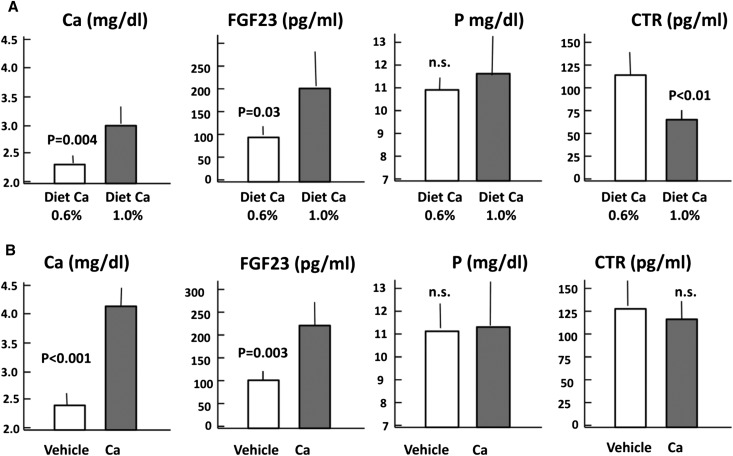
Hypocalcemia (induced by dietary calcium [Ca] restriction) decreases FGF23, whereas hypercalcemia (induced by intraperitoneal calcium administration) increases FGF23. (A) Serum concentration of ionized calcium, FGF23, phosphorus (P), and calcitriol (CTR) in PTX rats fed a 0.6% or 1.0% calcium diet for 10 days. (B) Serum concentration of ionized calcium, FGF23, phosphorus, and calcitriol in PTX rats after intraperitoneal infusion of calcium (10 mg/kg per hour) during 6 hours.

References

    1. Shimada T, Hasegawa H, Yamazaki Y, Muto T, Hino R, Takeuchi Y, Fujita T, Nakahara K, Fukumoto S, Yamashita T: FGF-23 is a potent regulator of vitamin D metabolism and phosphate homeostasis. J Bone Miner Res 19: 429–435, 2004 - PubMed
    1. Shimada T, Kakitani M, Yamazaki Y, Hasegawa H, Takeuchi Y, Fujita T, Fukumoto S, Tomizuka K, Yamashita T: Targeted ablation of Fgf23 demonstrates an essential physiological role of FGF23 in phosphate and vitamin D metabolism. J Clin Invest 113: 561–568, 2004 - PMC - PubMed
    1. Liu S, Tang W, Zhou J, Stubbs JR, Luo Q, Pi M, Quarles LD: Fibroblast growth factor 23 is a counter-regulatory phosphaturic hormone for vitamin D. J Am Soc Nephrol 17: 1305–1315, 2006 - PubMed
    1. Zisman AL, Wolf M: Recent advances in the rapidly evolving field of fibroblast growth factor 23 in chronic kidney disease. Curr Opin Nephrol Hypertens 19: 335–342, 2010 - PubMed
    1. Ben-Dov IZ, Galitzer H, Lavi-Moshayoff V, Goetz R, Kuro-o M, Mohammadi M, Sirkis R, Naveh-Many T, Silver J: The parathyroid is a target organ for FGF23 in rats. J Clin Invest 117: 4003–4008, 2007 - PMC - PubMed

Publication types

LinkOut - more resources