Comparative Study
. 2012 Aug;78(15):5127-32.
doi: 10.1128/AEM.00246-12. Epub 2012 May 11.

Quantitative estimation of the viability of Toxoplasma gondii oocysts in soil

Affiliations
Comparative Study

Quantitative estimation of the viability of Toxoplasma gondii oocysts in soil

Maud Lélu et al. Appl Environ Microbiol. 2012 Aug.

Abstract

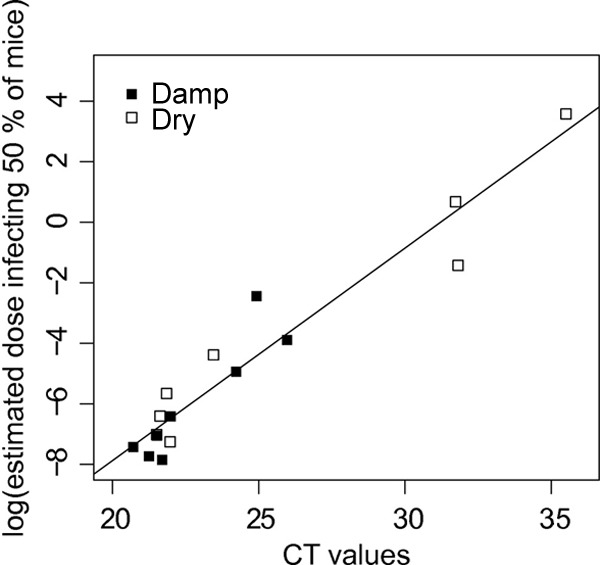
Toxoplasma gondii oocysts spread in the environment are an important source of toxoplasmosis for humans and animal species. Although the life expectancy of oocysts has been studied through the infectivity of inoculated soil samples, the survival dynamics of oocysts in the environment are poorly documented. The aim of this study was to quantify oocyst viability in soil over time under two rain conditions. Oocysts were placed in 54 sentinel chambers containing soil and 18 sealed water tubes, all settled in two containers filled with soil. Containers were watered to simulate rain levels of arid and wet climates and kept at stable temperature for 21.5 months. At nine sampling dates during this period, we sampled six chambers and two water tubes. Three methods were used to measure oocyst viability: microscopic counting, quantitative PCR (qPCR), and mouse inoculation. In parallel, oocysts were kept refrigerated during the same period to analyze their detectability over time. Microscopic counting, qPCR, and mouse inoculation all showed decreasing values over time and highly significant differences between the decreases under dry and damp conditions. The proportion of oocysts surviving after 100 days was estimated to be 7.4% (95% confidence interval [95% CI] = 5.1, 10.8) under dry conditions and 43.7% (5% CI = 35.6, 53.5) under damp conditions. The detectability of oocysts by qPCR over time decreased by 0.5 cycle threshold per 100 days. Finally, a strong correlation between qPCR results and the dose infecting 50% of mice was found; thus, qPCR results may be used as an estimate of the infectivity of soil samples.


Figures
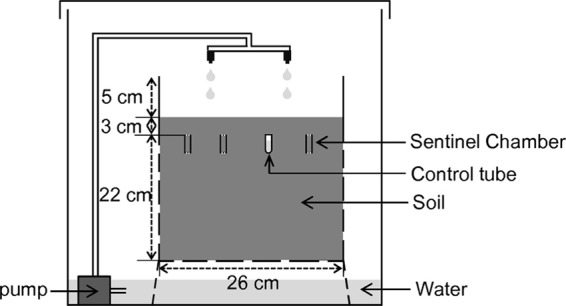
Fig 1
Fig 1
Experimental design for the viability experiment (only one container is represented). Test chambers were filled with 2.5 g of soil and inoculated with 1 ml of suspension containing 2 × 10⁵ oocysts. Control tubes contained 2 × 10⁵ oocysts diluted in 1 ml of Milli-Q water. The chambers exchanged with the soil in which they were buried, whereas the control tubes were hermetically sealed. The system was duplicated to compare two rainfall conditions: 15 min of rainfall was simulated each week for damp conditions or every 3 months for dry conditions.
Fig 2
Fig 2
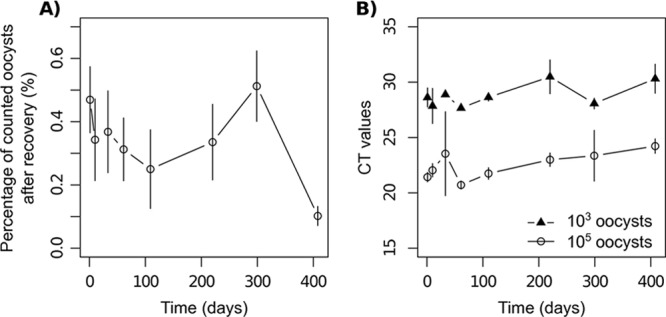
Detectability of oocysts aged 3 to 15.6 months, conserved at 4°C in H2SO4 (2%), after inoculation in soil. (A) Proportion of oocysts counted under a UV microscope after recovery from soil samples inoculated with 105 oocysts; (B) CT values obtained from qPCR performed after recovery of oocysts from soil samples inoculated with 105 and 103 oocysts as a function of time (days; 1 day corresponds to oocysts aged 3 months).
Fig 3
Fig 3
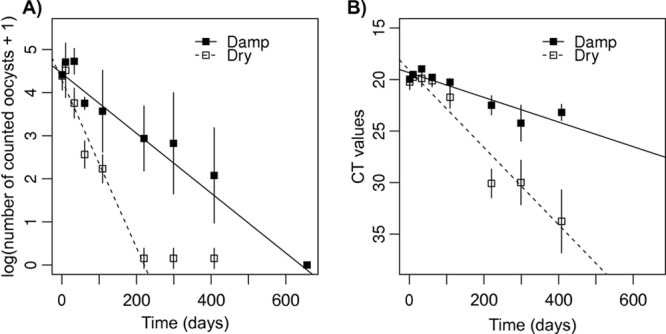
Viability experiment. (A) Log-transformed number of oocysts, counted under a UV microscope, after recovery from chambers; (B) CT values obtained from qPCR performed after recovery of oocysts from chambers, as a function of time (days), for dry and damp conditions.
Fig 4
Fig 4
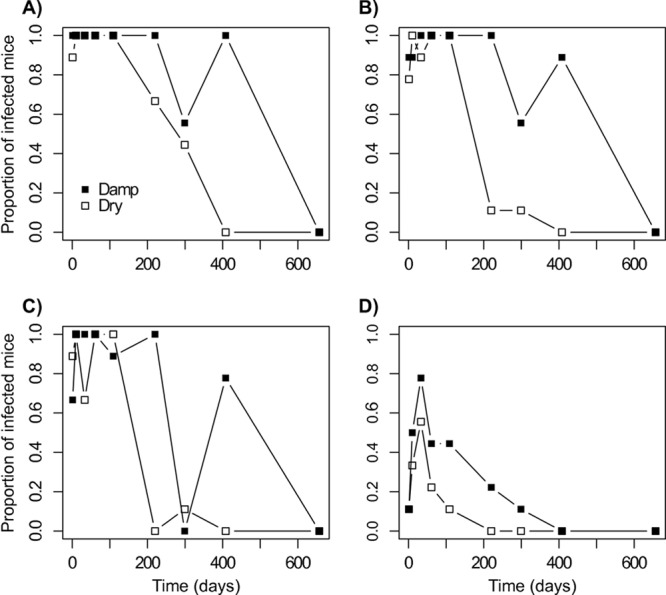
Viability experiment. Proportion of mice infected after inoculation of oocyst suspensions, obtained after recovery from chambers, at different concentrations as a function of time (days) for dry and damp conditions. (A) Original suspension; (B) dilution by 10; (C) dilution by 100; (D) dilution by 1,000.
Fig 5
Fig 5
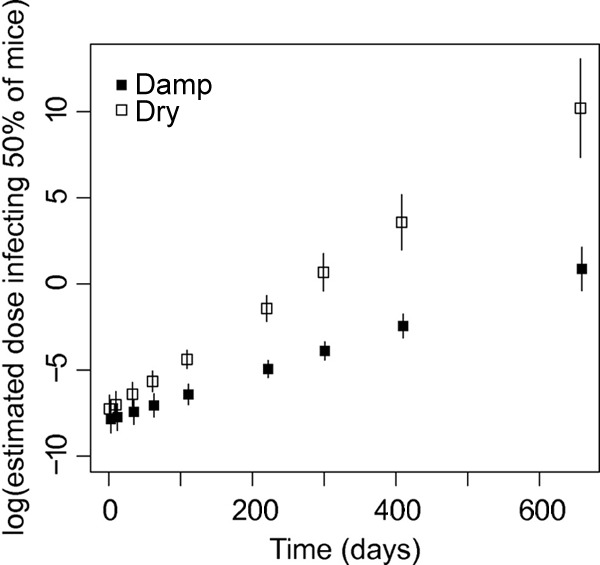
Viability experiment. Logarithm of the estimated ID50 with 95% confidence interval as a function of time (days) for dry and damp conditions. ID50s were obtained from the logistic model analyzing the probability that mice would be infected after inoculation of oocyst suspensions recovered from chambers.
Fig 6
Fig 6
Relationship between CT values obtained from qPCR performed on oocyst suspensions recovered from chambers and the log of the dose infecting 50% of mice estimated from inoculation of the same suspensions into mice for dry and damp conditions.

References

    1. Afonso E, et al. 2008. Spatial distribution of soil contamination by Toxoplasma gondii in relation with cat defecation behaviour in an urban area. Int. J. Parasitol. 38:1017–1023 - PubMed
    1. Boyer K, et al. 2011. Unrecognized ingestion of Toxoplasma gondii oocysts leads to congenital toxoplasmosis and causes epidemics in North America. Clin. Infect. Dis. 53:1081–1089 - PMC - PubMed
    1. Carme B, et al. 2002. Severe acquired toxoplasmosis in immunocompetent adult patients in French Guiana. J. Clin. Microbiol. 40:4037–4044 - PMC - PubMed
    1. Cook AJC, et al. 2000. Sources of Toxoplasma infection in pregnant women: European multicentre case-control study. Br. Med. J. 321:142–147 - PMC - PubMed
    1. Davies CM, et al. 2005. Environmental inactivation of Cryptosporidium oocysts in catchment soils. J. Appl. Microbiol. 98:308–317 - PubMed

Publication types

LinkOut - more resources