


Preterm infants who are prone to distress: differential effects of parenting on 36-month behavioral and cognitive outcomes
- PMID: 22582942
- PMCID: PMC3467011
- DOI: 10.1111/j.1469-7610.2012.02564.x
Preterm infants who are prone to distress: differential effects of parenting on 36-month behavioral and cognitive outcomes
Abstract
Background: The differential susceptibility (DS) model suggests that temperamentally prone-to-distress infants may exhibit adverse outcomes in negative environments but optimal outcomes in positive environments. This study explored temperament, parenting, and 36-month cognition and behavior in preterm infants using the DS model. We hypothesized that temperamentally prone to distress preterm infants would exhibit more optimal cognition and fewer behavior problems when early parenting was positive; and less optimal cognition and more behavior problems when early parenting was less positive.
Methods: Participants included 109 preterm infants (gestation <37 weeks) and their mothers. We assessed neonatal risk and basal vagal tone in the neonatal intensive care unit; infant temperament and parenting interactions at 9 months post-term; and child behavior and cognitive skills at 36 months post-term. Hierarchical regression analyses tested study hypotheses.
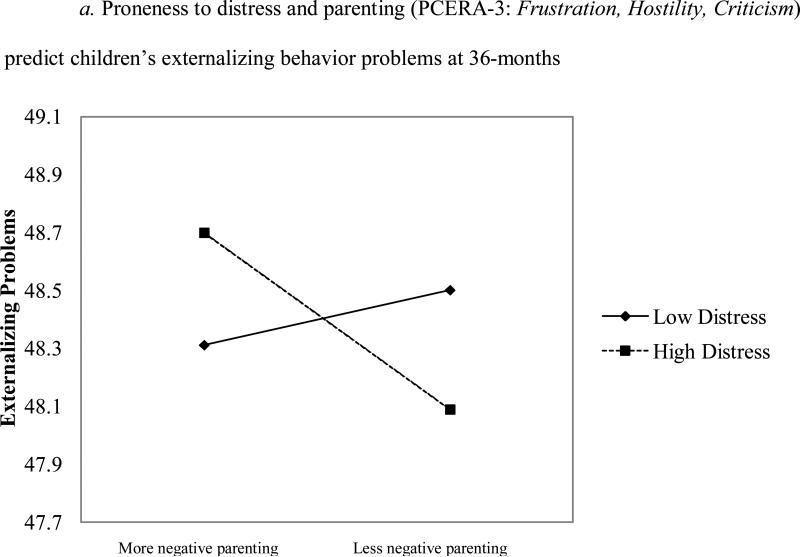
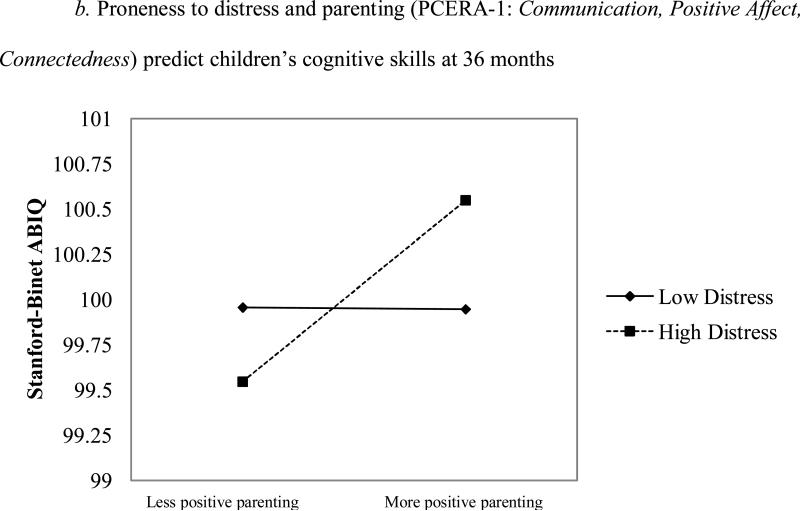
Results: Temperamentally prone-to-distress infants exhibited more externalizing problems if they experienced more critical parenting at 9 months (β = -.20, p < 0.05) but fewer externalizing problems with more positive parenting. Similarly, variations in maternal positive affect (β = .25, p < .01) and intrusive behaviors (β = .23, p < .05) at 9 months predicted 36-month cognition at high but not at low levels of infant temperamental distress. Higher basal vagal tone predicted fewer externalizing problems (β = -.19, p < .05).
Conclusions: Early parenting behaviors relate to later behavior and development in preterm infants who are temperamentally prone to distress, and neonatal basal vagal tone predicts subsequent externalizing behaviors. These findings suggest that both biological reactivity and quality of caregiving are important predictors for later outcomes in preterm infants and may be considered as foci for developmental surveillance and interventions.
© 2012 The Authors. Journal of Child Psychology and Psychiatry © 2012 Association for Child and Adolescent Mental Health.
Figures
References
-
- Aiken LS, West SG. Multiple regression: Testing and interpreting interactions. Newbury Park; Sage: 1991.
-
- Bakersman-Kranenburg MJ, van IJzendoorn MH. Differential susceptibility to rearing environment depending on dopamine-related genes: New evidence and a meta-analysis. Developmental Psychopathology. 2011;23:39–52. - PubMed
-
- Beauchaine TP. Vagal tone, development, and Gray's motivational theory: Toward an integrated model of autonomic nervous system functioning in psychopathology. Developmental Psychology. 2001;13:183–214. - PubMed
-
- Beck CT. A meta-analysis of the relationship between postpartum depression and infant temperament. Nursing Research. 1996;45:225–230. - PubMed
-
- Belsky J. Variation in susceptibility to environmental influences: An evolutionary argument. Psychological Inquiry. 1997;8:182–186.
