. 2013 Apr;81(2):155-70.
doi: 10.1111/j.1467-6494.2012.00794.x.

Self-other knowledge asymmetries in personality pathology

Affiliations

Self-other knowledge asymmetries in personality pathology

Erika N Carlson et al. J Pers. 2013 Apr.

Abstract

Objective: Self-reports of personality provide valid information about personality disorders (PDs). However, informant reports provide information about PDs that self-reports alone do not provide. The current article examines whether and when one perspective is more valid than the other in identifying PDs.

Method: Using a representative sample of adults 55 to 65 years of age (N = 991; 45% males), we compared the validity of self- and informant (e.g., spouse, family, or friend) reports of the Five-Factor Model traits in predicting PD scores (i.e., composite of interviewer, self-, and informant reports of PDs).

Results: Self-reports (particularly of Neuroticism) were more valid than informant reports for most internalizing PDs (i.e., PDs defined by high Neuroticism). Informant reports (particularly of Agreeableness and Conscientiousness) were more valid than self-reports for externalizing and/or antagonistic PDs (i.e., PDs defined by low Agreeableness and Conscientiousness). Neither report was consistently more valid for thought disorder PDs (i.e., PDs defined by low Extraversion). However, informant reports (particularly of Agreeableness) were more valid than self-reports for PDs that were both internalizing and externalizing (i.e., PDs defined by high Neuroticism and low Agreeableness).

Conclusions: The intrapersonal and interpersonal manifestations of PDs differ, and these differences influence who knows more about pathology.


Figures

Figure 1
Figure 1
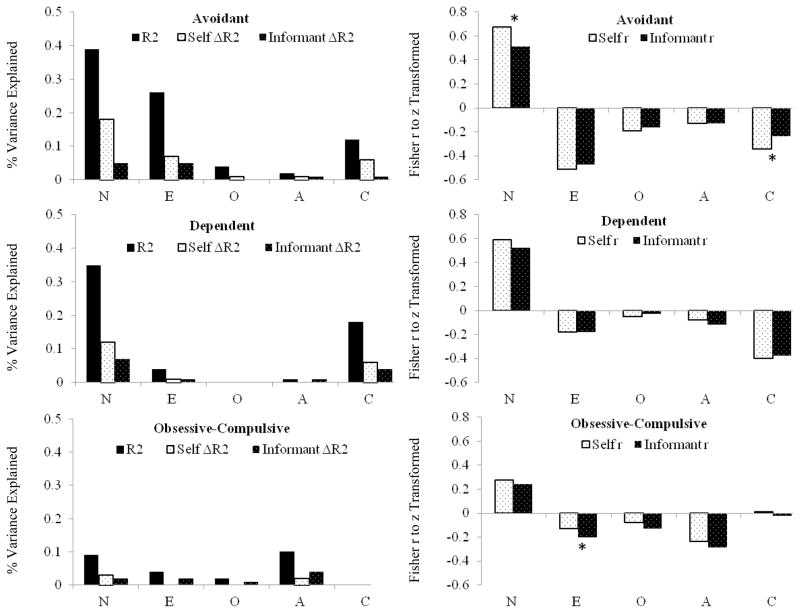
The amount of unique information (i.e., ΔR2) self- and informant-reports of the FFM factors explain in internalizing PDs and the relative strength of the correlations between PDC scores and self- and informant-reports of FFM factors. The left panel shows results from multiple regression analyses where self- and informant-reports of a given FFM factor were simultaneously entered as predictors of PDC scores. The right panel shows the correlations between PDC scores and self- and informant-reports of a given FFM facet. Asterisks reflect a significant difference between correlations (p < .01, two-tailed).
Figure 2
Figure 2
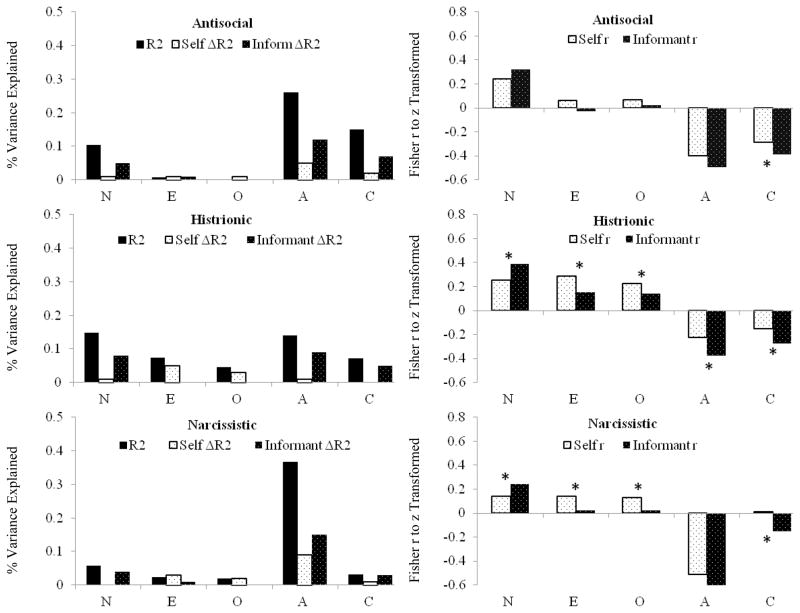
The amount of unique information (i.e., ΔR2) self- and informant-reports of the FFM factors explain in externalizing and antagonistic PDs and the relative strength of the correlations between PDC scores and self- and informant-reports of FFM factors. The left panel shows results from multiple regression analyses where self- and informant-reports of a given FFM factor were simultaneously entered as predictors of PDC scores. The right panel shows the correlations between PDC scores and self- and informant-reports of a given FFM facet. Asterisks reflect a significant difference between correlations (p < .01, two-tailed).
Figure 3
Figure 3
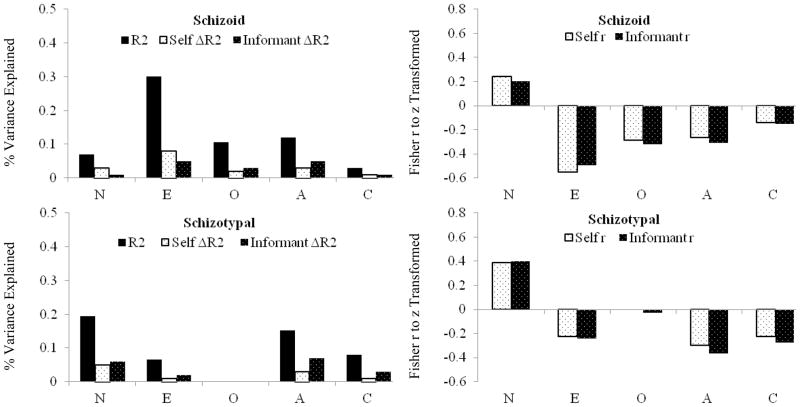
The amount of unique information (i.e., ΔR2) self- and informant-reports of the FFM factors explain in thought disorder PDs and the relative strength of the correlations between PDC scores and self- and informant-reports of FFM factors. The left panel shows results from multiple regression analyses where self- and informant-reports of a given FFM factor were simultaneously entered as predictors of PDC scores. The right panel shows the correlations between PDC scores and self- and informant-reports of a given FFM facet. Asterisks reflect a significant difference between correlations (p < .01, two-tailed).
Figure 4
Figure 4
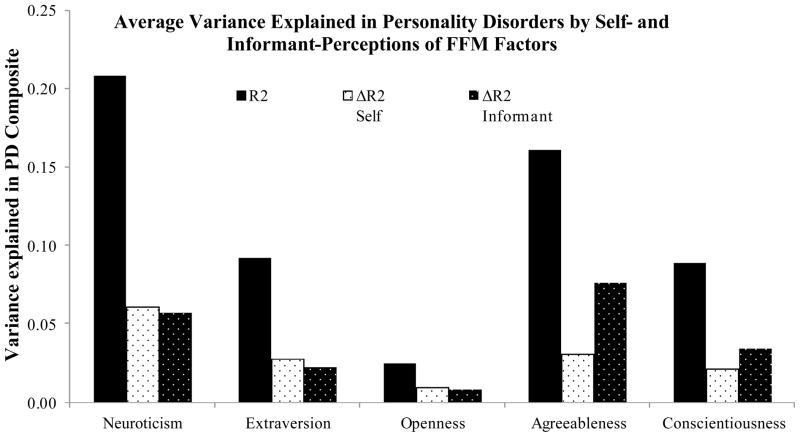
The amount of unique information (i.e., ΔR2) self- and informant-reports of the FFM factors explain in internalizing/antagonistic PDs and the relative strength of the correlations between PDC scores and self- and informant-reports of FFM factors. The left panel shows results from multiple regression analyses where self- and informant-reports of a given FFM factor were simultaneously entered as predictors of PDC scores. The right panel shows the correlations between PDC scores and self- and informant-reports of a given FFM facet. Asterisks reflect a significant difference between correlations (p < .01, two-tailed).
Figure 5
Figure 5
Average amount of variance explained by self- and informant-reports of the FFM factors across the 10 PDs. R2 = the average amount of variance self- and informant-reports of a given FFM factor explain together in PDs. ΔR2 Self = the average amount of unique variance self-reports of a given FFM factor explain in PDC scores. ΔR2 informant = the average amount of unique variance informant-reports of a given FFM factor explain in PDC scores.

References

    1. Achenbach TM, Krukowski R, Dumenci L, Yivanova M. Assessment of adult psychopathology: Meta-analyses and implications of cross-informant correlations. Psychological Bulletin. 2005;131:361–382. - PubMed
    1. American Psychiatric Association. Diagnostic and statistical manual of mental disorder. 4. Washington, DC: Author; 2000.
    1. Bagby RM, Sellbom M, Costa PT, Jr, Widiger TA. Predicting Diagnostic and Statistical Manual of Mental Disorder-IV personality disorder with the five-factor model of personality and the personality psychopathology five. Personality and Mental Health. 2008;2:55–69.
    1. Bucholz KK, Nurnberger JI, Kramer JR, Hesselbrock VM, Schuckit M, Bierut LJ. Comparison of psychiatric diagnoses from interview reports with those from best-estimate procedures. Journal of Studies on Alcohol. 2006;67:157–168. - PubMed
    1. Carlson EN. Honestly arrogant or simply misunderstood? Narcissists’ awareness of their narcissism. Self and Identity in press.

Publication types

LinkOut - more resources