. 2012 May 14:9:42.
doi: 10.1186/1742-4690-9-42.

T cell independent secondary antibody responses to the envelope protein of simian immunodeficiency virus

Affiliations

T cell independent secondary antibody responses to the envelope protein of simian immunodeficiency virus

Ghulam Nabi et al. Retrovirology. .

Abstract

Background: During human (HIV) and simian (SIV) immunodeficiency virus infection, loss of CD4+ T cells and progression to AIDS are associated with a decline in antibody titers to the viral Gag protein, while antibodies to the Env protein remain high, suggesting a T cell independent antibody response to Env.

Results: To explore differential regulation of Gag and Env antibody responses, immunocompetent BALB/c and T cell deficient nude mice were immunized with virus like particles (VLP) of simian immunodeficiency virus or adenoviral vectors expressing SIV Gag and Env. High levels of antibodies against Gag and Env could only be induced in immunocompetent mice, but not in the immunodeficient mice. Thus, neither cells expressing Env after adenoviral gene transfer nor VLPs induce a T cell independent primary anti-Env antibody response. However, secondary B cell responses to Env, but not to Gag, were observed in immunodeficient mice after transfer of primed B cells and boosting with VLPs or adenoviral vectors expressing Gag and Env. This T cell independent secondary antibody response to Env was reduced after stimulation with VLPs modified to contain monomeric membrane bound gp130 surface subunit of Env and undetectable after injection of soluble gp130.

Conclusions: Membrane-bound trimeric Env seems to be responsible for the maintenance of high levels of anti-Env antibodies during progression to AIDS. This T cell independent secondary antibody response may prevent T cell-dependent affinity maturation and thus contribute to viral immune escape by favoring persistence of non-protective antibodies.


Figures
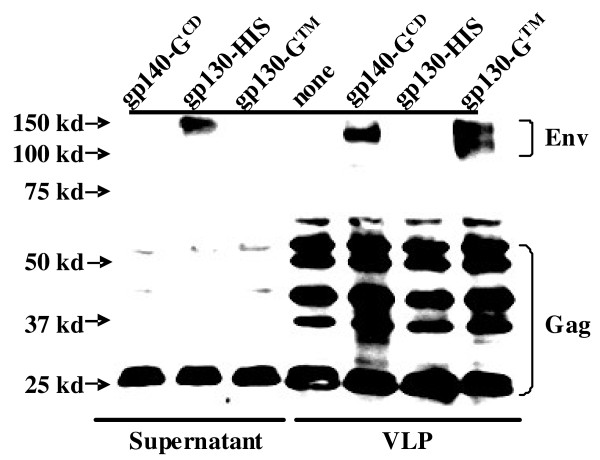
Figure 1
Figure 1
Western blot analyses. 293 T cells were co-transfected with Sgpsyn and the indicated Env expression plasmids. Supernatants of transfected cells (left) and VLPs partially purified and concentrated by ultracentrifugation (right) were analysed by Western blot for SIV proteins.
Figure 2
Figure 2
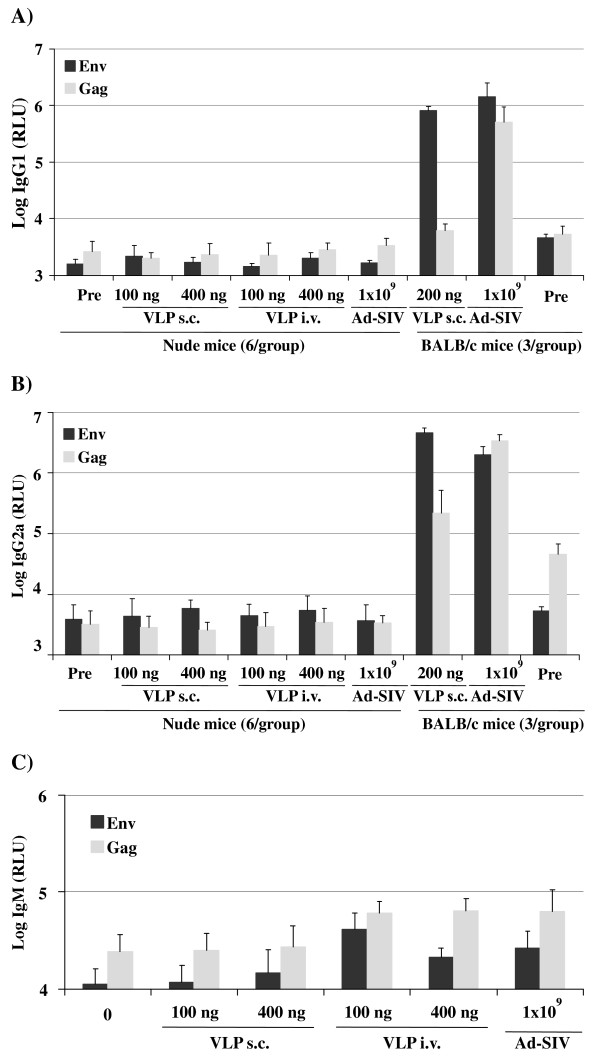
Antibody response to VLP and adenoviral vector immunization in immunodeficient (A-C) and immunocompetent (A,B) mice. Mice were immunized with SIV VLPs at the indicated dose of gp140 ectodomain (ng) and route on days 0, 35 and 45. Subcutaneous adenoviral vector immunizations (Ad-SIV) with 1 × 109 particles were performed on day 0 and 35. Serum antibody levels of the indicated isotypes (A-C) to Env and Gag were determined before immunization (0) and on day 49.
Figure 3
Figure 3
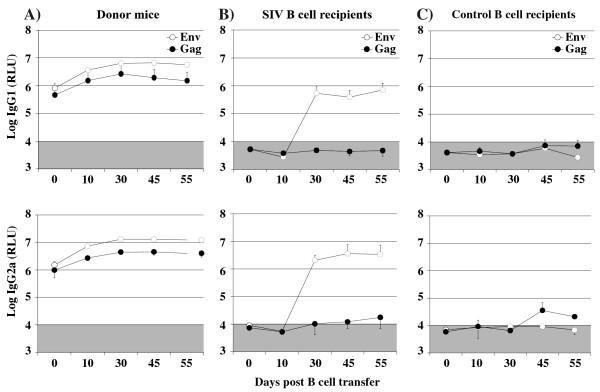
T cell independent secondary Env antibody responses after adoptive B cell transfer. BALB/c donor mice were immunized subcutaneously with 1 × 109 particles of Ad-SIV or as a control Ad-GFP. Six weeks later splenic B cells from both groups were transferred to nude mice resulting in SIV B cell recipient and control B cell recipient mice. At 6, 11 and 41 days after B cell transfer, primed B cell recipient, control B cell recipient, and Ad-SIV immunized donor mice were boosted i.v. with VLPs containing 300 ng of the gp140 ectodomain. IgG1 and IgG2a antibody levels to Env and Gag were determined at the indicated time points after B cell transfer. The mean and standard deviation of three animals per group are given. The shaded area indicates background antibody levels.
Figure 4
Figure 4
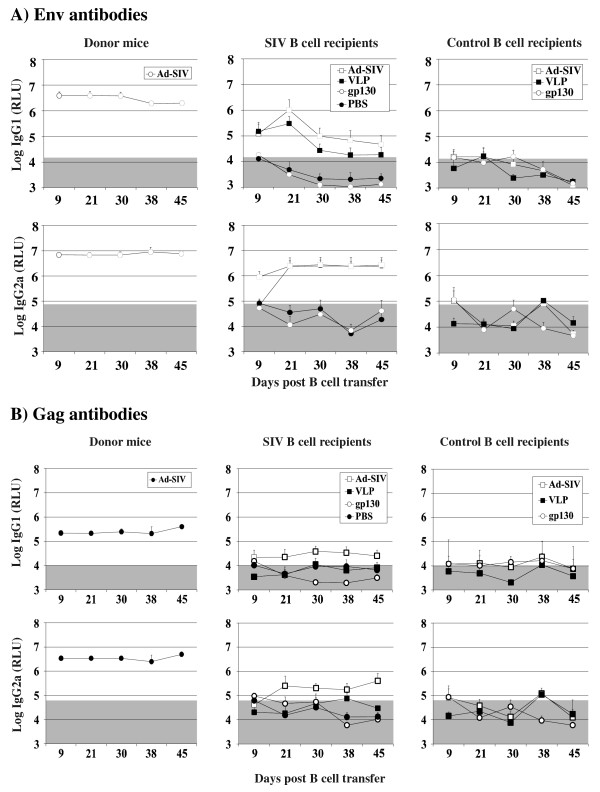
T cell independent secondary Env antibody responses after adoptive B cell transfer and stimulation with soluble gp130. BALB/c donor mice were immunized subcutaneously with 1 × 109 particles of Ad-SIV or as a control Ad-GFP. Six weeks later splenic B cells from both groups were transferred to nude mice resulting in SIV B cell recipient and control B cell recipient mice. At 4, 13 and 25 days after B cell transfer, SIV B cell recipient, control B cell recipient and Ad-SIV immunized donor mice were boosted i.v. with VLPs containing 300 ng of the gp140 ectodomain or with 300 ng of secreted gp130 SU. B cell recipient mice were also immunized s.c with Ad-SIV (109 particles, immunization of day 13 ommitted). IgG1 and IgG2a antibody levels to Env (A) and Gag (B) were determined at the indicated time points after B cell transfer. The mean and standard deviation of four animals per group are given. The shaded area indicates background antibody levels.
Figure 5
Figure 5
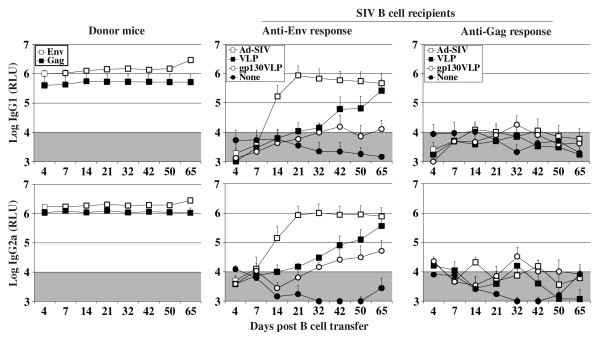
T cell independent secondary Env antibody responses after adoptive B cell transfer and stimulation with VLPs containing monomeric gp130 SU. BALB/c donor mice were immunized subcutaneously with 1 × 109 particles of Ad-SIV. Six weeks later, splenic B cells were transferred into nude mice resulting in SIV B cell recipient mice. At 4, 35 and 41 days after B cell transfer, SIV B cell recipient and Ad-SIV immunized donor mice were boosted i.v. with VLPs containing 300 ng gp140 ectodomain. B cell recipient mice were also immunized s.c with Ad-SIV (109 particles, immunization of day 35 omitted) or i.v. with VLPs containing 300 ng of membrane-anchored monomeric gp130 (gp130-VLPs). IgG1 and IgG2a antibody levels to Env and Gag were determined at the indicated time points after B cell transfer. The mean and standard deviation of four animals per group are given. The shaded area indicates background antibody levels.

References

    1. Huber M, Trkola A. Humoral immunity to HIV-1: neutralization and beyond. J Intern Med. 2007;262:5–25. doi: 10.1111/j.1365-2796.2007.01819.x. - DOI - PubMed
    1. Albert J, Abrahamsson B, Nagy K, Aurelius E, Gaines H, Nystrom G, Fenyo EM. Rapid Development of Isolate-Specific Neutralizing Antibodies after Primary Hiv-1 Infection and Consequent Emergence of Virus Variants Which Resist Neutralization by Autologous Sera. AIDS. 1990;4:107–112. doi: 10.1097/00002030-199002000-00002. - DOI - PubMed
    1. Chamow SM, Zhang DZ, Tan XY, Mhatre SM, Marsters SA, Peers DH, Byrn RA, Ashkenazi A, Junghans RP. A Humanized, Bispecific Immunoadhesin-Antibody That Retargets Cd3(+) Effectors to Kill Hiv-1-Infected Cells. J Immunol. 1994;153:4268–4280. - PubMed
    1. Huber M, Fischer M, Misselwitz B, Manrique A, Kuster H, Niederost B, Weber R, von Wyl V, Guenthard HF, Trkola A. Complement lysis activity in autologous plasma is associated with lower viral loads during the acute phase of HIV-1 infection. PLoS Med. 2006;3:2078–2093. - PMC - PubMed
    1. Yang AG, Chen SY. A new class of antigen-specific killer cells. Nat Biotechnol. 1997;15:46–51. doi: 10.1038/nbt0197-46. - DOI - PubMed

Publication types

MeSH terms