


Network for Pancreatic Organ Donors with Diabetes (nPOD): developing a tissue biobank for type 1 diabetes
- PMID: 22585677
- PMCID: PMC3456997
- DOI: 10.1002/dmrr.2316
Network for Pancreatic Organ Donors with Diabetes (nPOD): developing a tissue biobank for type 1 diabetes
Abstract
Background: The Network for Pancreatic Organ Donors with Diabetes (nPOD) was established to recover and characterize pancreata and related organs from cadaveric organ donors with various risk levels for type 1 diabetes (T1D). These biospecimens are available to investigators for collaborative studies aimed at addressing questions related to T1D natural history and pathogenesis.
Research design and methods: Organ donors included T1D patients (new onset to long term), non-diabetic autoantibody-positive subjects, non-diabetic controls and individuals with disorders relevant to β-cell function. Pancreas recovery and transport met transplant-grade criteria. Additional samples recovered included serum, whole blood, spleen and pancreatic and non-pancreatic lymph nodes. Biospecimens were processed for cryopreserved cells, fixed paraffin and fresh frozen blocks and snap frozen samples. T1D autoantibodies, C-peptide levels and high-resolution HLA genotyping for risk alleles were also determined.
Results: Over 160 donors have been enrolled (ages of 1 day to >90 years). Standard operating procedures were established along with a quality management system. Donor demographics, laboratory assays and histopathological characterizations were shared through an open online informatics system. Biospecimens were distributed to more than 60 investigators.
Conclusions: The nPOD programme provides access to high quality biospecimens without cost to investigators. Collaborations and open data sharing are emphasized to maximize research potential of each donor. On the basis of initial successes, the nPOD programme is expanding to recover additional organs relevant to T1D pathogenesis and complications from European countries (PanFin network).
Copyright © 2012 John Wiley & Sons, Ltd.
Conflict of interest statement
None declared.
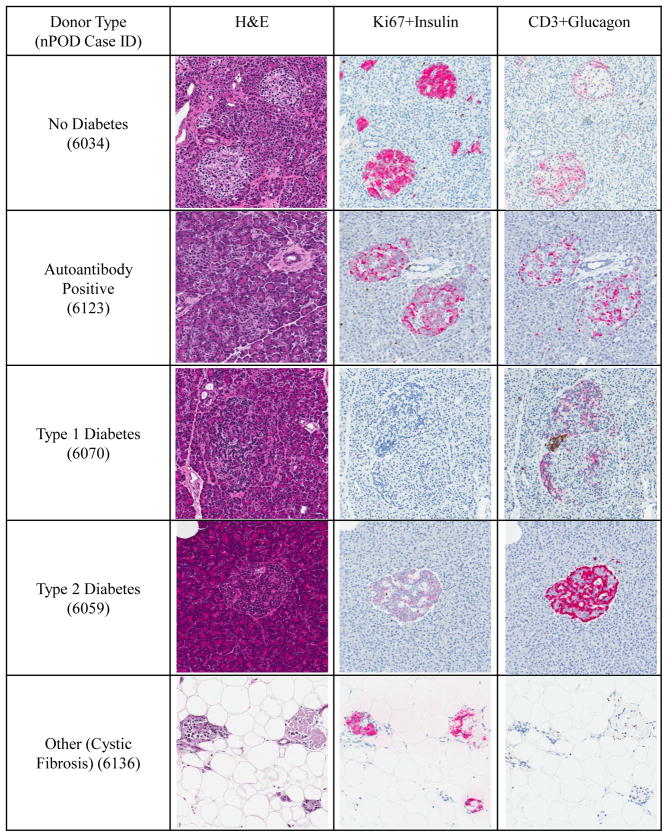
Figures
References
-
- Atkinson MA, Gianani R. The pancreas in human type 1 diabetes: providing new answers to age-old questions. Curr Opin Endocrinol Diabetes Obes. 2009;16(4):279–85. Epub 2009/06/09. - PubMed
-
- Dabelea D, Bell RA, D’Agostino RB, Imperatore G, Johansen JM, Linder B, et al. Incidence of diabetes in youth in the United States. JAMA. 2007;297(24):2716–24. - PubMed
-
- van Belle TL, Coppieters KT, von Herrath MG. Type 1 diabetes: etiology, immunology, and therapeutic strategies. Physiol Rev. 2011;91(1):79–118. - PubMed
-
- von Herrath M. Diabetes: A virus-gene collaboration. Nature. 2009;459(7246):518–9. - PubMed
Publication types
MeSH terms
Grants and funding
LinkOut - more resources
Full Text Sources
Other Literature Sources
Medical
Research Materials
Miscellaneous
