


Photoprotection in a purple phototrophic bacterium mediated by oxygen-dependent alteration of carotenoid excited-state properties
- PMID: 22586075
- PMCID: PMC3365192
- DOI: 10.1073/pnas.1201413109
Photoprotection in a purple phototrophic bacterium mediated by oxygen-dependent alteration of carotenoid excited-state properties
Abstract
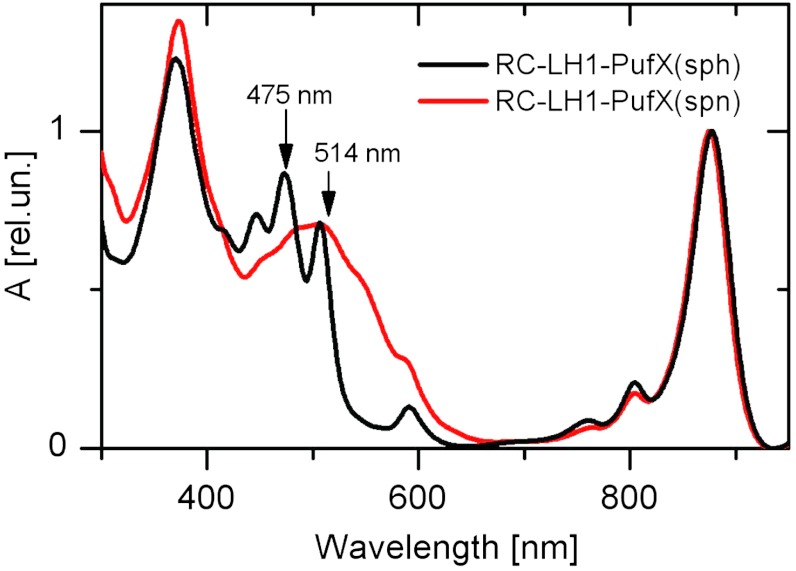
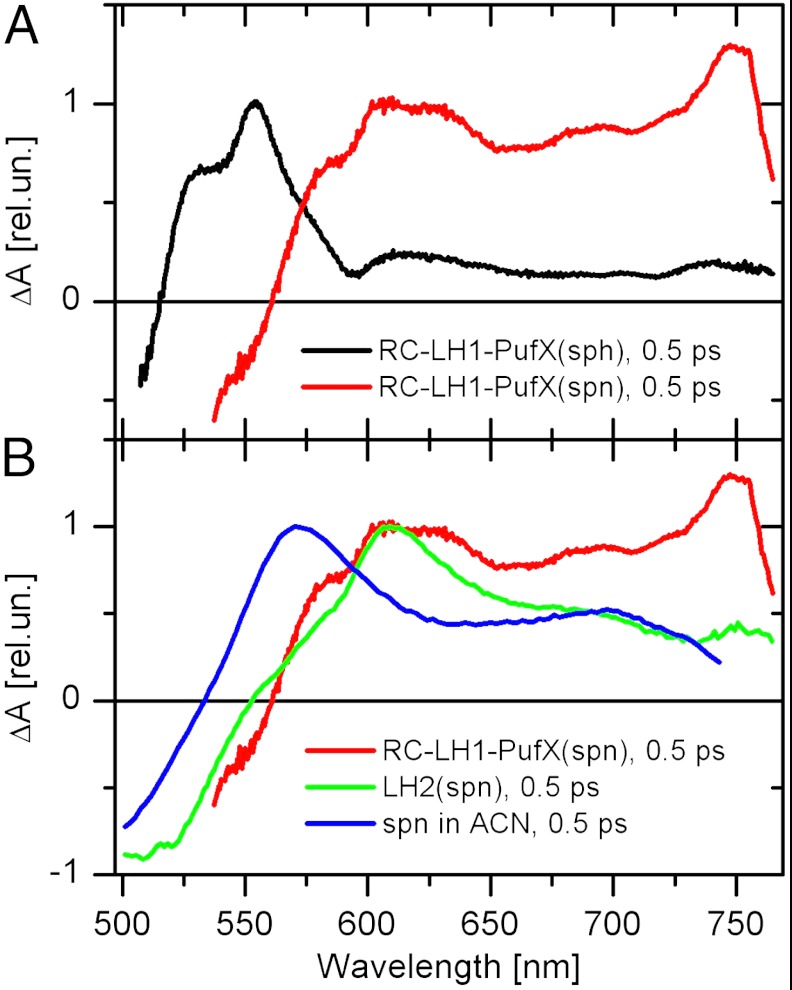
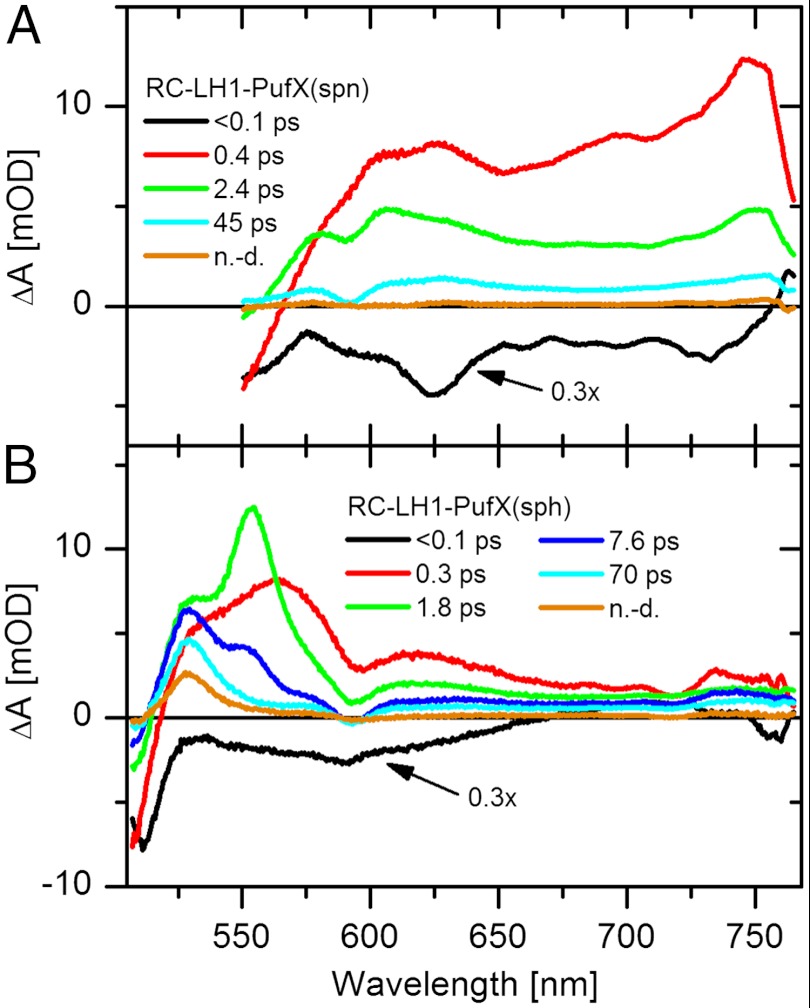
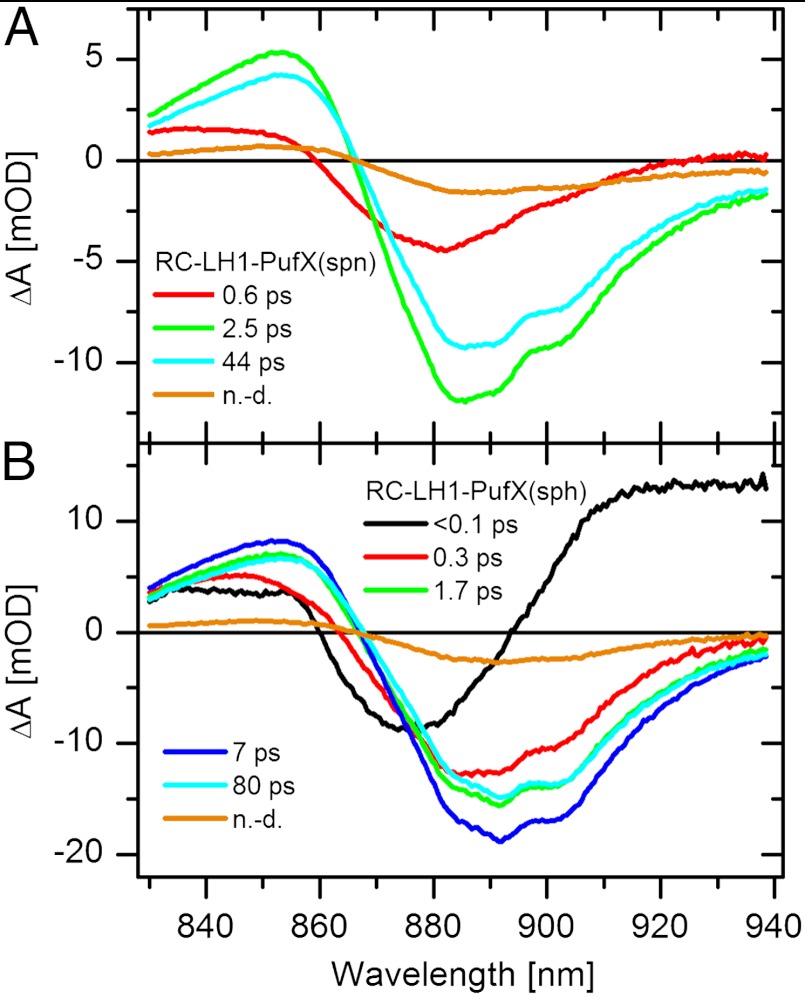
Carotenoids are known to offer protection against the potentially damaging combination of light and oxygen encountered by purple phototrophic bacteria, but the efficiency of such protection depends on the type of carotenoid. Rhodobacter sphaeroides synthesizes spheroidene as the main carotenoid under anaerobic conditions whereas, in the presence of oxygen, the enzyme spheroidene monooxygenase catalyses the incorporation of a keto group forming spheroidenone. We performed ultrafast transient absorption spectroscopy on membranes containing reaction center-light-harvesting 1-PufX (RC-LH1-PufX) complexes and showed that when oxygen is present the incorporation of the keto group into spheroidene, forming spheroidenone, reconfigures the energy transfer pathway in the LH1, but not the LH2, antenna. The spheroidene/spheroidenone transition acts as a molecular switch that is suggested to twist spheroidenone into an s-trans configuration increasing its conjugation length and lowering the energy of the lowest triplet state so it can act as an effective quencher of singlet oxygen. The other consequence of converting carotenoids in RC-LH1-PufX complexes is that S(2)/S(1)/triplet pathways for spheroidene is replaced with a new pathway for spheroidenone involving an activated intramolecular charge-transfer (ICT) state. This strategy for RC-LH1-PufX-spheroidenone complexes maintains the light-harvesting cross-section of the antenna by opening an active, ultrafast S(1)/ICT channel for energy transfer to LH1 Bchls while optimizing the triplet energy for singlet oxygen quenching. We propose that spheroidene/spheroidenone switching represents a simple and effective photoprotective mechanism of likely importance for phototrophic bacteria that encounter light and oxygen.
Conflict of interest statement
The authors declare no conflict of interest.
Figures
References
-
- Demmig-Adams B, Adams WW. The role of xanthophyll cycle carotenoids in the protection of photosynthesis. Trends Plant Sci. 1996;1:21–26.
Publication types
MeSH terms
Substances
Grants and funding
LinkOut - more resources
Full Text Sources
Molecular Biology Databases
