. 2012 May 4:6:110.
doi: 10.3389/fnhum.2012.00110. eCollection 2012.

Brain networks of visuospatial attention and their disruption in visual neglect

Affiliations

Brain networks of visuospatial attention and their disruption in visual neglect

Paolo Bartolomeo et al. Front Hum Neurosci. .

Abstract

Visual neglect is a multi-component syndrome including prominent attentional disorders. Research on the functional mechanisms of neglect is now moving from the description of dissociations in patients' performance to the identification of the possible component deficits and of their interaction with compensatory strategies. In recent years, the dissection of attentional deficits in neglect has progressed in parallel with increasing comprehension of the anatomy and function of large-scale brain networks implicated in attentional processes. This review focuses on the anatomy and putative functions of attentional circuits in the brain, mainly subserved by fronto-parietal networks, with a peculiar although not yet completely elucidated role for the right hemisphere. Recent results are discussed concerning the influence of a non-spatial attentional function, phasic alertness, on conscious perception in normal participants and on conflict resolution in neglect patients. The rapid rate of expansion of our knowledge of these systems raises hopes for the development of effective strategies to improve the functioning of the attentional networks in brain-damaged patients.

Keywords: attention; consciousness; frontal lobe; neglect; parietal lobe.


Figures
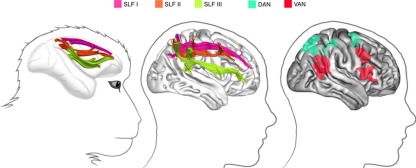
Figure 1
Figure 1
Fronto-parietal networks linked by the three branches of the superior longitudinal fasciculus. Left: in the monkey brain (from Schmahmann and Pandya, 2006): middle: in the human right hemisphere (from Thiebaut de Schotten et al., 2011); right: attentional networks in the right hemisphere, according to Corbetta and Shulman (2002).
Figure 2
Figure 2
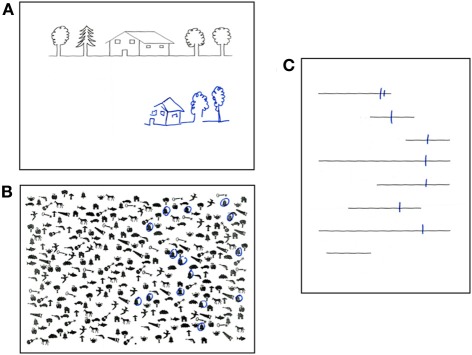
Performance of a patient with left spatial neglect on paper-and-pencil tests. (A) copy of a linear drawing with omission of left-sided elements; (B) target cancellation task, with omission of left-sided targets (bells); (C) bisection of horizontal lines, with rightward deviation of the bisection mark and complete omission of one left-sided line.
Figure 3
Figure 3
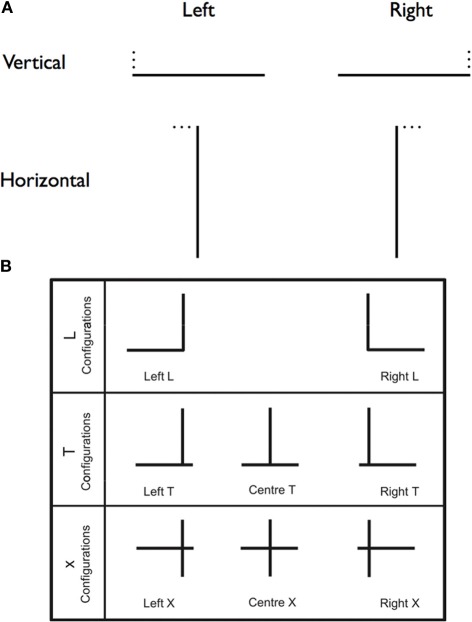
Neglect and length estimation. (A) A schematic depiction of the stimuli used by Charras et al. (2010). A single black line, either horizontal or vertical (40 mm long, 1 mm thick), was printed in the center of the sheet. Participants performed a line extension task in which they were to draw either a horizontal or a vertical line to complete an L figure. The missing line was located either to the left or right of the presented line. The position of the missing line was indicated by three small black dots. (B) Schematic depiction of the stimuli used by Charras et al. (2012). The L configurations enabled to test leftwards and rightrightwards biases separately. In the T and X configurations, there was a left/right competition between the horizontal line segments left and right of the bisection line. The results showed that, in the T configuration, the vertical line was overestimated, while in the X configuration, the horizontal line was overestimated.
Figure 4
Figure 4
Imaginal neglect. In their seminal paper, Bisiach and Luzzatti (1978) reported two left neglect patients who, when asked to imagine and describe from memory familiar surroundings (the Piazza del Duomo in Milan), omitted to mention left-sided details regardless of the imaginary vantage point that they assumed.
Figure 5
Figure 5
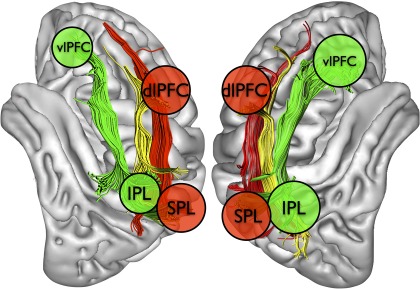
Schematic depiction of fronto-parietal attentional networks for visuospatial processing in the two hemispheres, based on Corbetta and Shulman (2002) and Thiebaut de Schotten et al. (2011). IPL and SPL, inferior and superior parietal lobules. dlPFC and vlPFC, dorsolateral and ventrolateral prefrontal cortex.

References

    1. Allport D. A. (1989). “Visual attention,” in Foundations of Cognitive Science, ed Posner M. I. (Cambridge, MA: MIT Press; ), 631–687
    1. Anderson B. (1993). Spared awareness for the left side of internal visual images in patients with left-sided extrapersonal neglect. Neurology 43, 213–216 - PubMed
    1. Andrade K., Samri D., Sarazin M., Cruz De Souza L., Cohen L., Thiebaut de Schotten M., Dubois B., Bartolomeo P. (2010). Visual neglect in posterior cortical atrophy. BMC Neurol. 10, 68 10.1186/1471-2377-10-68 - DOI - PMC - PubMed
    1. Asplund C. L., Todd J. J., Snyder A. P., Marois R. (2010). A central role for the lateral prefrontal cortex in goal-directed and stimulus-driven attention. Nat. Neurosci. 13, 507–512 10.1038/nn.2509 - DOI - PMC - PubMed
    1. Augustine J. R. (1996). Circuitry and functional aspects of the insular lobe in primates including humans. Brain Res. Rev. 22, 229–244 10.1016/S0165-0173(96)00011-2 - DOI - PubMed

LinkOut - more resources