Prevention of persistent human papillomavirus infection by an HPV16/18 vaccine: a community-based randomized clinical trial in Guanacaste, Costa Rica
- PMID: 22586631
- PMCID: PMC3354733
- DOI: 10.1158/2159-8290.CD-11-0131
Prevention of persistent human papillomavirus infection by an HPV16/18 vaccine: a community-based randomized clinical trial in Guanacaste, Costa Rica
Abstract
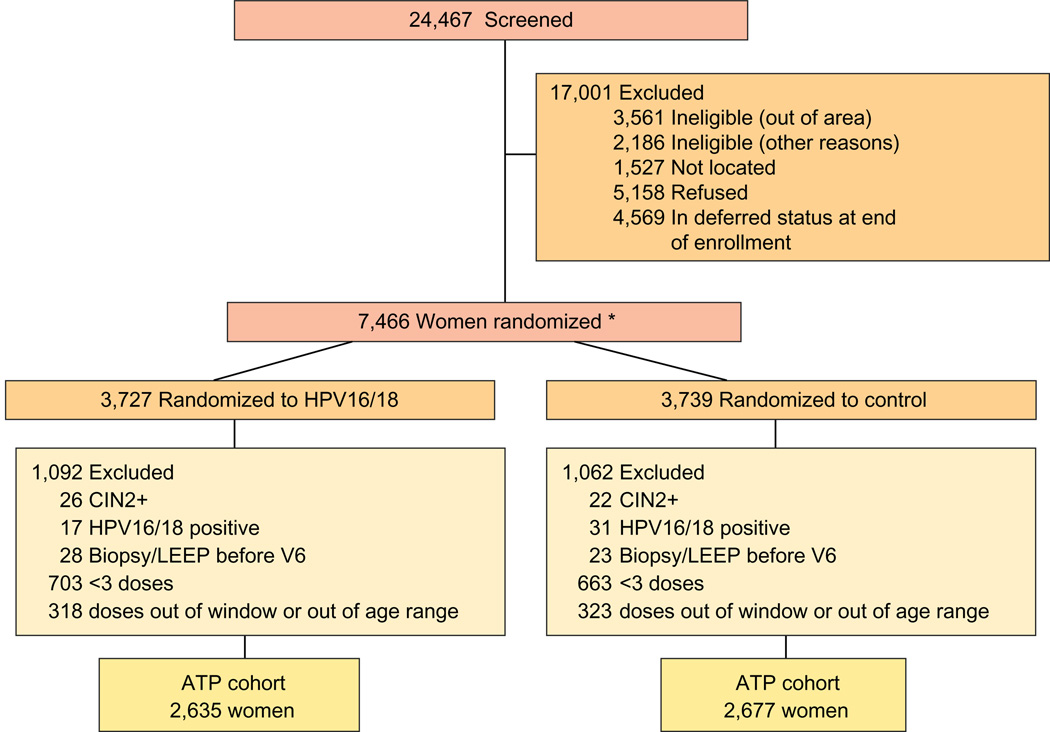
Target groups for human papillomavirus (HPV) vaccination are controversial. We evaluated vaccine efficacy (VE) against 1-year persistent infection, stratified by age and sexual behavior, among young women in Costa Rica. We randomized 7,466 healthy women 18 to 25 years of age to HPV16/18 or hepatitis A vaccine (follow-up, 50.4 months). According-to-protocol (ATP) cohorts included compliant HPV-negative women; intention-to-treat (ITT) included all randomized women. ATP VE was 90.9% (95% CI, 82.0-95.9) against HPV16/18 infections, 44.5% against HPV31/33/45 (95% CI, 17.5-63.1), and 12.4% (95% CI, -3.2 to 25.6) against any oncogenic infection. Overall ITT VE against HPV16/18 infections was 49.0%, but ATP and ITT VE almost reached 100% in year 4 of follow-up. ATP efficacy against HPV16/18 was similar by age, but ITT VE was greatest among youngest women (68.9% among those 18-19 years of age; 21.8% among those 24-25 years of age) and 79.8% among virgins. Among previously unexposed women, vaccination is highly efficacious against HPV16/18 and partially against HPV31/33/45. Vaccination is most effective in women and girls before they initiate sexual activity, with programmatic and individual decision implications.
Conflict of interest statement
The Costa Rican Vaccine Trial is a longstanding collaboration between investigators in Costa Rica and NCI. The trial is sponsored and funded by NCI (N01-CP-11005) with support from the NIH Office of Research on Women's Health and conducted in agreement with the Ministry of Health of Costa Rica. The NCI and Costa Rica investigators are responsible for the design and conduct of the study; collection, management, analysis, and interpretation of the data; and preparation of the manuscript. Vaccine was provided for our trial by GSK Biologicals, under a Clinical Trials Agreement with NCI. GSK also provided support for aspects of the trial associated with regulatory submission needs of the company under FDA BB-IND 7920. D.R. Lowy and J.T. Schiller are named inventors on U.S. government-owned HPV vaccine patents that are licensed to GSK and Merck, and so are entitled to limited royalties as specified by federal law. None of the other coauthors have any potential conflicts of interest to report.
Figures
Comment in
-
The prospects of HPV vaccination in cervical cancer prevention: results of a new independent trial.Cancer Discov. 2011 Oct;1(5):377-80. doi: 10.1158/2159-8290.CD-11-0229. Cancer Discov. 2011. PMID: 22586628
References
-
- Arbyn M, Castellsague X, de Sanjose S, Bruni L, Saraiya M, Bray F, et al. Worldwide burden of cervical cancer in 2008. Ann Oncol. 2011 Apr 6; [epub ahead of print] - PubMed
-
- Koutsky LA, Ault KA, Wheeler CM, Brown DR, Barr E, Alvarez FB, et al. A controlled trial of a human papillomavirus type 16 vaccine. N Engl J Med. 2002;347:1645–1651. - PubMed
-
- Munoz N, Kjaer SK, Sigurdsson K, Iversen OE, Hernandez-Avila M, Wheeler CM, et al. Impact of human papillomavirus (HPV)-6/11/16/18 vaccine on all HPV-associated genital diseases in young women. J Natl Cancer Inst. 2010;102:325–339. - PubMed
-
- Paavonen J, Jenkins D, Bosch FX, Naud P, Salmeron J, Wheeler CM, et al. Efficacy of a prophylactic adjuvanted bivalent L1 virus-like-particle vaccine against infection with human papillomavirus types 16 and 18 in young women: an interim analysis of a phase III double-blind, randomised controlled trial. Lancet. 2007;369:2161–2170. - PubMed
-
- Paavonen J, Naud P, Salmeron J, Wheeler CM, Chow SN, Apter D, et al. Efficacy of human papillomavirus (HPV)-16/18 AS04-adjuvanted vaccine against cervical infection and precancer caused by oncogenic HPV types (PATRICIA): final analysis of a double-blind, randomised study in young women. Lancet. 2009;374:301–314. - PubMed
Publication types
MeSH terms
Substances
Grants and funding
LinkOut - more resources
Full Text Sources