. 2012 May;24(5):1776-92.
doi: 10.1105/tpc.112.095752. Epub 2012 May 15.

Grass microRNA gene paleohistory unveils new insights into gene dosage balance in subgenome partitioning after whole-genome duplication

Affiliations

Grass microRNA gene paleohistory unveils new insights into gene dosage balance in subgenome partitioning after whole-genome duplication

Michael Abrouk et al. Plant Cell. 2012 May.

Abstract

The recent availability of plant genome sequences, combined with a robust evolutionary scenario of the modern monocot and eudicot karyotypes from their diploid ancestors, offers an opportunity to gain insights into microRNA (miRNA) gene paleohistory in plants. Characterization and comparison of miRNAs and associated protein-coding targets in plants allowed us to unravel (1) contrasted genome conservation patterns of miRNAs in monocots and eudicots after whole-genome duplication (WGD), (2) an ancestral miRNA founder pool in the monocot genomes dating back to 100 million years ago, (3) miRNA subgenome dominance during the post-WGD diploidization process with selective miRNA deletion complemented with possible transposable element-mediated return flows, and (4) the miRNA/target interaction-directed differential loss/retention of miRNAs following the gene dosage balance rule. Together, our data suggest that overretained miRNAs in grass genomes may be implicated in connected gene regulations for stress responses, which is essential for plant adaptation and useful for crop variety innovation.


Figures
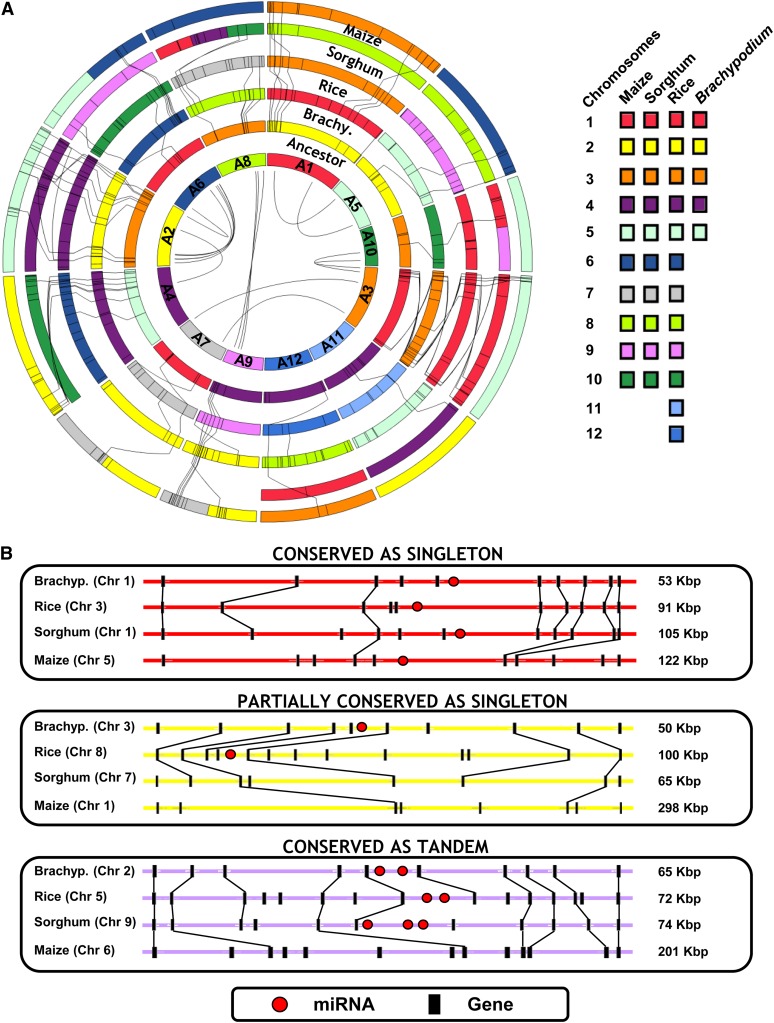
Figure 1.
Figure 1.
Genome-Wide miRNA Conservation in Grasses. (A) Grass genome synteny is illustrated as concentric circles. The chromosome number is highlighted with a color code (at right) that illuminates the n = 12 monocot ancestral genome structure. Any radius of the circle shows orthologous chromosomes from Brachypodium, rice, sorghum, and maize genomes. Maize genome is depicted as a double circle originating from the maize-specific recent WGD. Colinear miRNAs are linked with black lines between circles, and ancestral duplicated miRNAs are linked with black lines at the center of the circle. (B) Illustration of conservation fate from the miRNA (red dots) evolutionary analysis as (1) conservation between the four species (top inset), (2) conservation between two species (middle inset), and (3) conservation as clusters (bottom inset). Colinear genes are shown as black boxes and linked with lines.
Figure 2.
Figure 2.
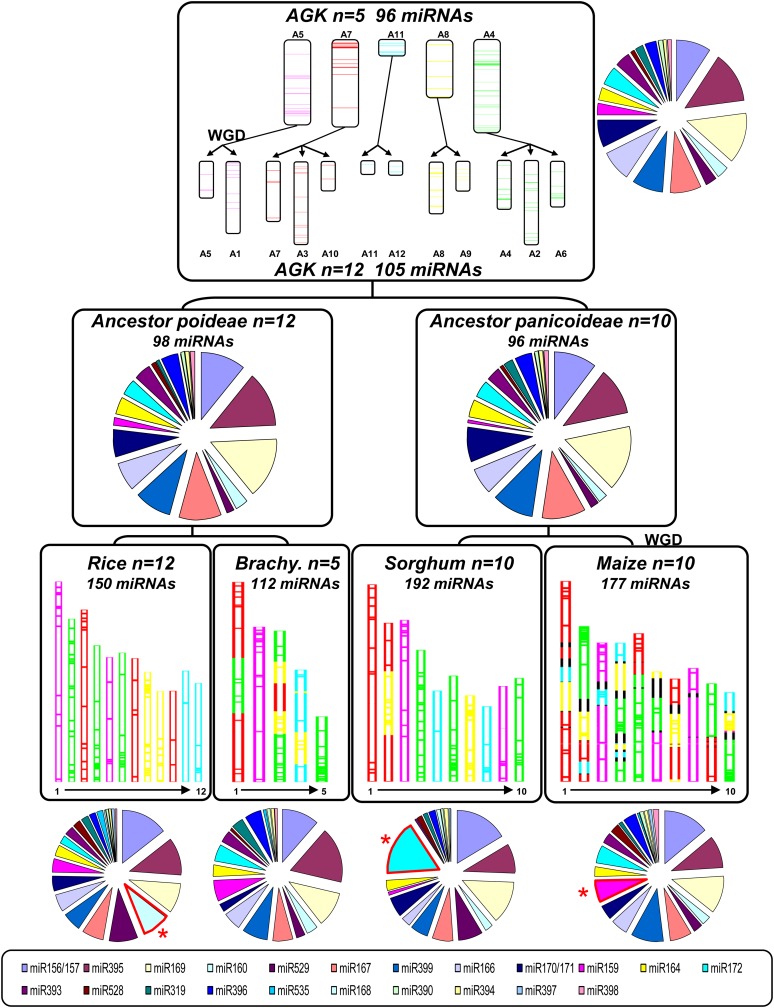
Paleohistory of miRNA Evolution in Plants. The modern grass genome structures (bottom) are depicted with a five-color code that illuminates their relationship with the n = 5 AGK (top). The percentage of miRNAs per family (reference color code legend at the bottom) are shown with circular distribution for the four monocot genomes (bottom), the rice/Brachypodium and sorghum/maize ancestral genome intermediates (center), as well as for the AGK (top), according to the paleogenomic study in the monocots from Murat et al. (2010).
Figure 3.
Figure 3.
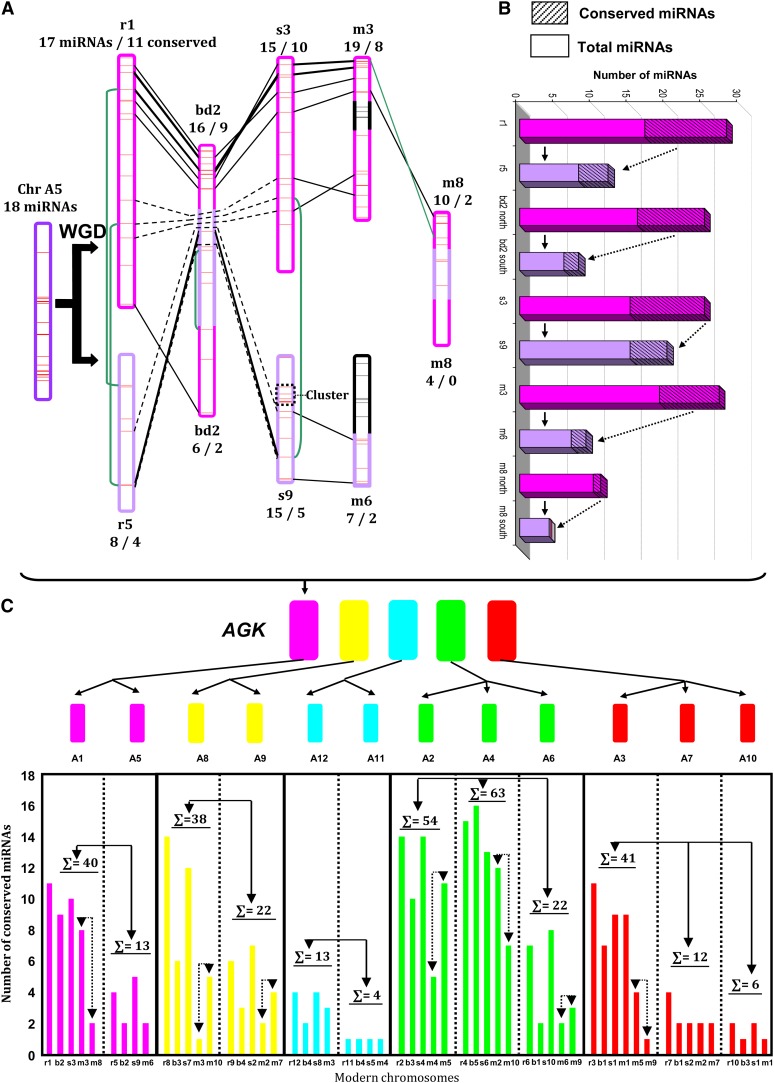
Differential Conservation Patterns of miRNA Duplicates. (A) Illustration of paralogous chromosomes in rice (Chr 1-5), Brachypodium (Chr 2), sorghum (Chr 3-9), and maize (Chr 3-6-8) originating from the single ancestral preduplication chromosome A5. miRNAs are shown with horizontal colored bars on the chromosomes, colinear miRNAs are linked with black lines, and paleo-duplicated miRNAs are linked with green lines. The numbers of miRNAs and associated number of orthologous miRNAs are mentioned at the extremity of each chromosome. (B) Illustration of the number (y axis) in total miRNA content (solid bars) and conservation (dashed bars) between duplicated chromosomes (x axis) in rice (chr 1-5), Brachypodium (chr 2 north-south), sorghum (chr 3/9), and maize (chr 3/6/8). (C) Illustration of the conservation of duplicated miRNAs (y axis) in the modern genomes (bottom) Brachypodium (b), rice (r), sorghum (s), and maize (m) derived from a single paleo-tetraploid event from ancestral chromosomes A5, A8, A11, A4, and A7 (top). Differences in miRNA content in one of the paleo-duplicated (black arrows) or neo-duplicated (dotted arrows for maize) chromosomes are shown.
Figure 4.
Figure 4.
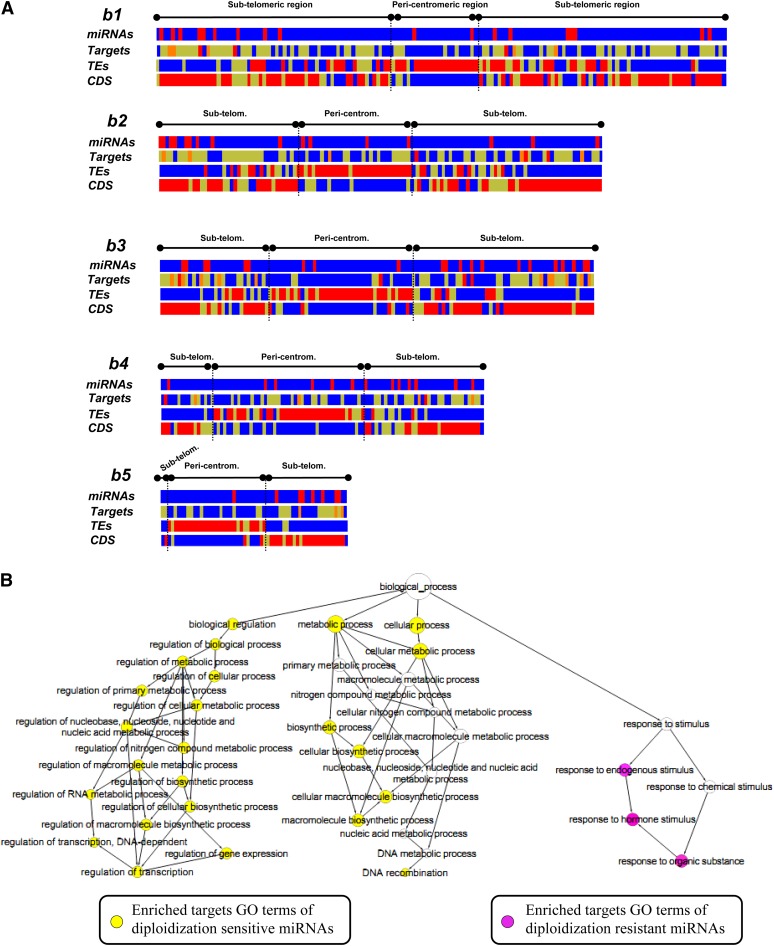
Chromosomal Distribution and Conservation of miRNAs and Their Targets. (A) Brachypodium heat map is illustrated for the miRNAs (first heat map color code blue = 0 and red ≤1 of miRNAs in intervals), miRNA targets (second heat map, color code color blue = 0, yellow <4, red >5 of miRNA targets in intervals), TEs (third heat map, color code blue <80%, yellow >80%, red ∼100% of TEs in intervals), and CDS (last heat map, color code blue <40, yellow = 40 to 50, red >50 of CDS in intervals) for the five pseudomolecules. (B) A Cytoscape view of enriched GO biological processes among targets of overretained (i.e., duplicated) and underretained (i.e., nonduplicated) miRNAs in rice. The size of the node is proportional to the number of targets in the GO category. Purple solid nodes represent GO terms enriched in targets of overretained miRNAs; yellow solid nodes represent GO terms enriched in targets of underretained miRNAs; white nodes represent nonenriched GO terms to show the hierarchical relationship between enriched ontology branches. Enrichment significance level P value < 0.05 and FDR < 0.05.
Figure 5.
Figure 5.
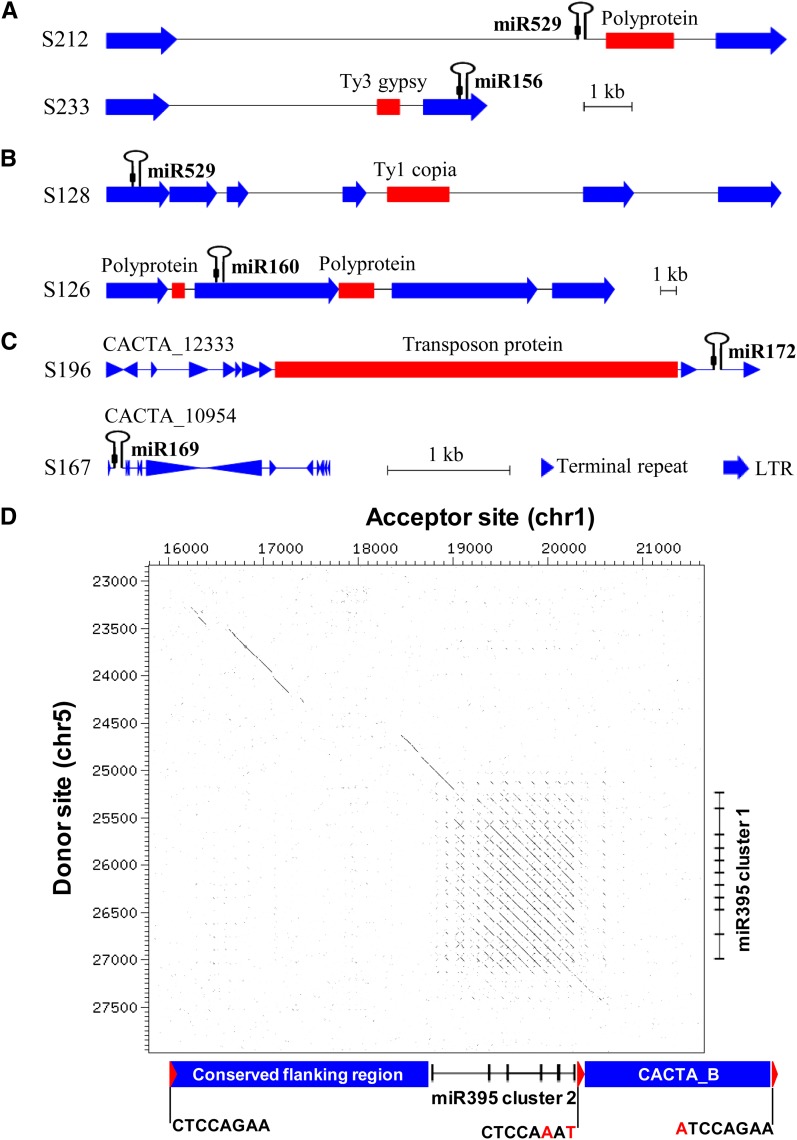
Mechanisms of TE-Mediated miRNA Gene Transposition. (A) to (C) Potential TE-mediated miRNA transposition. (A) miRNAs located inside the retrotransposon polyprotein region. (B) miRNAs located on LTRs of nested retrotransposons. (C) miRNAs carried by CACTA transposon elements. (D) Blue arrows indicated the long terminal repeat DotPlot alignment showing high similarity between the donor and the acceptor sites that contain two miR395 clusters on Brachypodium chromosomes 5 and 1, respectively. Red arrows indicate TSDs produced upon CACTA insertion. Imperfectly matched bases are in red. The length of CACTA is not in proportion.
Figure 6.
Figure 6.
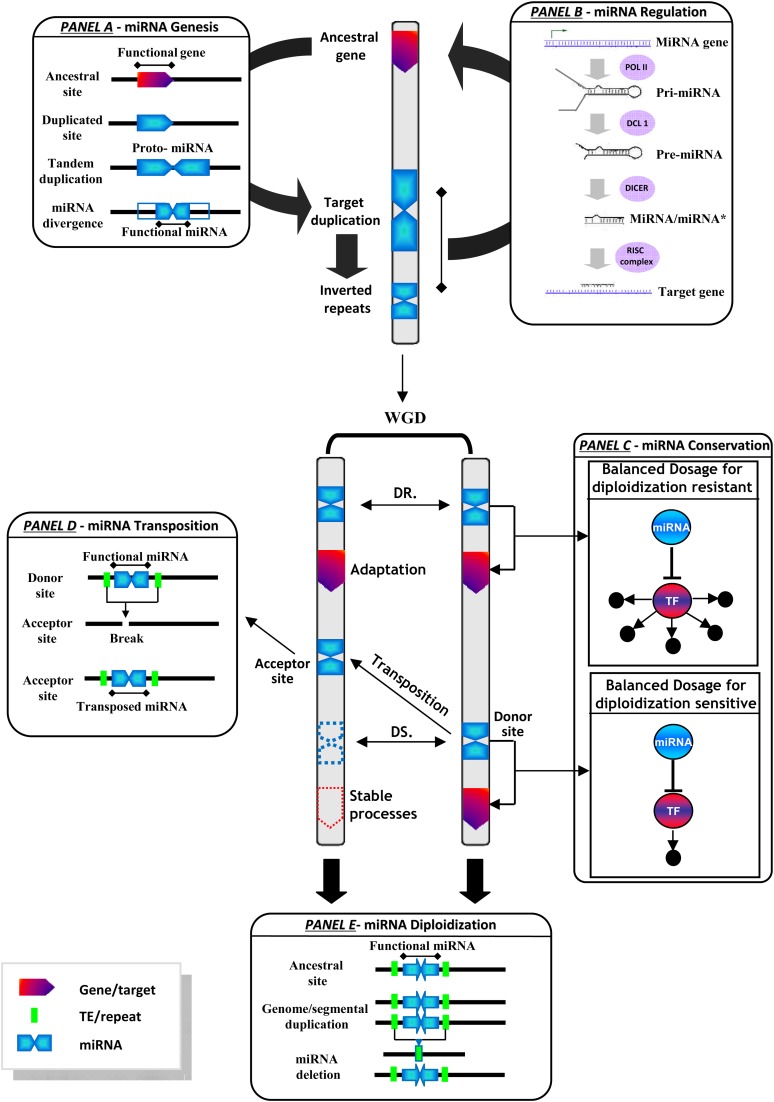
Evolutionary Model of miRNA Genesis, Regulation, Conservation, and Transposition in Plants. Major conclusions are schematically illustrated in five panels regarding miRNA (1) genesis through gene duplication and sequence divergence (A), (2) regulation of targeted gene via the formation of primary miRNA and pre-miRNA and miRNA/miRNA* complexes (B), (3) conservation (C) or transposition (D) following the gene dosage hypothesis, and (4) evolution via diploidization following the subgenome dominance process (E). miRNAs (blue arrow), protein-coding genes (red arrow), and TEs (green box) are shown on a single ancestral chromosome (top black bar) and derived duplicated (bottom black bars) chromosomes after a WGD. DR, diploidization resistant; DS, diploidization sensitive.

References

    1. Abrouk M., Murat F., Pont C., Messing J., Jackson S., Faraut T., Tannier E., Plomion C., Cooke R., Feuillet C., Salse J. (2010). Palaeogenomics of plants: Synteny-based modelling of extinct ancestors. Trends Plant Sci. 15: 479–487 - PubMed
    1. Agmon N., Pur S., Liefshitz B., Kupiec M. (2009). Analysis of repair mechanism choice during homologous recombination. Nucleic Acids Res. 37: 5081–5092 - PMC - PubMed
    1. Allen E., Xie Z., Gustafson A.M., Sung G.H., Spatafora J.W., Carrington J.C. (2004). Evolution of microRNA genes by inverted duplication of target gene sequences in Arabidopsis thaliana. Nat. Genet. 36: 1282–1290 - PubMed
    1. Altschul S.F., Gish W., Miller W., Myers E.W., Lipman D.J. (1990). Basic local alignment search tool. J. Mol. Biol. 215: 403–410 - PubMed
    1. Ambros V. (2004). The functions of animal microRNAs. Nature 431: 350–355 - PubMed

Publication types

LinkOut - more resources