doi: 10.1371/journal.pbio.1001323.
Epub 2012 May 8.
Bit by bit: the Darwinian basis of life
Affiliations
- PMID: 22589698
- PMCID: PMC3348159
- DOI: 10.1371/journal.pbio.1001323
Item in Clipboard
Bit by bit: the Darwinian basis of life
PLoS Biol.
2012.
Abstract
All known examples of life belong to the same biology, but there is increasing enthusiasm among astronomers, astrobiologists, and synthetic biologists that other forms of life may soon be discovered or synthesized. This enthusiasm should be tempered by the fact that the probability for life to originate is not known. As a guiding principle in parsing potential examples of alternative life, one should ask: How many heritable "bits" of information are involved, and where did they come from? A genetic system that contains more bits than the number that were required to initiate its operation might reasonably be considered a new form of life.
Conflict of interest statement
The author has declared that no competing interests exist.
Figures
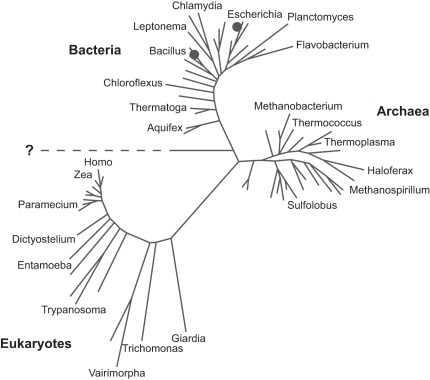
The root of the tree is indicated by a horizontal line. The locations on the tree of Halomonas sp. (GFAJ-1) and Mycoplasma mycoides (JCVI-syn1.0) are indicated by black circles adjacent to Escherichia and Bacillus, respectively.
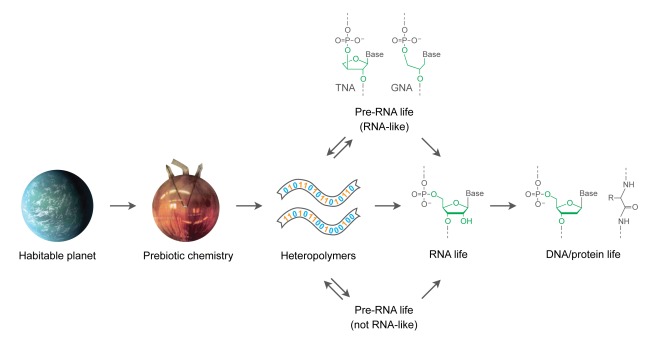
The planet is an artist's conception of the recently discovered “Earth-like” planet Kepler-22b (image courtesy of NASA/Ames/JPL-Caltech). Prebiotic chemistry is represented by the Miller-Urey spark-discharge apparatus (modification of photo by Ned Shaw, Indiana University). Two examples of hypothesized pre-RNA life are shown, based on either threose nucleic acid (TNA) or glycol nucleic acid (GNA).
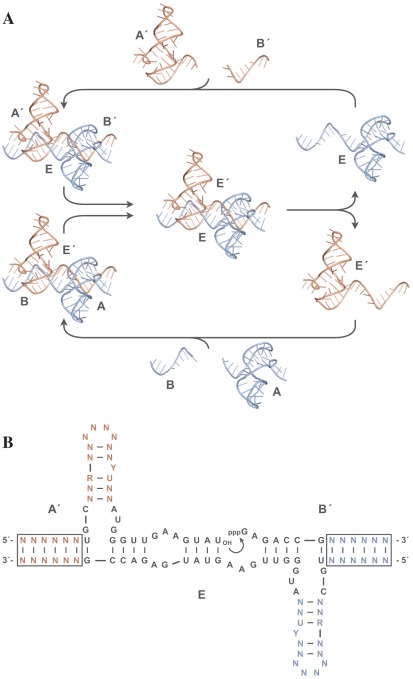
(A) The replication cycle involves paired RNA enzymes (E in blue, E′ in orange) that catalyze each other's synthesis by joining two corresponding oligonucleotide substrates (A′ and B′ to form E′, A and B to form E). Each substrate contains six nucleotides of variable sequence that are recognized by Watson-Crick pairing to the enzyme. The tertiary structure is based on homology modeling to the crystal structure of the L1 ligase RNA enzyme . (B) Sequence and secondary structure of the E·A′·B′ complex, with the two genetic regions (boxed) and two corresponding regions within the functional domain of the enzyme shown in color, and with the immutable nucleotides that are essential for replication shown in black. Curved arrow indicates the site of ligation of A′ and B′ to form E′. The E′·A·B complex has reciprocal composition.
References
-
- McKay D. S, Gibson E. K, Jr, Thomas-Keprta K. L, Vali H, Romanek C. S, et al. Search for past life on Mars: possible relic biogenic activity in Martian meteorite ALH84001. Science. 1996;273:924–930. - PubMed
-
- Wolfe-Simon F, Switzer Blum J, Kulp T. R, Gordon G. W, Hoeft S. E, et al. A bacterium that can grow by using arsenic instead of phosphorus. Science. 2011;332:1163–1166. - PubMed
-
- Gibson D. G, Glass J. I, Lartigue C, Noskov V. N, Chuang R. Y, et al. Creation of a bacterial cell controlled by a chemically synthesized genome. Science. 2010;329:52–56. - PubMed
-
- Joyce G. F. The antiquity of RNA-based evolution. Nature. 2002;418:214–221. - PubMed
Publication types
MeSH terms
Substances
LinkOut - more resources
Full Text Sources
Research Materials