High diversity of rabies viruses associated with insectivorous bats in Argentina: presence of several independent enzootics
- PMID: 22590657
- PMCID: PMC3348165
- DOI: 10.1371/journal.pntd.0001635
High diversity of rabies viruses associated with insectivorous bats in Argentina: presence of several independent enzootics
Abstract
Background: Rabies is a fatal infection of the central nervous system primarily transmitted by rabid animal bites. Rabies virus (RABV) circulates through two different epidemiological cycles: terrestrial and aerial, where dogs, foxes or skunks and bats, respectively, act as the most relevant reservoirs and/or vectors. It is widely accepted that insectivorous bats are not important vectors of RABV in Argentina despite the great diversity of bat species and the extensive Argentinean territory.
Methods: We studied the positivity rate of RABV detection in different areas of the country, and the antigenic and genetic diversity of 99 rabies virus (RABV) strains obtained from 14 species of insectivorous bats collected in Argentina between 1991 and 2008.
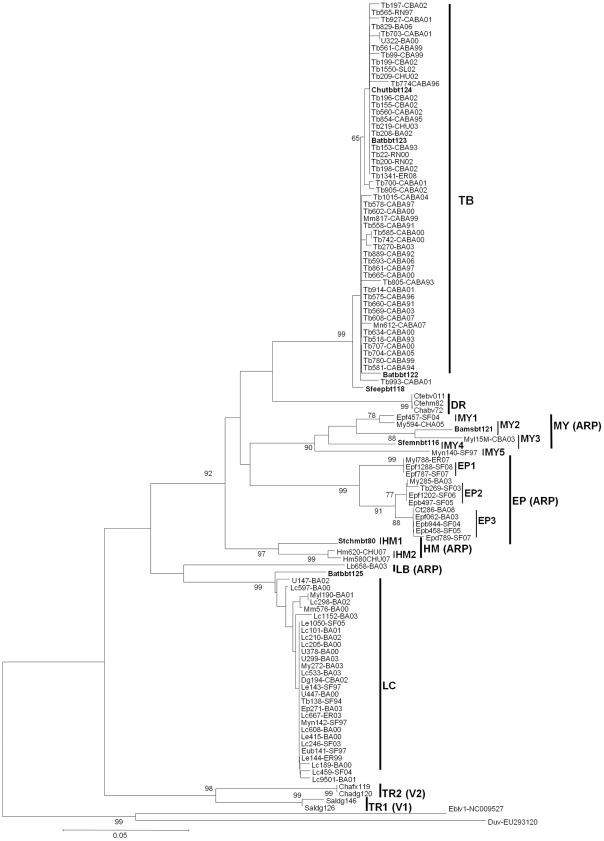
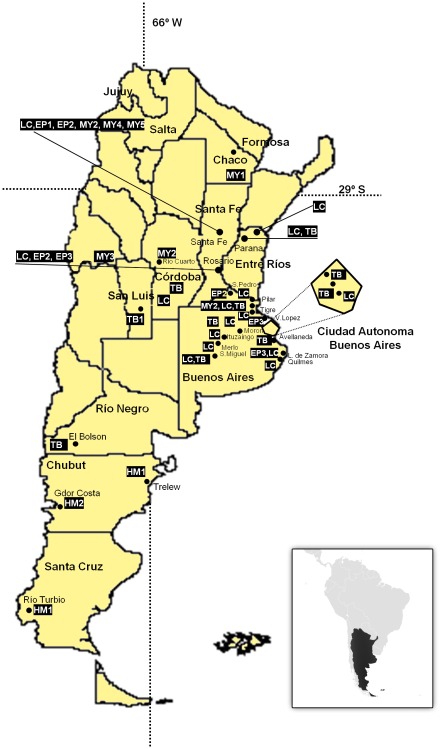
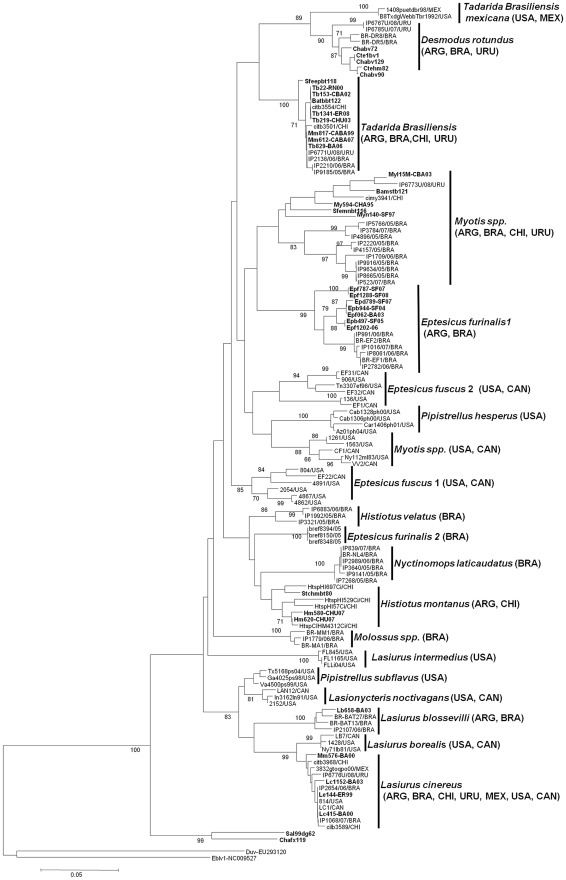
Results: Based on the analysis of bats received for RABV analysis by the National Rabies system of surveillance, the positivity rate of RABV in insectivorous bats ranged from 3.1 to 5.4%, depending on the geographic location. The findings were distributed among an extensive area of the Argentinean territory. The 99 strains of insectivorous bat-related sequences were divided into six distinct lineages associated with Tadarida brasiliensis, Myotis spp, Eptesicus spp, Histiotus montanus, Lasiurus blosseviilli and Lasiurus cinereus. Comparison with RABV sequences obtained from insectivorous bats of the Americas revealed co-circulation of similar genetic variants in several countries. Finally, inter-species transmission, mostly related with Lasiurus species, was demonstrated in 11.8% of the samples.
Conclusions: This study demonstrates the presence of several independent enzootics of rabies in insectivorous bats of Argentina. This information is relevant to identify potential areas at risk for human and animal infection.
Conflict of interest statement
The authors have declared that no competing interests exist.
Figures
References
-
- Delpietro HA, Russo RG. Ecological and epidemiologic aspects of the attacks by vampire bats and paralytic rabies in Argentina and analysis of the proposals carried out for their control. Rev Sci Tech. 1996;15:971–984. - PubMed
-
- Larghi OP, Delpietro H. Casos de rabia humana transmitida por murcielagos, Argentina. In: Cacchione RA, Durlach R, Larghi OP, editors. Tema de Zoonosis II. Buenos Aires: Asociacion Argentina de Zoonosis; 2004. pp. 135–138.
-
- De Serres G, Dallaire F, Cote M, Skowronski DM. Bat rabies in the United States and Canada from 1950 through 2007: human cases with and without bat contact. Clin Infect Dis. 2008;46:1329–1337. - PubMed
-
- Barquez RM, Mares M, Braun JK. 1999. The bats of Argentina; University MoTT, editor. Texas.
-
- Mena Segura C. Rabia. Ciudad de Buenos Aires: 1964–2007. 44 años de lucha, logros alcanzados y progresos. In: Cacchione RA, Durlach R, Martino P, editors. Temas de Zoonosis IV. Buenos Aires: Asociacion Argentina de Zoonosis; 2008. pp. 139–150.
Publication types
MeSH terms
Substances
Associated data
- Actions
- Actions
- Actions
- Actions
- Actions
- Actions
- Actions
- Actions
- Actions
- Actions
- Actions
- Actions
- Actions
- Actions
- Actions
- Actions
- Actions
- Actions
- Actions
- Actions
- Actions
- Actions
- Actions
- Actions
- Actions
- Actions
- Actions
- Actions
- Actions
- Actions
- Actions
- Actions
- Actions
- Actions
- Actions
- Actions
- Actions
- Actions
- Actions
- Actions
- Actions
- Actions
- Actions
- Actions
- Actions
- Actions
- Actions
- Actions
- Actions
- Actions
- Actions
- Actions
- Actions
- Actions
- Actions
- Actions
- Actions
- Actions
- Actions
- Actions
- Actions
- Actions
- Actions
- Actions
- Actions
- Actions
- Actions
- Actions
- Actions
- Actions
- Actions
- Actions
- Actions
- Actions
- Actions
- Actions
- Actions
- Actions
- Actions
- Actions
- Actions
- Actions
- Actions
- Actions
- Actions
- Actions
- Actions
- Actions
- Actions
- Actions
- Actions
- Actions
- Actions
- Actions
- Actions
- Actions
- Actions
- Actions
- Actions
LinkOut - more resources
Full Text Sources
Medical
Miscellaneous