


African American race, obesity, and blood product transfusion are risk factors for acute kidney injury in critically ill trauma patients
- PMID: 22591570
- PMCID: PMC3472045
- DOI: 10.1016/j.jcrc.2012.02.002
African American race, obesity, and blood product transfusion are risk factors for acute kidney injury in critically ill trauma patients
Abstract
Purpose: Acute kidney injury (AKI) is a common source of morbidity after trauma. We sought to determine novel risk factors for AKI, by Acute Kidney Injury Network (AKIN) criteria, in critically ill trauma patients.
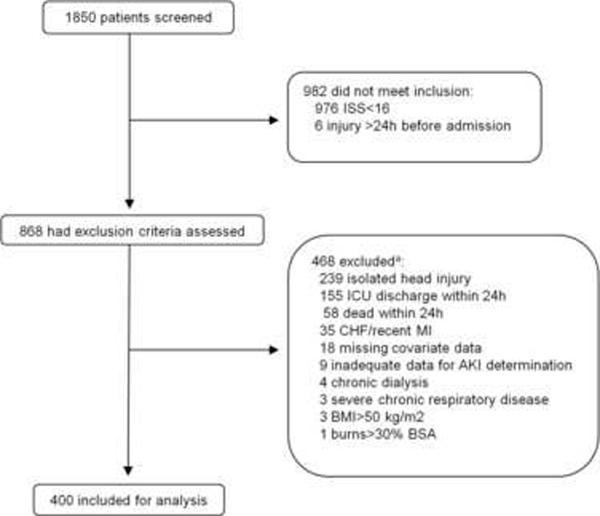
Materials and methods: A prospective cohort of 400 patients admitted to the intensive care unit of a level 1 trauma center was followed for the development of AKI over 5 days.
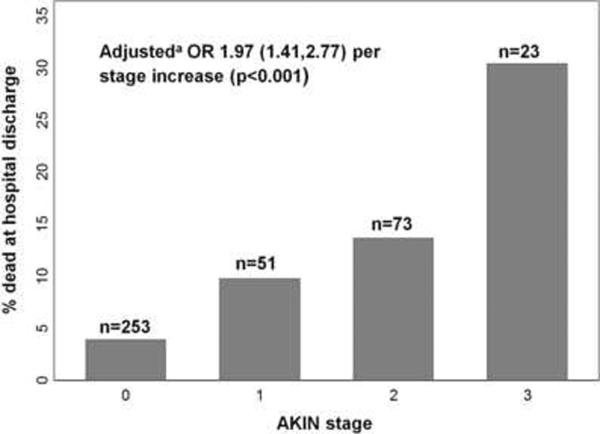
Results: Acute kidney injury developed in 147 (36.8%) of 400 patients. In multivariable regression analysis, independent risk factors for AKI included African American race (odds ratio [OR], 1.86; 95% confidence interval [CI], 1.08-3.18; P = .024), body mass index of 30 kg/m(2) or greater (OR, 4.72 versus normal body mass index; 95% CI, 2.59-8.61; P < .001), diabetes mellitus (OR, 3.26; 95% CI, 1.30-8.20; P = .012), abdominal Abbreviated Injury Scale score of 4 or more (OR, 3.78; 95% CI, 1.79-7.96; P < .001), and unmatched packed red blood cells administered during resuscitation (OR, 1.13 per unit; 95% CI, 1.04-1.23; P = .004). Acute Kidney Injury Network stages 1, 2, and 3 were associated with hospital mortality rates of 9.8%, 13.7%, and 30.4%, respectively, compared with 3.8% for those without AKI (P < .001).
Conclusions: Acute kidney injury in critically ill trauma patients is associated with substantial mortality. The findings of African American race, obesity, and blood product administration as independent risk factors for AKI deserve further study to elucidate underlying mechanisms.
Copyright © 2012 Elsevier Inc. All rights reserved.
Figures
References
-
- National Center for Injury Prevention and Control, CDC: 10 Leading Causes of Death by Age Group, United States -- 2007. http://www.cdc.gov/injury/wisqars/pdf/Death_by_Age_2007-a.pdf.
-
- Bagshaw SM, George C, Gibney RTN, et al. A multi-center evaluation of early acute kidney injury in critically ill trauma patients. Ren Fail. 2008;30:581–589. - PubMed
-
- Yuan F, Hou FF, Wu Q, et al. Natural history and impact on outcomes of acute kidney injury in patients with road traffic injury. Clin Nephrol. 2009;71:669–679. - PubMed
Publication types
MeSH terms
Grants and funding
LinkOut - more resources
Full Text Sources
Medical
