


The intravascular volume effect of Ringer's lactate is below 20%: a prospective study in humans
- PMID: 22591647
- PMCID: PMC3580629
- DOI: 10.1186/cc11344
The intravascular volume effect of Ringer's lactate is below 20%: a prospective study in humans
Abstract
Introduction: Isotonic crystalloids play a central role in perioperative fluid management. Isooncotic preparations of colloids (for example, human albumin or hydroxyethyl starch) remain nearly completely intravascular when infused to compensate for acute blood losses. Recent data were interpreted to indicate a comparable intravascular volume effect for crystalloids, challenging the occasionally suggested advantage of using colloids to treat hypovolemia. General physiological knowledge and clinical experience, however, suggest otherwise.
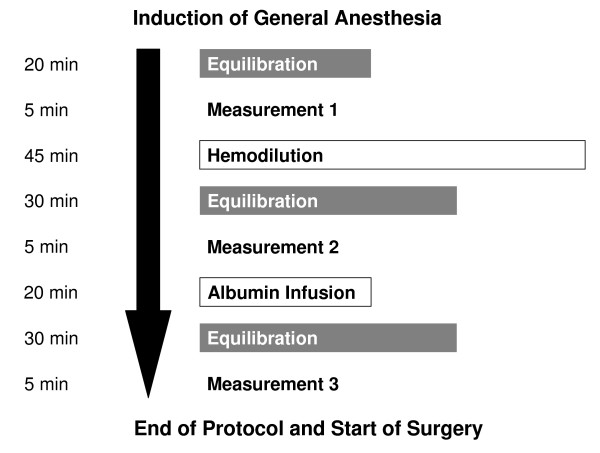
Methods: In a prospective study, double-tracer blood volume measurements were performed before and after intended normovolemic hemodilution in ten female adults, simultaneously substituting the three-fold amount of withdrawn blood with Ringer's lactate. Any originated deficits were substituted with half the volume of 20% human albumin, followed by a further assessment of blood volume. To assess significance between the measurements, repeated measures analysis of variance (ANOVA) according to Fisher were performed. If significant results were shown, paired t tests (according to Student) for the singular measurements were taken. P < 0.05 was considered to be significant.
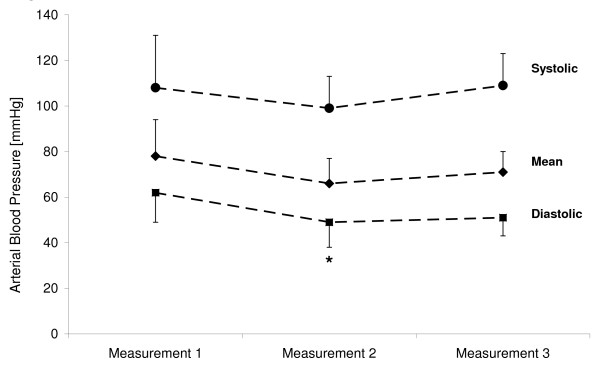
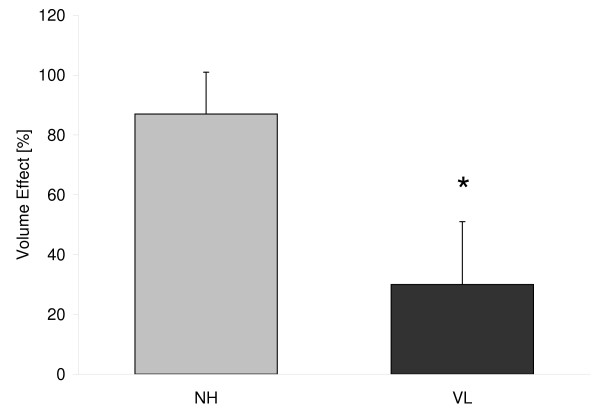
Results: A total of 1,097 ± 285 ml of whole blood were withdrawn (641 ± 155 ml/m(2) body surface area) and simultaneously replaced by 3,430 ± 806 ml of Ringer's lactate. All patients showed a significant decrease in blood volume after hemodilution (-459 ± 185 ml; P < 0.05) that did not involve relevant hemodynamical changes, and a significant increase in interstitial water content (+2,157 ± 606 ml; P < 0.05). The volume effect of Ringer's lactate was 17 ± 10%. The infusion of 245 ± 64 ml of 20% human albumin in this situation restored blood volume back to baseline values, the volume effect being 184 ± 63%.
Conclusions: Substitution of isolated intravascular deficits in cardiopulmonary healthy adults with the three-fold amount of Ringer's lactate impedes maintenance of intravascular normovolemia. The main side effect was an impressive interstitial fluid accumulation, which was partly restored by the intravenous infusion of 20% human albumin. We recommend to substitute the five-fold amount of crystalloids or to use an isooncotic preparation in the face of acute bleeding in patients where edema prevention might be advantageous.
Figures
References
-
- de Leeuw PW, Dees A. Fluid homeostasis in chronic obstructive lung disease. Eur Respir J Suppl. 2003;46:33s–40s. - PubMed
-
- Brunkhorst FM, Engel C, Bloos F, Meier-Hellmann A, Ragaller M, Weiler N, Moerer O, Gruendling M, Oppert M, Grond S, Olthoff D, Jaschinski U, John S, Rossaint R, Welte T, Schaefer M, Kern P, Kuhnt E, Kiehntopf M, Hartog C, Natanson C, Loeffler M, Reinhart K. German Competence Network Sepsis (SepNet) Intensive insulin therapy and pentastarch resuscitation in severe sepsis. N Engl J Med. 2008;358:125–139. doi: 10.1056/NEJMoa070716. - DOI - PubMed
Publication types
MeSH terms
Substances
LinkOut - more resources
Full Text Sources
Other Literature Sources
