


Treatment of ureteral and renal stones: a systematic review and meta-analysis of randomized, controlled trials
- PMID: 22591962
- PMCID: PMC3774029
- DOI: 10.1016/j.juro.2012.02.2569
Treatment of ureteral and renal stones: a systematic review and meta-analysis of randomized, controlled trials
Abstract
Purpose: We compared the clinical outcomes of patients with ureteral or renal stones treated with ureteroscopy, shock wave lithotripsy using HM3 (Dornier®) and nonHM3 lithotripters, and percutaneous nephrolithotomy.
Materials and methods: A systematic literature search identified 6, 4 and 3 randomized, controlled trials of treatment of distal and proximal ureteral stones, and renal stones, respectively, published between 1995 and 2010. Overall stone-free, re-treatment and complication rates were calculated by meta-analytical techniques.
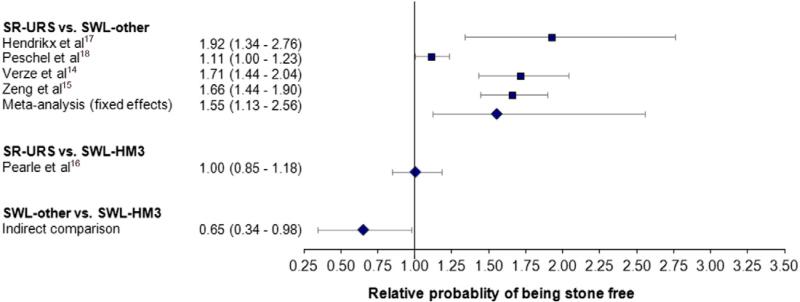
Results: Based on the randomized, controlled trials evaluated the treatment of distal ureteral stones with semirigid ureteroscopy showed a 55% greater probability (pooled RR 1.55, 95% CI 1.13-2.56) of stone-free status at the initial assessment than treatment with shock wave lithotripsy. Patients treated with semirigid ureteroscopy were also less likely to require re-treatment than those treated with shock wave lithotripsy (nonHM3) (RR 0.14, 95% CI 0.08-0.23). The risk of complications was no different between the 2 modalities. Only 2 of the 4 randomized, controlled trials identified for proximal ureteral stones evaluated flexible ureteroscopy and each focused specifically on the treatment of stones 1.5 cm or greater, limiting their clinical relevance. The degree of heterogeneity among the studies evaluating renal stones was so great that it precluded any meaningful comparison.
Conclusions: Semirigid ureteroscopy is more efficacious than shock wave lithotripsy for distal ureteral stones. To our knowledge there are no relevant randomized, controlled trials of flexible ureteroscopy treatment of proximal ureteral calculi of a size commonly noted in the clinical setting. Collectively the comparative effectiveness of ureteroscopy and shock wave lithotripsy for proximal ureteral and renal calculi is poorly characterized with no meaningful published studies.
Copyright © 2012 American Urological Association Education and Research, Inc. Published by Elsevier Inc. All rights reserved.
Figures
References
-
- Stamatelou KK, Francis ME, Jones CA, et al. Time trends in reported prevalence of kidney stones in the United States: 1976–1994. Kidney Int. 2003;63:1817. - PubMed
-
- Pearle MS, Calhoun EA, Curhan GC. Urologic Diseases in America project: urolithiasis. J Urol. 2005;173:848. - PubMed
-
- Matlaga BR. Contemporary surgical management of upper urinary tract calculi. 2007 guideline for the management of ureteral calculi. J Urol. 2009;1181:2152. - PubMed
-
- Nabi G, Downey P, Keeley F, et al. Extra-corporeal shock wave lithotripsy (ESWL) versus ureteroscopic management for ureteric calculi. Cochrane Database Syst Rev. 2007:CD006029. - PubMed
-
- Preminger GM, Tiselius HG, Assimos DG, et al. Guideline for the management of ureteral calculi. Eur Urol. 2007;2007;52:1610. - PubMed
Publication types
MeSH terms
Grants and funding
LinkOut - more resources
Full Text Sources
Other Literature Sources
