. 2012 May 17;3(5):e309.
doi: 10.1038/cddis.2012.43.

Inhibition of Bax protects neuronal cells from oligomeric Aβ neurotoxicity

Affiliations

Inhibition of Bax protects neuronal cells from oligomeric Aβ neurotoxicity

W Kudo et al. Cell Death Dis. .

Abstract

Although oligomeric β-amyloid (Aβ) has been suggested to have an important role in Alzheimer disease (AD), the mechanism(s) of how Aβ induces neuronal cell death has not been fully identified. The balance of pro- and anti-apoptotic Bcl-2 family proteins (e.g., Bcl-2 and Bcl-w versus Bad, Bim and Bax) has been known to have a role in neuronal cell death and, importantly, expression levels of these proteins are reportedly altered in the vulnerable neurons in AD. However, the roles of apoptotic proteins in oligomeric Aβ-induced cell death remain unclear in vivo or in more physiologically relevant models. In addition, no study to date has examined whether Bax is required for the toxicity of oligomeric Aβ. Here, we found that treatment with oligomeric Aβ increased Bim levels but decreased Bcl-2 levels, leading to the activation of Bax and neuronal cell death in hippocampal slice culture and in vivo. Furthermore, the inhibition of Bax activity either by Bax-inhibiting peptide or bax gene knockout significantly prevented oligomeric Aβ-induced neuronal cell death. These findings are first to demonstrate that Bax has an essential role in oligomeric Aβ-induced neuronal cell death, and that the targeting of Bax may be a therapeutic approach for AD.


Figures

Figure 1
Figure 1
Physicochemical and morphological features of the synthetic Aβ1–42. (a) Electron micrograph shows the typical pattern of oligomer formation of Aβ. The arrows indicate oligomers in the lower panel. Scale bar, 100 nm. (b) Synthetic Aβ1–42 was subjected to SDS-polyacrylamide gel and detected by western blotting with 6E10 antibody. Molecular weight markers in kDa are at left
Figure 2
Figure 2
Oligomeric Aβ differentially regulates Bim, Bcl-2 and Bax in the hippocampal slice culture. (a) Representative western blots showed oligomeric Aβ induced upregulation of Bim and downregulation of Bcl-2 in a time-dependent manner. Bax levels were not changed by oligomeric Aβ treatment. Actin was used as internal loading control. The values of each band were normalized to that of actin and shown as a relative value of each group compared with the non-treatment slices. The indicated comparisons are significant at *P<0.05, n=4. (b) Immunocytochemistry analysis demonstrated the increased number of positive cells stained with 6A7 antibody, which specifically detect the active form of Bax, 24 h after oligomeric Aβ treatment in hippocampal slice cultures. Conversely, control peptide (Aβ42–1) did not induce the active form of Bax (green: 6A7, blue: DAPI). Scale bar, 100 μm
Figure 3
Figure 3
bax−/− neurons are resistant to oligomeric Aβ neurotoxicity. (a) DNA was extracted from bax+/+ and bax−/− mice, and each genotype was identified by PCR with the primer sets specifically detecting each genotype as described in the previous study. bax+/+ yields a 304-bp PCR product and bax−/− yields a 507-bp PCR product. (b) Total protein (20 μg) from whole brain was analyzed by immunoblot with anti-Bax antibody. Immunoblot analysis showed Bax in bax+/+ mouse samples at the expected molecular weight of 21 kDa, and no expression of Bax in bax−/− samples. (c) Hippocampal slice culture were treated with oligomeric Aβ (500 nM) in the presence of PI (red) for 48 h. Representative data showed oligomeric Aβ-induced PI uptake was significantly reduced in the slice cultures from bax−/− mice compared with bax+/+ mice. The PI uptake was quantitatively analyzed (n=5). Control Aβ42–1 peptide had no effect on PI uptake. Scale bar, 500 μm. *P<0.05, **P<0.01. (d) Neuronal cell loss by oligomeric Aβ (arrows) was significantly reduced in the hippocampal slice cultures from bax−/− mice. Scale bar, 500 μm
Figure 4
Figure 4
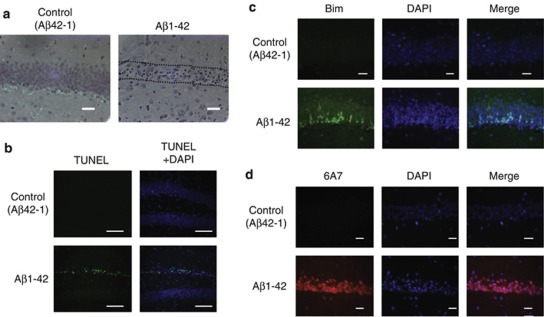
Intrahippocampal injection of oligomeric Aβ upregulates Bim and activates Bax. C57BL/6J mice were killed and the levels of Bim and active Bax were analyzed at 10 or 20 days after oligomeric Aβ injection. (a) At 20 days after oligomeric Aβ injection, neuronal cell loss in hippocampus was evident in Aβ injected mice in H&E staining, but not in control peptide-injected mice. The region of neuronal cell loss is indicated by dotted lines. Scale bar, 100 μm. (b) The number of TUNEL-positive cells in hippocampus was dramatically increased after oligomeric Aβ injection whereas virtually no TUNEL-positive cell (green) was detected in control peptide-injected hippocampus tissues. Blue: DAPI. Scale bar, 200 μm. (c) Immunoreactivity for Bim (green) was increased in hippocampus at 10 days after the oligomeric Aβ injection. Scale bar, 100 μm. (d) The number of active Bax-positive cells detected by 6A7 antibody (red) was dramatically increased at 10 days after the oligomeric Aβ injection. Scale bar, 100 μm compared with control peptide-injected mice
Figure 5
Figure 5
Bax-inhibiting peptide (BIP) suppresses neuronal cell death induced by oligomeric Aβ. Either BIP (VPTLK) or control peptide (KLPVT) was added to hippocampal slice cultures at the same time with oligomeric Aβ to examine its neuroprotective effect. (a) Cell permeability of both peptides was confirmed by green fluorescence in hippocampal slice cultures. Strong green fluorescence of both BIP- and negative-control peptide was found at 24 h after the peptide treatment, indicating both peptides are penetrated to neurons. (b) The intensity of PI in slices treated with oligomeric Aβ for 48 h was quantified as a marker of cell death. BIP significantly prevented oligomeric Aβ-induced PI uptake (n=5). Scale bar, 500 μm. *P<0.01 versus control #P<0.05 versus Aβ only (−). Aβ42–1 peptide was used as a control. (c) Nissl staining demonstrated that the treatment of BIP significantly prevented neuronal cell loss induced by oligomeric Aβ. Arrows indicate the region of neuronal cell loss. (d) BIP suppressed the activation of caspase-3 (cleaved caspase-3) induced by oligomeric Aβ (n=4). *P<0.01 versus control, #P<0.05 versus Aβ only (−)
Figure 6
Figure 6
BIP prevents the conformational change of Bax induced by oligomeric Aβ. BIP (VPTLK) was treated to hippocampal slice cultures with oligomeric Aβ for 48 h. Aβ42–1 was used as a control. The slices were stained with 6A7 antibody for detecting active conformational change of Bax. In the BIP-treated slices, the number and intensity of 6A7-positive signal (green) was significantly decreased compared with the slices treated with Aβ only. Scale bar, 100 μm

References

    1. Lambert MP, Barlow AK, Chromy BA, Edwards C, Freed R, Liosatos M, et al. Diffusible, nonfibrillar ligands derived from Abeta1-42 are potent central nervous system neurotoxins. Proc Natl Acad Sci USA. 1998;95:6448–6453. - PMC - PubMed
    1. Kudo W, Lee HP, Zou WQ, Wang X, Perry G, Zhu X, et al. Cellular prion protein is essential for oligomeric amyloid-beta-induced neuronal cell death. Hum Mol Genet. 2012;21:1138–1144. - PMC - PubMed
    1. De Felice FG, Velasco PT, Lambert MP, Viola K, Fernandez SJ, Ferreira ST, et al. Abeta oligomers induce neuronal oxidative stress through an N-methyl-D-aspartate receptor-dependent mechanism that is blocked by the Alzheimer drug memantine. J Biol Chem. 2007;282:11590–11601. - PubMed
    1. Kitamura Y, Shimohama S, Kamoshima W, Ota T, Matsuoka Y, Nomura Y, et al. Alteration of proteins regulating apoptosis, Bcl-2, Bcl-x, Bax, Bak, Bad, ICH-1 and CPP32, in Alzheimer's disease. Brain Res. 1998;780:260–269. - PubMed
    1. Davies AM. The Bcl-2 family of proteins, and the regulation of neuronal survival. Trends Neurosci. 1995;18:355–358. - PubMed

Publication types

MeSH terms