


Subthalamic deep brain stimulation at individualized frequencies for Parkinson disease
- PMID: 22592373
- PMCID: PMC3369506
- DOI: 10.1212/WNL.0b013e318259e183
Subthalamic deep brain stimulation at individualized frequencies for Parkinson disease
Abstract
Objectives: The oscillation model of Parkinson disease (PD) states that, in the subthalamic nucleus (STN), increased θ (4-10 Hz) and β (11-30 Hz) frequencies were associated with worsening whereas γ frequencies (31-100 Hz) were associated with improvement of motor symptoms. However, the peak STN frequency in each band varied widely from subject to subject. We hypothesized that STN deep brain stimulation (DBS) at individualized γ frequencies would improve whereas θ or β frequencies would worsen PD motor signs.
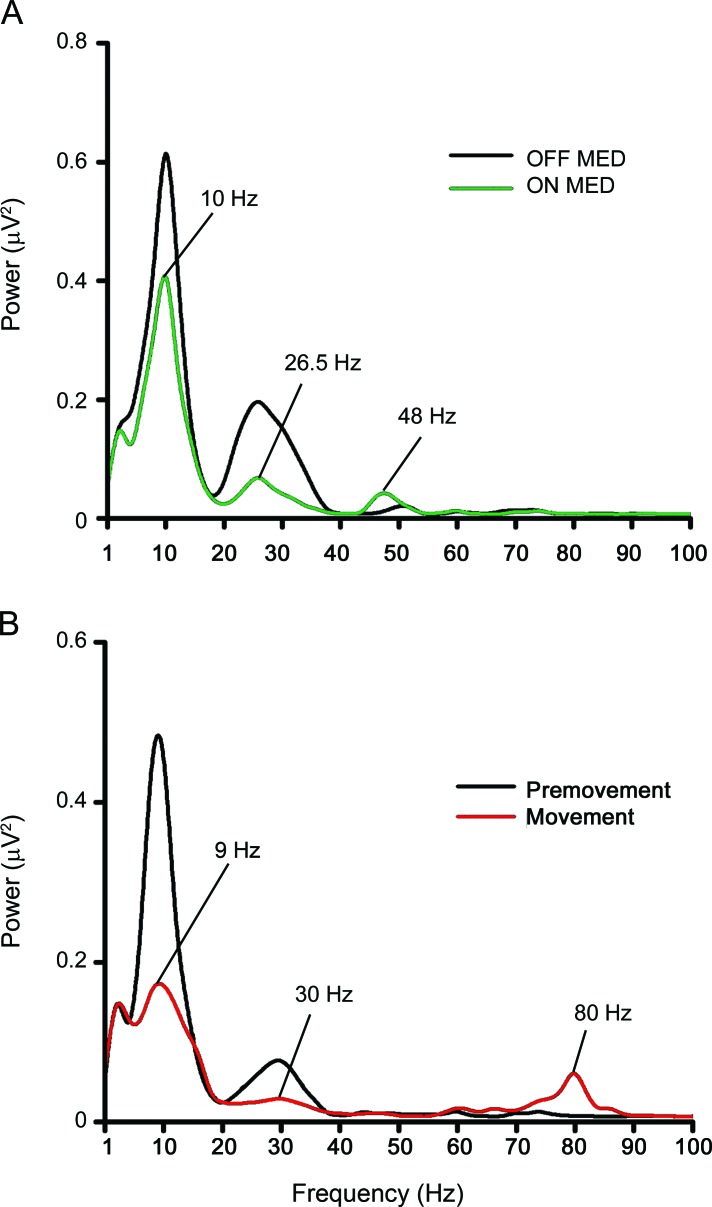
Methods: We prospectively studied 13 patients with PD. STN local field potential (LFP) was recorded after electrode implantations, in the OFF and then in ON dopaminergic medication states while patients performed wrist movements. Six individual peak frequencies of the STN LFP power spectra were obtained: the greatest decrease in θ and β and greatest increase in γ frequencies in the ON state (MED) and during movements (MOVE). Eight DBS frequencies were applied including 6 MED and MOVE frequencies, high frequency (HF) used for chronic stimulation, and no stimulation. The patients were assessed using the motor Unified Parkinson's Disease Rating Scale (mUPDRS).
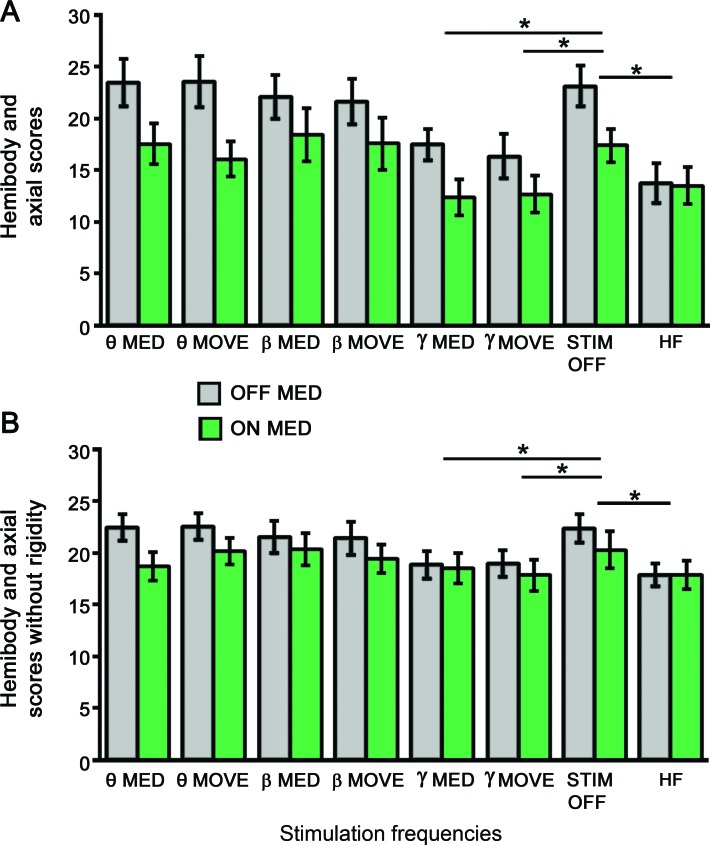
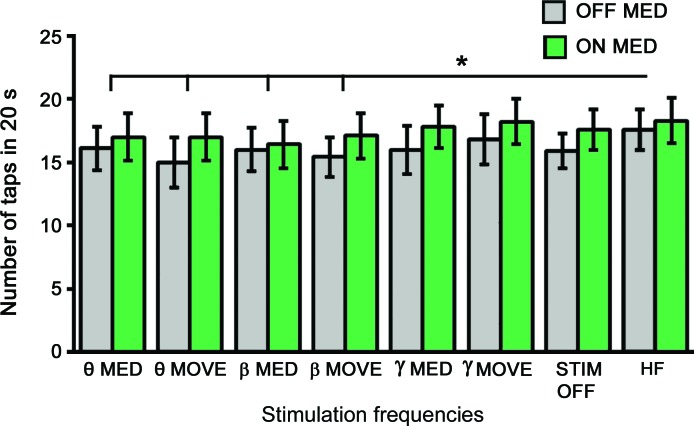
Results: STN DBS at γ frequencies (MED and MOVE) and HF significantly improved mUPDRS scores compared to no stimulation and both γ frequencies were not different from HF. DBS at θ and β frequencies did not worsen mUPDRS scores compared to no stimulation.
Conclusion: Short-term administration of STN DBS at peak dopamine-dependent or movement-related γ frequencies were as effective as HF for reducing parkinsonian motor signs but DBS at θ and β frequencies did not worsen PD motor signs.
Classification of evidence: This study provides Class III evidence that STN DBS at patient-specific γ frequencies and at usual high frequencies both improved mUPDRS scores compared to no stimulation and did not differ in effect.
Figures
Comment in
-
Personalized medicine in deep brain stimulation through utilization of neural oscillations.Neurology. 2012 Jun 12;78(24):1900-1. doi: 10.1212/WNL.0b013e318259e2af. Epub 2012 May 16. Neurology. 2012. PMID: 22592364 No abstract available.
-
Subthalamic deep brain stimulation at individualized frequencies for Parkinson disease.Neurology. 2012 Oct 30;79(18):1934. doi: 10.1212/WNL.0b013e31827543f6. Neurology. 2012. PMID: 23109655 No abstract available.
References
-
- Benabid AL, Chabardes S, Mitrofanis J, Pollak P. Deep brain stimulation of the subthalamic nucleus for the treatment of Parkinson's disease. Lancet Neurol 2009; 8: 67– 81 - PubMed
-
- Hammond C, Bergman H, Brown P. Pathological synchronization in Parkinson's disease: networks, models and treatments. Trends Neurosci 2007; 30: 357– 364 - PubMed
-
- Brown P. Oscillatory nature of human basal ganglia activity: relationship to the pathophysiology of Parkinson's disease. Mov Disord 2003; 18: 357– 363 - PubMed
-
- Reck C, Florin E, Wojtecki L, et al. Characterisation of tremor-associated local field potentials in the subthalamic nucleus in Parkinson's disease. Eur J Neurosci 2009; 29: 599– 612 - PubMed
-
- Levy R, Ashby P, Hutchison WD, Lang AE, Lozano AM, Dostrovsky JO. Dependence of subthalamic nucleus oscillations on movement and dopamine in Parkinson's disease. Brain 2002; 125: 1196– 1209 - PubMed
Publication types
MeSH terms
Substances
Grants and funding
LinkOut - more resources
Full Text Sources
Other Literature Sources
Medical
Research Materials
Miscellaneous
