Review
. 2012 Aug;14(4):349-57.
doi: 10.1007/s11926-012-0259-1.

Altered bone biology in psoriatic arthritis

Affiliations
Review

Altered bone biology in psoriatic arthritis

Homaira Rahimi et al. Curr Rheumatol Rep. 2012 Aug.

Abstract

Psoriatic arthritis (PsA) is characterized by focal bone erosions mediated by osteoclasts at the bone-pannus junction. The bulk of research over the past decade has centered on mechanisms that underlie osteoclastogenesis along with new insights into osteoimmunology; however, recent advances that focus on steps that lead to new bone formation are beginning to emerge. New revelations about bone formation may have direct relevance to PsA given the presence of enthesophytes, syndesmophytes, and bony ankylosis frequently observed in patients with this disorder. In this review, we discuss current developments in the pathogenesis of new bone formation, novel imaging approaches to study bone remodeling and highlight innovative approaches to study the effect of inflammation on bone. Lastly, we discuss promising therapies that target joint inflammation and osteitis with the potential to mediate pathologic bone formation.


Figures
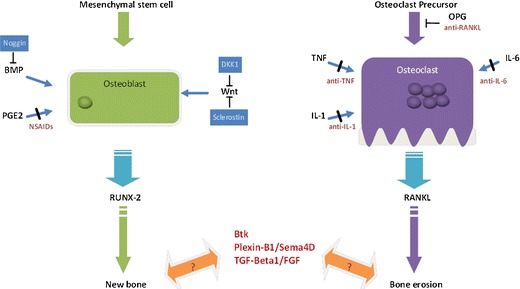
Fig. 1
Fig. 1
Dual Aspects of Altered Bone Remodeling in Psoriatic Arthritis. In the presence of certain differentiation signals, mesenchymal stem cells are induced to become osteoblasts, bone forming cells. Osteoblasts are then stimulated by via pathways including BMP, PGE2 and Wnt signaling. This leads to activation of the master transcription factor RUNX-2 and subsequent new bone formation. The natural antagonist of BMP is Noggin and of the Wnt pathway is DKK1 and Sclerostin; antibodies to these molecules are currently in development to promote bone formation. In bone resorption, osteoclasts derived from precursors receive signaling from inflammatory molecules such as TNF, IL-1, and IL-6. This activates the master regulator RANKL and subsequent bone erosion. A natural inhibitor of osteoclast formation is osteoprotegrin (OPG). Several therapeutic agents (dark red) are used to block steps in these pathways. Additionally, new molecules and pathways such as Btk, Plexin-B1/Sema4D, and TFG-Beta1 are being studied as their specific roles in bone remodeling have yet to be clarified.

References

    1. Takayanagi H. Osteoimmunology and the effects of the immune system on bone. Nat Rev Rheumatol. 2009;5(12):667–676. doi: 10.1038/nrrheum.2009.217. - DOI - PubMed
    1. Day MS, Nam D, Goodman S, Su EP, Figgie M. Psoriatic arthritis. J Am Acad Orthop Surg. 2012;20(1):28–37. doi: 10.5435/JAAOS-20-01-028. - DOI - PubMed
    1. Healy PJ, Helliwell PS. Measuring clinical enthesitis in psoriatic arthritis: assessment of existing measures and development of an instrument specific to psoriatic arthritis. Arthritis Rheum. 2008;59(5):686–691. doi: 10.1002/art.23568. - DOI - PubMed
    1. Finzel S, Englbrecht M, Engelke K, Stach C, Schett G. A comparative study of periarticular bone lesions in rheumatoid arthritis and psoriatic arthritis. Ann Rheum Dis. 2011;70(1):122–127. doi: 10.1136/ard.2010.132423. - DOI - PubMed
    1. Walsh MC, Kim N, Kadono Y, Rho J, Lee SY, Lorenzo J, et al. Osteoimmunology: interplay between the immune system and bone metabolism. Annu Rev Immunol. 2006;24:33–63. doi: 10.1146/annurev.immunol.24.021605.090646. - DOI - PubMed

MeSH terms

Substances
