


Locked nailing for the treatment of displaced articular fractures of the calcaneus: description of a new procedure with calcanail(®)
- PMID: 22593729
- PMCID: PMC3332337
- DOI: 10.1007/s00590-012-0968-1
Locked nailing for the treatment of displaced articular fractures of the calcaneus: description of a new procedure with calcanail(®)
Abstract
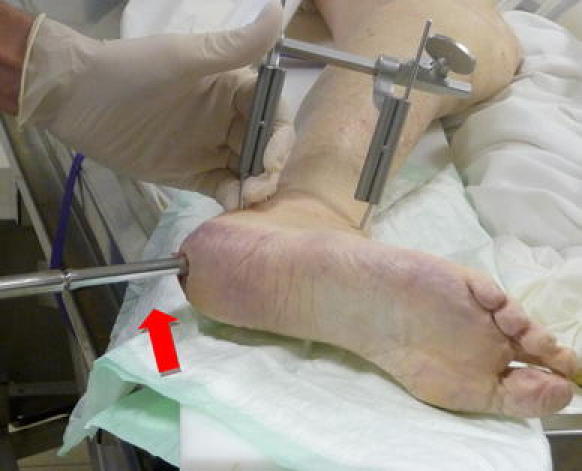
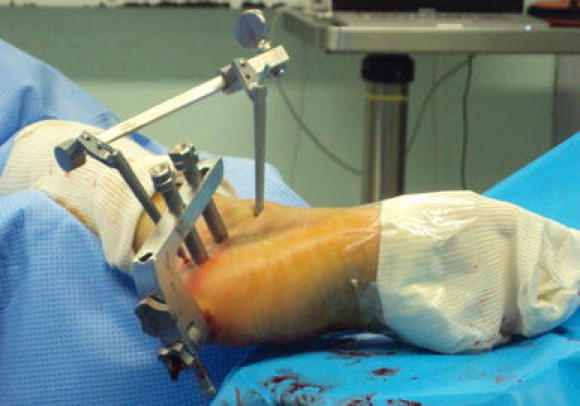
Although open reduction and internal fixation is considered the best method for treating displaced articular fractures of the calcaneus, lateral approach is at high risk for wound healing complications. For this reason, the authors developed a posterior approach and a new implant to perform both intrafocal reduction and internal fixation. The aim of this technical note is to describe this method of treatment for displaced articular fractures of the calcaneus, which offered the following advantages: (a) the creation of a working channel that provides also a significant bone autograft, (b) the intrafocal reduction of the displaced articular surface, (c) the insertion of a locking nail that maintains the reduced articular surface at the right height, (d) the possibility to switch from an ORIF to a reconstruction arthrodesis with the same approach and instrumentation in case of severely damaged posterior facet.
Figures




References
-
- Simon P, Babin SR. Fractures thalamiques du calcanéum de l’adulte en pratique civile. Etude statistique des résultats. Rev Chir Orthop. 1989;75(supp I):108–112.
-
- Thodarson DB, Krieger LE. Operative vs. Nonoperative treatment of intra-articular fractures of the calcaneus: a prospective randomized trial. Foot Ankle Int. 1996;17:1–9. - PubMed
-
- Utheza G, Flurin PH, Colombier JA. Les fractures thalamiques du calcaneum: description et anatomopathologie. Apport de la tomodensitométrie. Rev Chir Orthop. 1993;79:47–57. - PubMed
-
- Abidi NA, Dhawan S, Gruen GS, et al. Wound-healing risk factors after open reduction and internal fixation of calcaneal fractures. Foot Ankle Int. 1998;19:856–861. - PubMed
-
- Howard JL, Buckley R, Mc Cormack R, Pate G, Leighton R, Petrie D, Galpin R. Complications following management of displaced intra-articular calcaneal fractures: a prospective randomized trial comparing open reduction internal fixation with non operative management. J Orthop Trauma. 2003;17:241–249. doi: 10.1097/00005131-200304000-00001. - DOI - PubMed
LinkOut - more resources
Full Text Sources