Review
. 2012 May;7(3):409-19.
doi: 10.2217/rme.12.12.

Tissue-engineered vascular grafts for use in the treatment of congenital heart disease: from the bench to the clinic and back again

Affiliations
Review

Tissue-engineered vascular grafts for use in the treatment of congenital heart disease: from the bench to the clinic and back again

Joseph T Patterson et al. Regen Med. 2012 May.

Abstract

Since the first tissue-engineered vascular graft (TEVG) was implanted in a child over a decade ago, growth in the field of vascular tissue engineering has been driven by clinical demand for improved vascular prostheses with performance and durability similar to an autologous blood vessel. Great strides were made in pediatric congenital heart surgery using the classical tissue engineering paradigm, and cell seeding of scaffolds in vitro remained the cornerstone of neotissue formation. Our second-generation bone marrow cell-seeded TEVG diverged from tissue engineering dogma with a design that induces the recipient to regenerate vascular tissue in situ. New insights suggest that neovessel development is guided by cell signals derived from both seeded cells and host inflammatory cells that infiltrate the graft. The identification of these signals and the regulatory interactions that influence cell migration, phenotype and extracellular matrix deposition during TEVG remodeling are yielding a next-generation TEVG engineered to guide neotissue regeneration without the use of seeded cells. These developments represent steady progress towards our goal of an off-the-shelf tissue-engineered vascular conduit for pediatric congenital heart surgery.


Figures
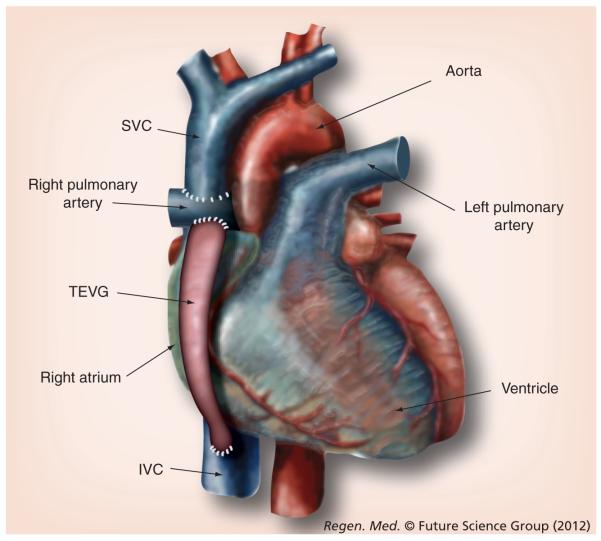
Figure 1
Figure 1. Tissue-engineered vascular graft as an extracardiac total cavopulmonary connection in the modified Fontan operation
In the treatment of single ventricle physiology, the two-stage modified Fontan diverges from the classic Glenn operation by isolating the right atrium from venous return. Venous blood is passively delivered to the right pulmonary artery. In the first stage of the operaton, the SVC is anastomed to the right pulmonary artery. After the second stage, a vascular conduit such as a TEVG connects the IVC to the right pulmonary artery. IVC: Inferior vena cava; SVC: Superior vena cava; TEVG: Tissue-engineered vascular graft.
Figure 2
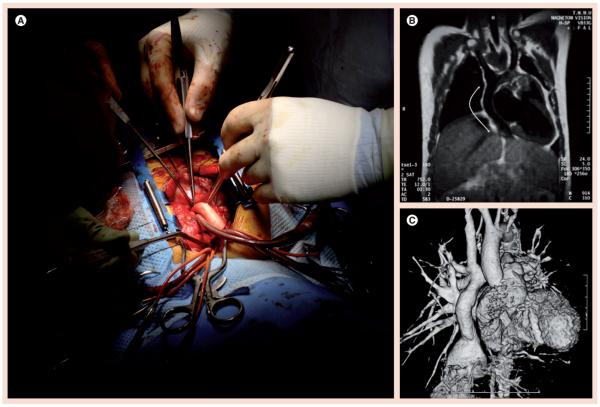
Figure 2. Modified Fontan operation with tissue-engineered vascular graft as an extracardiac total cavopulmonary connection graft in pediatric patients with congenital heart defects
(A) The tissue-engineered vascular graft was seeded with bone marrow-derived mononuclear cells harvested from the patient at the start of the operation. (B) MRI 9 months after implantation showing patent tissue-engineered vascular graft (arrows). (C) Computed tomography angiogram of the graft shown in (B) 1 year after implantation. (B & C) Reproduced with permission from [30].
Figure 3
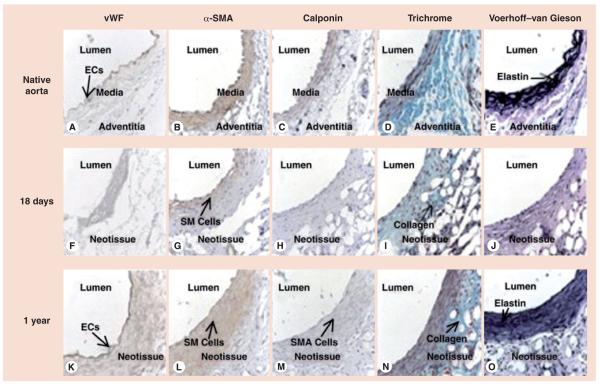
Figure 3. Natural history of tissue-engineered vascular graft remodeling by histologic evaluation of the native mouse aorta and tissue-engineered vascular graft at 18 days and 1 year postimplantation
Native mouse aorta stained with (A) vWF, (B) α-SMA, (C) calponin, (D) Gomori one-step trichrome and (E) Voerhoff–van Gieson. Graft at 18 days postimplantation stained with (F) vWF, (G) α-SMA, (H) calponin, (I) Gomori one-step trichrome and (J) Voerhoff–van Gieson shows formation of luminal endothelial and mural SM cell layers. Graft at 1 year postimplantation stained with (K) vWF, (L) α-SMA, (M) calponin, (N) Gomori one-step trichrome and (O) Voerhoff–van Gieson shows organized trilayer architecture of native aorta (A–E). Original magnification: ×400. EC: Endothelial cell; SM: Smooth muscle; SMA: Smooth muscle actin; vWF: von Willebrand factor. Reproduced with permission from [42].
Figure 4
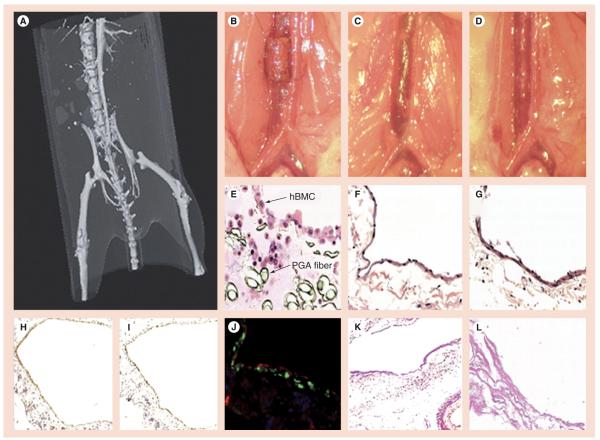
Figure 4. Human tissue-engineered vascular grafts constructed from human bone marrow cell-seeded scaffolds transform into living blood vessels in SCID/bg mice
(A) Micro-computed tomography angiography at week 10 shows a patent tissue-engineered vascular graft (TEVG) functioning as an inferior vena cava (IVC) venous conduit. Gross images of a human TEVG interposed into the IVC of the SCID/bg mouse (B) at operative day 0 and (C) after 24 weeks in vivo. (D) Gross image of native mouse IVC for comparison. Corresponding hematoxylin and eosin images of (E) a TEVG at day 0 (demonstrating hBMCs transplanted into the scaffold wall), (F) a TEVG at 24 week (notice that scaffold has degraded) and (G) native mouse IVC. Low-magnification (×100) photomicrographs of a TEVG at 10 weeks postimplantation show scaffold materials still present, but also the development of a confluent smooth muscle cell (α-smooth muscle actin, brown) layer (H) and endothelial cell (von Willebrand factor, brown) lining (I) throughout the inner lumen. By 24 weeks, the scaffold material has degraded and the TEVG displays mature vessel architecture. (J) High-magnification (×400) photomicrograph demonstrates an organized endothelial cell-lined intima (von Willebrand factor, red) and smooth muscle cell media (α-smooth muscle actin, green). (K) Low-magnification (×100) Verhoeff–van Gieson stain shows scaffold replaced by a supportive adventitial layer composed of collagen (pink). (L) High-magnification (×400) Verhoeff–van Gieson stain demonstrates collagen fibrils but no elastin fibers (elastin, black; collagen, pink). hBMC: Human bone marrow mononuclear cell; PGA: Polyglycolic acid. Reproduced with permission from [46].

References

    1. Connelly M, Webb G, Somerville J, et al. Canadian consensus conference on adult congenital heart disease 1996. Can. J. Cardiol. 1998;14(3):395–452. - PubMed
    1. Webb CL, Jenkins KJ, Karpawich PP, et al. Collaborative care for adults with congenital heart disease. Circulation. 2002;105(19):2318–2323. - PubMed
    1. Hager A, Kaemmerer H, Eicken A, Fratz S, Hess J. Long-term survival of patients with univentricular heart not treated surgically. J. Thorac. Cardiovasc. Surg. 2002;123(6):1214–1217. - PubMed
    1. Samánek M. Children with congenital heart disease: probability of natural survival. Pediatr. Cardiol. 1992;13(3):152–158. - PubMed
    1. Fontan F, Baudet E. Surgical repair of tricuspid atresia. Thorax. 1971;26(3):240–248. - PMC - PubMed

Websites

    1. The Children’s Heart Foundation fact sheets. http://childrensheartfoundation.org.
    1. Breuer C. NCT01034007: a pilot study investigating the clinical use of tissue engineered vascular grafts in congenital heart surgery. http://clinicaltrials.gov/ct2/show/NCT01034007.

Publication types