. 2012 Jun 13;134(23):9812-9.
doi: 10.1021/ja303580b. Epub 2012 May 31.

Atomic ensemble and electronic effects in Ag-rich AgPd nanoalloy catalysts for oxygen reduction in alkaline media

Affiliations

Atomic ensemble and electronic effects in Ag-rich AgPd nanoalloy catalysts for oxygen reduction in alkaline media

Daniel A Slanac et al. J Am Chem Soc. .

Abstract

The ability to design and characterize uniform, bimetallic alloy nanoparticles, where the less active metal enhances the activity of the more active metal, would be of broad interest in catalysis. Herein, we demonstrate that simultaneous reduction of Ag and Pd precursors provides uniform, Ag-rich AgPd alloy nanoparticles (~5 nm) with high activities for the oxygen reduction reaction (ORR) in alkaline media. The particles are crystalline and uniformly alloyed, as shown by X-ray diffraction and probe corrected scanning transmission electron microscopy. The ORR mass activity per total metal was 60% higher for the AgPd(2) alloy relative to pure Pd. The mass activities were 2.7 and 3.2 times higher for Ag(9)Pd (340 mA/mg(metal)) and Ag(4)Pd (598 mA/mg(metal)), respectively, than those expected for a linear combination of mass activities of Ag (60 mA/mg(Ag)) and Pd (799 mA/mg(Pd)) particles, based on rotating disk voltammetry. Moreover, these synergy factors reached 5-fold on a Pd mass basis. For silver-rich alloys (Ag(≥4)Pd), the particle surface is shown to contain single Pd atoms surrounded by Ag from cyclic voltammetry and CO stripping measurements. This morphology is favorable for the high activity through a combination of modified electronic structure, as shown by XPS, and ensemble effects, which facilitate the steps of oxygen bond breaking and desorption for the ORR. This concept of tuning the heteroatomic interactions on the surface of small nanoparticles with low concentrations of precious metals for high synergy in catalytic activity may be expected to be applicable to a wide variety of nanoalloys.


Conflict of interest statement

The authors declare no competing financial interest.

Figures
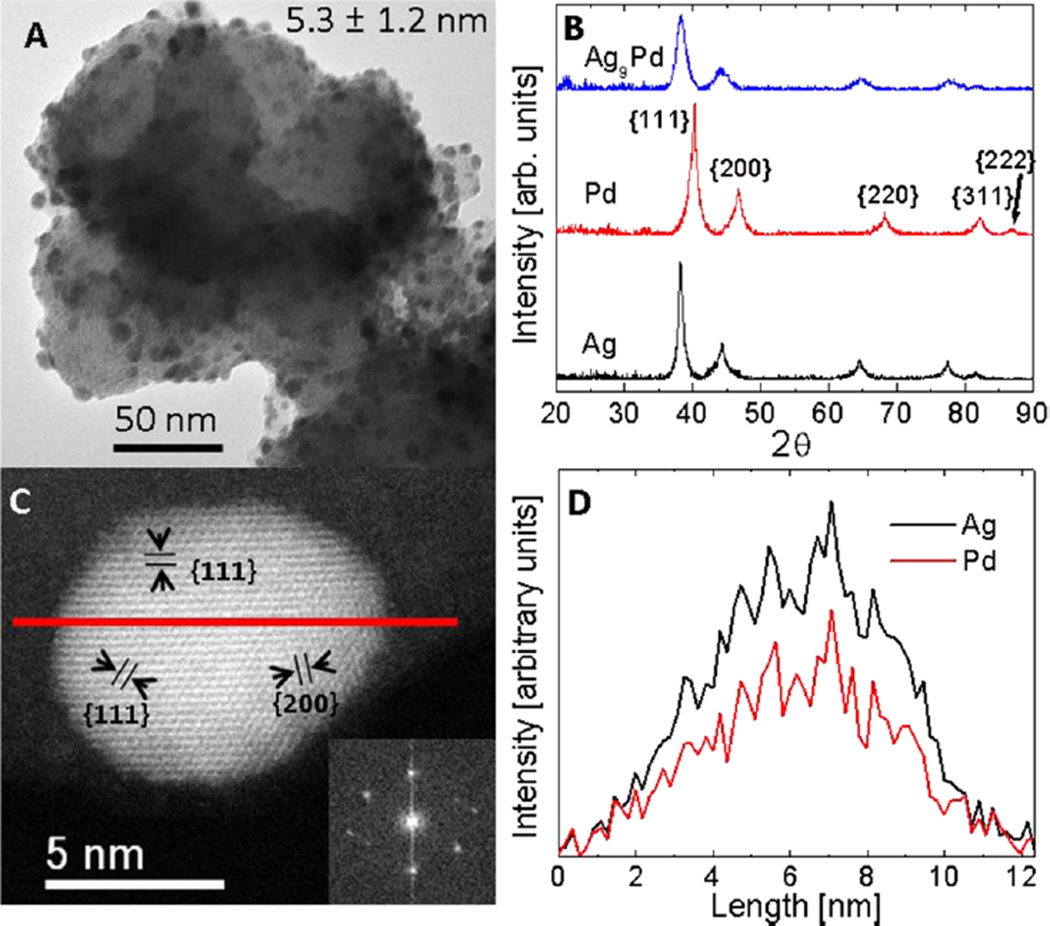
Figure 1
Figure 1
Ag9Pd nanoparticles supported on Vulcan XC72 carbon after calcination at 350 °C in N2 as shown by (A) TEM and (B) XRD. The TEM shows that the particles are uniformly distributed over VC with an average particle size of 5.3 ± 1.2 nm. The peak for {111} is located between both pure Pd and Ag due to the alloying with 10 mol % Pd (as confirmed by Vegard’s law). The lack of additional peak shoulders suggests that the particles are composed of a single alloy phase, Ag9Pd. The uniform composition is confirmed by the STEM EDS line scan (C,D). Furthermore, the particles are shown to be composed primarily of {111} facets (C, inset), along with twinning for the {111}.
Figure 2
Figure 2
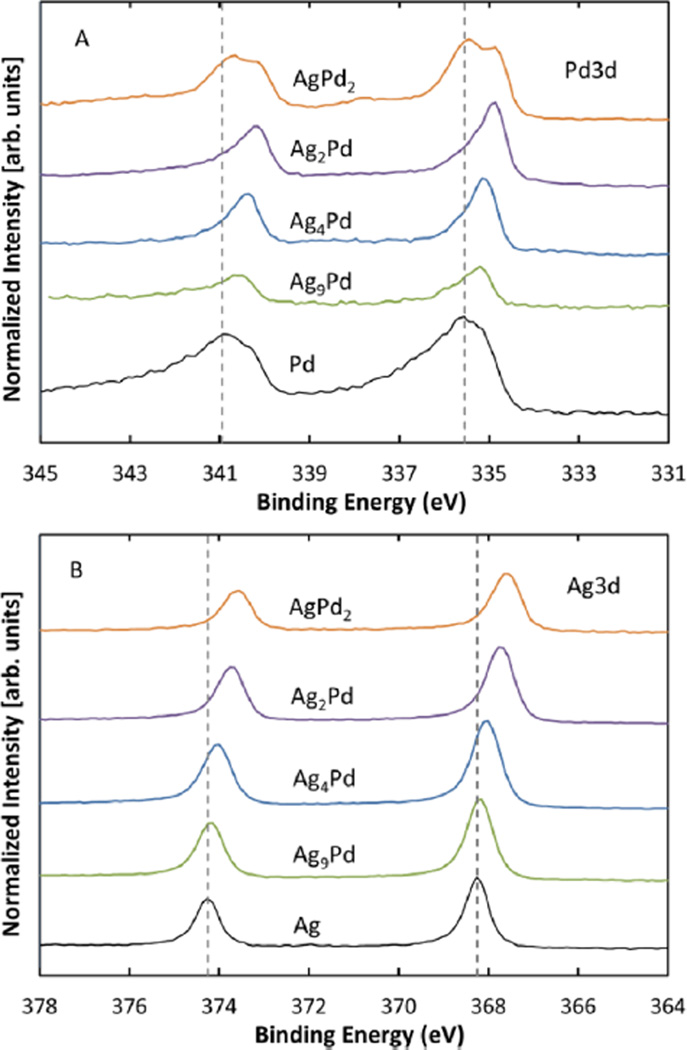
XPS spectra for the (A) Pd3d and (B) Ag3d regions for all Pd:Ag alloy ratios as well as the pure metals. The Pd peaks are shifted negatively for all alloy ratios, as the Pd atoms always have a significant number of Ag atoms with which to interact. However, the Ag peaks only show a shift when the alloy ratio is Ag≤4Pd, when there are enough Pd atoms in the particles to sufficiently disturb the Ag–Ag interactions.
Figure 3
Figure 3
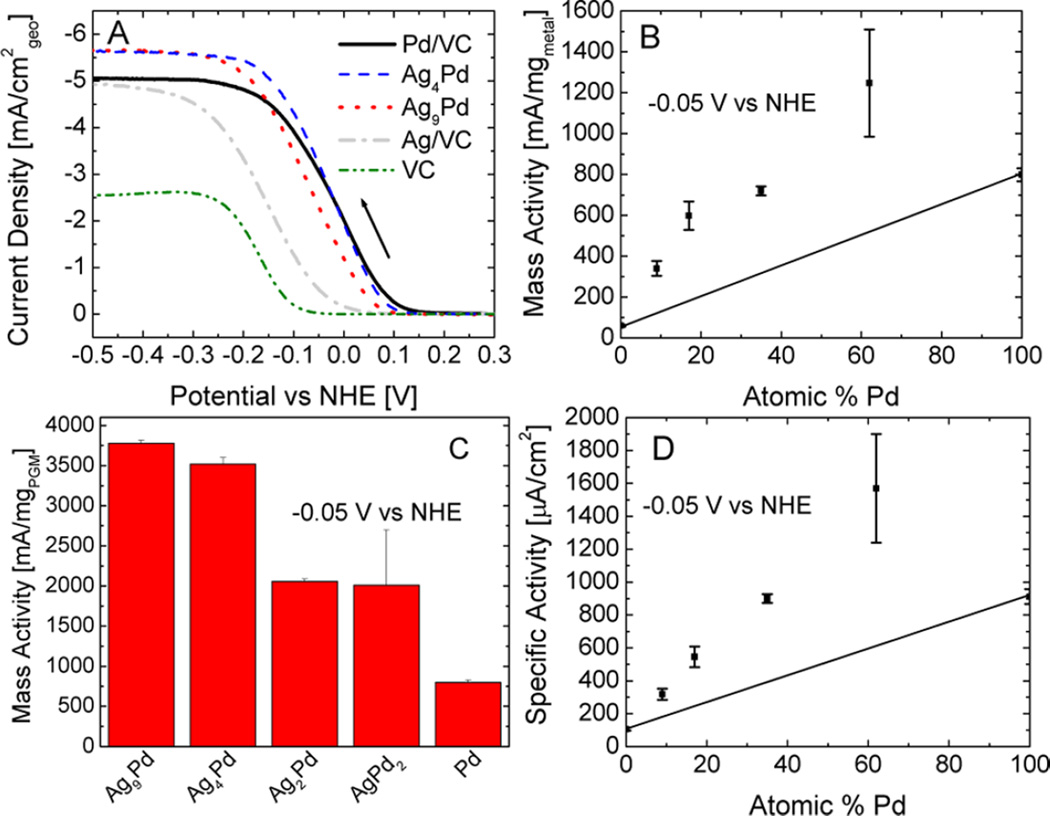
Oxygen reduction activity comparison between Ag-rich alloys and pure components. (A) Linear sweep voltammograms from a rotating disk electrode measurement in O2 saturated 0.1 M KOH. The diffusion-limited current density for the alloy corresponds to a 4 electron process, higher than either pure Ag or Pd (3.4). (B) Synergy plot of mass activity normalized by total metal loading versus Pd composition. The solid line indicates the linear combination of activities between the pure Ag and Pd components. All of the activities lie above the solid line, indicating a synergy in ORR activities across the compositional range. (C) Bar plot summarizing the ORR activity per Pd loading. The synergy between the Ag and Pd in the alloy achieves a Pd mass normalized activity of 4.7× over the commercial Pd/VC and up to 3.2× over the linear combination of mass activities for pure Ag and Pd. (D) Synergy plot of specific activity, where the solid line indicates a linear combination of pure component specific activities. Currents were normalized by metal particle surface areas based on measured TEM diameters.
Figure 4
Figure 4
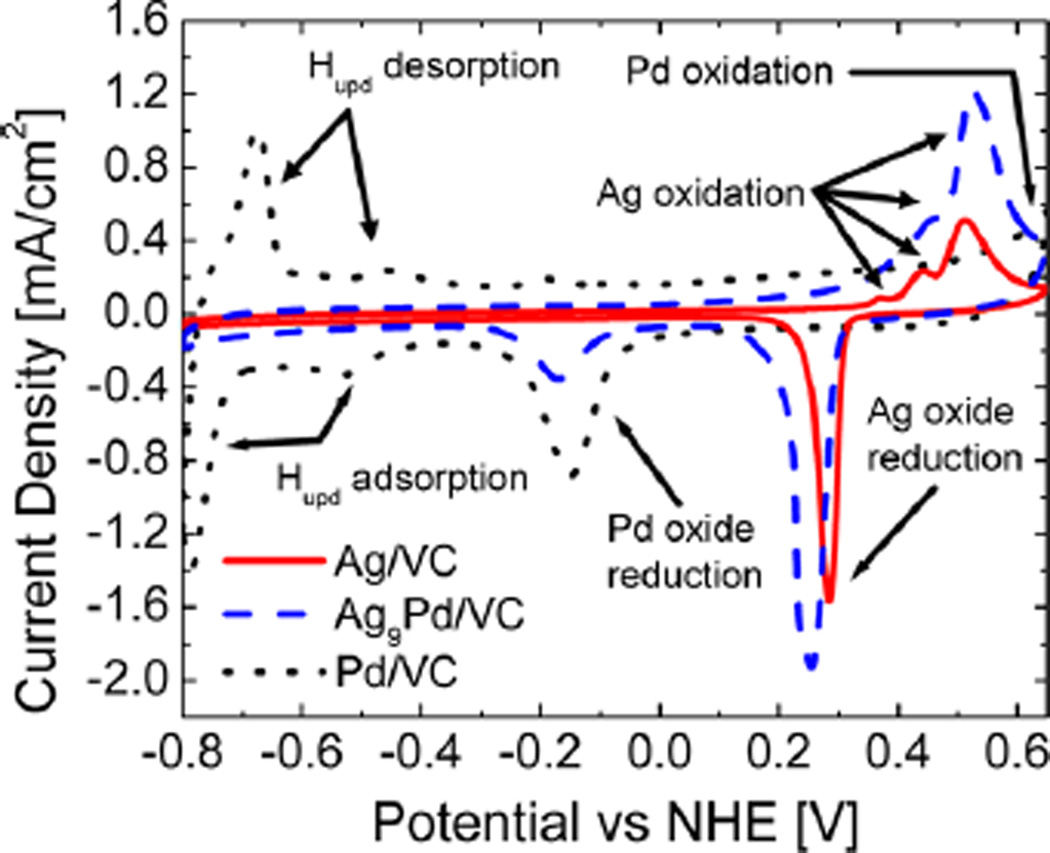
Cyclic voltammograms showing the characteristic redox peaks for the alloy and pure metal catalysts supported on Vulcan XC72 carbon. The presence of both Ag and Pd oxide reduction peaks shows that the surface is composed of both metals. However, the lack of Hupd for the alloy suggests that the Pd is dispersed primarily as single atomic sites. The silver oxidation peaks from 0.3 to 0.6 V shift slightly positive for the alloy catalyst, suggesting some resistance to oxidation due to the small amount of Pd. The large reduction peak of silver oxide is shifted negative, suggesting slightly more stable oxide formation.

References

    1. Liu P, Norskov JK. Phys. Chem. Chem. Phys. 2001;3:3814.
    1. Mavrikakis M, Hammer B, Norskov JK. Phys. Rev. Lett. 1998;81:2819.
    1. Rodriguez JA. Heterog. Chem. Rev. 1996;3:17.
    1. Fernandez JL, Raghuveer V, Manthiram A, Bard AJ. J. Am. Chem. Soc. 2005;127:13100. - PubMed
    1. Koh S, Strasser P. J. Am. Chem. Soc. 2007;129:12624. - PubMed

Publication types