. 2012 May 22;125(20):2447-53.
doi: 10.1161/CIRCULATIONAHA.111.082107. Epub 2012 May 17.

Prevalence of Kawasaki disease in young adults with suspected myocardial ischemia

Affiliations

Prevalence of Kawasaki disease in young adults with suspected myocardial ischemia

Lori B Daniels et al. Circulation. .

Abstract

Background: Up to 25% of patients with untreated Kawasaki disease (KD) and 5% of those treated with intravenous immunoglobulin will develop coronary artery aneurysms. Persistent aneurysms may remain silent until later in life when myocardial ischemia can occur. We sought to determine the prevalence of coronary artery aneurysms suggesting a history of KD among young adults undergoing coronary angiography for evaluation of possible myocardial ischemia.

Methods and results: We reviewed the medical histories and coronary angiograms of all adults <40 years of age who underwent coronary angiography for evaluation of suspected myocardial ischemia at 4 San Diego hospitals from 2005 to 2009 (n=261). History of KD-compatible illness and cardiac risk factors were obtained by medical record review. Angiograms were independently reviewed for the presence, size, and location of aneurysms and coronary artery disease by 2 cardiologists blinded to the history. Patients were evaluated for number of risk factors, angiographic appearance of their coronary arteries, and known history of KD. Of the 261 young adults who underwent angiography, 16 had coronary aneurysms. After all clinical criteria were assessed, 5.0% had aneurysms definitely (n=4) or presumed (n=9) secondary to KD as the cause of their coronary disease.

Conclusions: Coronary sequelae of KD are present in 5% of young adults evaluated by angiography for myocardial ischemia. Cardiologists should be aware of this special subset of patients who may benefit from medical and invasive management strategies that differ from the strategies used to treat atherosclerotic coronary artery disease.


Conflict of interest statement

Conflict of Interest Disclosures: None

Figures

Figure 1
Figure 1
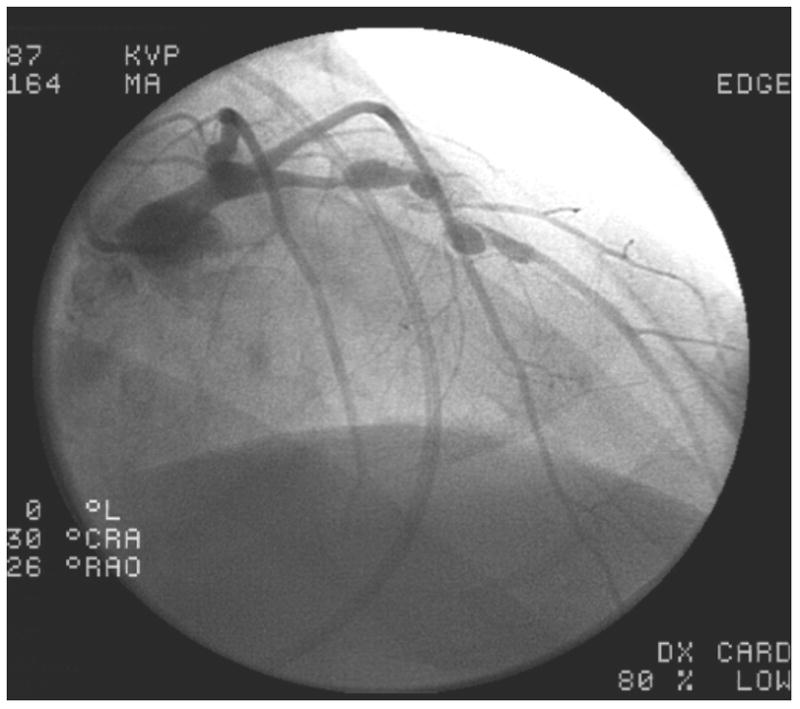
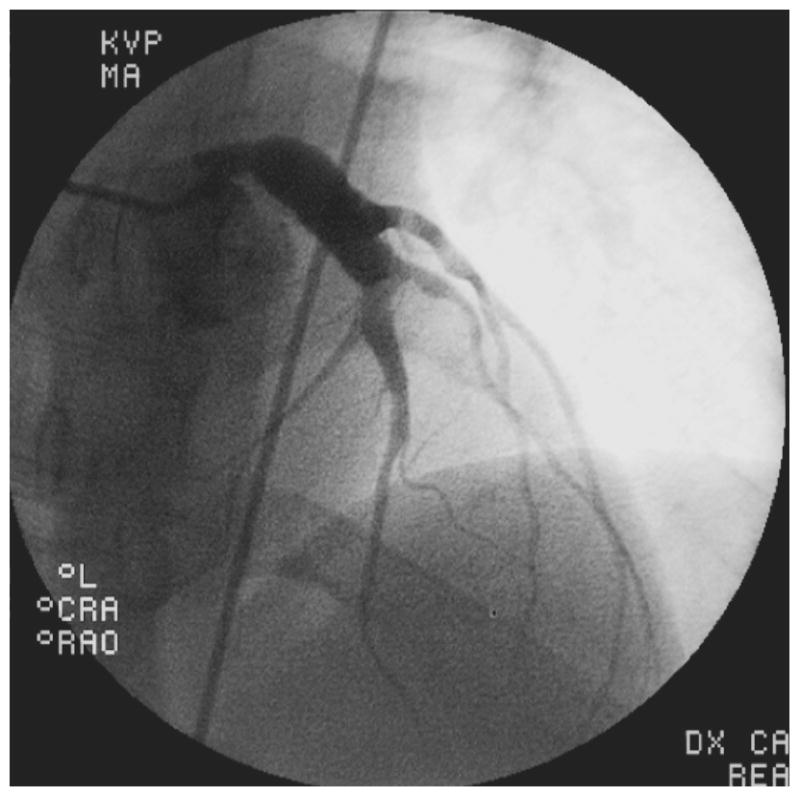
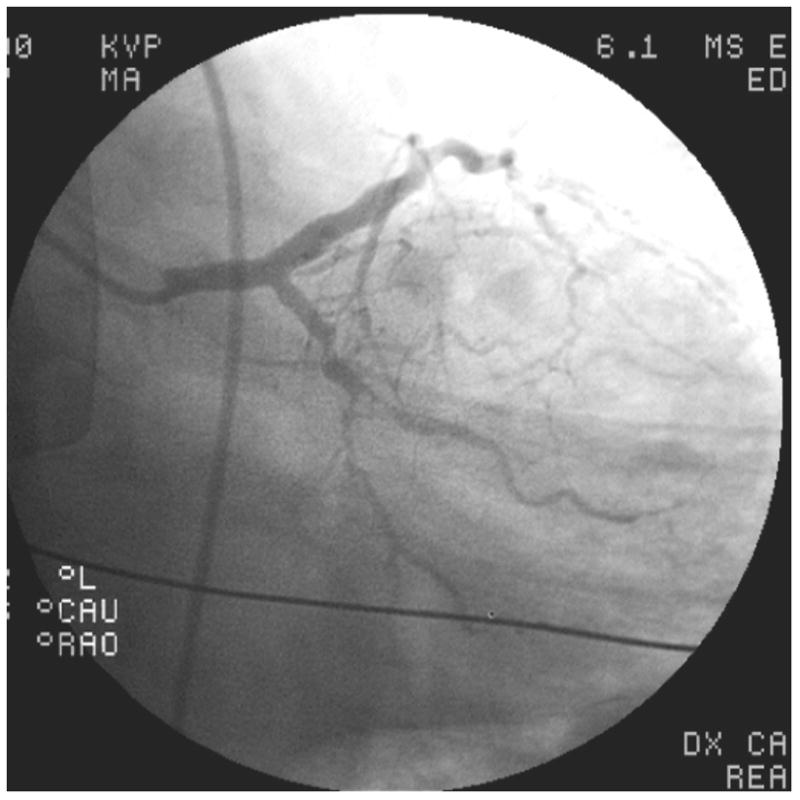
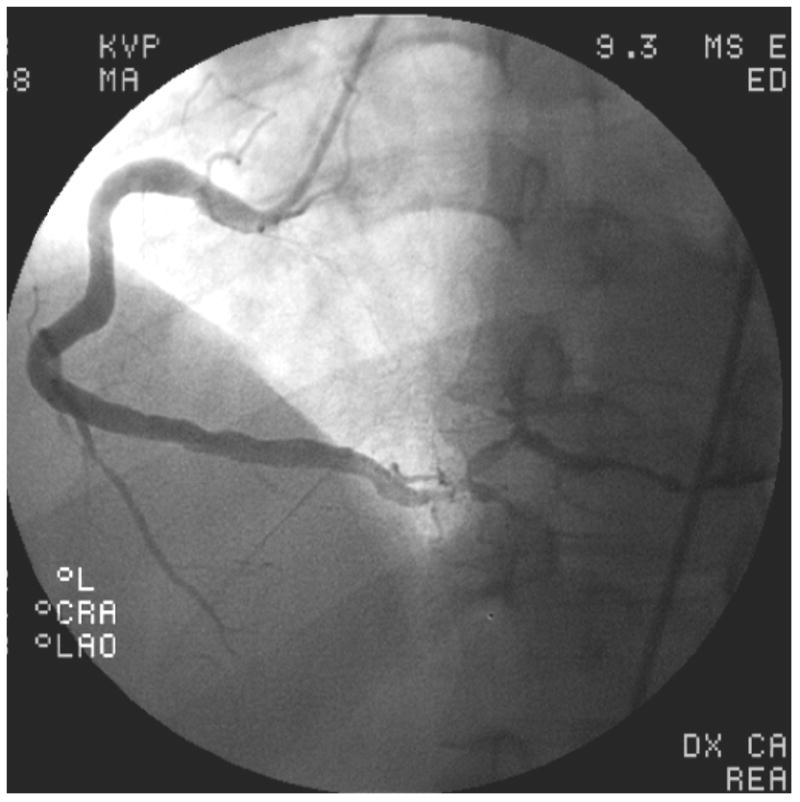
Images from coronary angiograms of patients with definite or probable Kawasaki Disease as the etiology of their coronary disease. A. Left anterior descending (LAD) artery of Patient #2, showing multiple giant proximal aneurysms, with pre- and post-aneurysm stenotic segments. The distal vessel is spared. B. Right coronary artery (RCA) of Patient # 2, showing a proximal giant aneurysm and sparing of the distal vessel. C. Left coronary arteries of Patient #5, showing giant aneurysmal dilation of the left main artery, extending into the proximal LAD and left circumflex arteries with sparing of the distal vessels. D. RCA of Patient #5, showing aneurysmal segments of the proximal and mid RCA.
Figure 1
Figure 1
Images from coronary angiograms of patients with definite or probable Kawasaki Disease as the etiology of their coronary disease. A. Left anterior descending (LAD) artery of Patient #2, showing multiple giant proximal aneurysms, with pre- and post-aneurysm stenotic segments. The distal vessel is spared. B. Right coronary artery (RCA) of Patient # 2, showing a proximal giant aneurysm and sparing of the distal vessel. C. Left coronary arteries of Patient #5, showing giant aneurysmal dilation of the left main artery, extending into the proximal LAD and left circumflex arteries with sparing of the distal vessels. D. RCA of Patient #5, showing aneurysmal segments of the proximal and mid RCA.
Figure 1
Figure 1
Images from coronary angiograms of patients with definite or probable Kawasaki Disease as the etiology of their coronary disease. A. Left anterior descending (LAD) artery of Patient #2, showing multiple giant proximal aneurysms, with pre- and post-aneurysm stenotic segments. The distal vessel is spared. B. Right coronary artery (RCA) of Patient # 2, showing a proximal giant aneurysm and sparing of the distal vessel. C. Left coronary arteries of Patient #5, showing giant aneurysmal dilation of the left main artery, extending into the proximal LAD and left circumflex arteries with sparing of the distal vessels. D. RCA of Patient #5, showing aneurysmal segments of the proximal and mid RCA.
Figure 1
Figure 1
Images from coronary angiograms of patients with definite or probable Kawasaki Disease as the etiology of their coronary disease. A. Left anterior descending (LAD) artery of Patient #2, showing multiple giant proximal aneurysms, with pre- and post-aneurysm stenotic segments. The distal vessel is spared. B. Right coronary artery (RCA) of Patient # 2, showing a proximal giant aneurysm and sparing of the distal vessel. C. Left coronary arteries of Patient #5, showing giant aneurysmal dilation of the left main artery, extending into the proximal LAD and left circumflex arteries with sparing of the distal vessels. D. RCA of Patient #5, showing aneurysmal segments of the proximal and mid RCA.
Figure 2
Figure 2
Representative images from coronary angiograms of patients with aneurysms considered possibly due to Kawasaki Disease (KD) (A), and unlikely to be due to KD (B–C). A. Left coronary arteries of Patient #10 with possible antecedent KD, showing an aneurysm of the proximal diagonal branch of the left anterior descending (LAD) artery. B. Angiogram of Patient #14, considered unlikely to have antecedent KD, showing proximally dilated left main and LAD arteries with mid-LAD occlusion, and diffuse stenoses in the left circumflex and obtuse marginal arteries. C. Angiogram of Patient #14, considered unlikely to have antecedent KD, showing a diffusely aneurysmal right coronary artery with focal distal stenoses.
Figure 2
Figure 2
Representative images from coronary angiograms of patients with aneurysms considered possibly due to Kawasaki Disease (KD) (A), and unlikely to be due to KD (B–C). A. Left coronary arteries of Patient #10 with possible antecedent KD, showing an aneurysm of the proximal diagonal branch of the left anterior descending (LAD) artery. B. Angiogram of Patient #14, considered unlikely to have antecedent KD, showing proximally dilated left main and LAD arteries with mid-LAD occlusion, and diffuse stenoses in the left circumflex and obtuse marginal arteries. C. Angiogram of Patient #14, considered unlikely to have antecedent KD, showing a diffusely aneurysmal right coronary artery with focal distal stenoses.
Figure 2
Figure 2
Representative images from coronary angiograms of patients with aneurysms considered possibly due to Kawasaki Disease (KD) (A), and unlikely to be due to KD (B–C). A. Left coronary arteries of Patient #10 with possible antecedent KD, showing an aneurysm of the proximal diagonal branch of the left anterior descending (LAD) artery. B. Angiogram of Patient #14, considered unlikely to have antecedent KD, showing proximally dilated left main and LAD arteries with mid-LAD occlusion, and diffuse stenoses in the left circumflex and obtuse marginal arteries. C. Angiogram of Patient #14, considered unlikely to have antecedent KD, showing a diffusely aneurysmal right coronary artery with focal distal stenoses.

Comment in

References

    1. Newburger JW, Takahashi M, Beiser AS, Burns JC, Bastian J, Chung KJ, Colan SD, Duffy CE, Fulton DR, Glode MP, Mason WH, Cody Meissner H, Rowley AH, Shulman ST, Reddy V, Sundel RP, Wiggings JW, Colton T, Melish ME, Rosen FS. A single intravenous infusion of gamma globulin as compared with four infusions in the treatment of acute Kawasaki syndrome. N Engl J Med. 1991;324:1633–1639. - PubMed
    1. Kato H, Inoue O, Kawasaki T, Fujiwara H, Watanabe T, Toshima H. Adult coronary artery disease probably due to childhood Kawasaki disease. Lancet. 1992;340:1127–1129. - PubMed
    1. Burns JC, Shike H, Gordon JB, Malhotra A, Schoenwetter M, Kawasaki T. Sequelae of Kawasaki disease in adolescents and young adults. J Am Coll Cardiol. 1996;28:253–257. - PubMed
    1. Kato H, Sugimura T, Akagi T, Sato N, Hashino K, Maeno Y, Kazue T, Eto G, Yamakawa R. Long-term consequences of Kawasaki disease. A 10- to 21-year follow-up study of 594 patients. Circulation. 1996;94:1379–1385. - PubMed
    1. Tremoulet AH, Best BM, Song S, Wang S, Corinaldesi E, Eichenfield JR, Martin DD, Newburger JW, Burns JC. Resistance to intravenous immunoglobulin in children with Kawasaki disease. J Pediatr. 2008;153:117–121. - PMC - PubMed

Publication types