


The prostate cancer conundrum revisited: treatment changes and prostate cancer mortality declines
- PMID: 22605665
- PMCID: PMC3424303
- DOI: 10.1002/cncr.27594
The prostate cancer conundrum revisited: treatment changes and prostate cancer mortality declines
Abstract
Background: Prostate cancer mortality rates in the United States declined by >40% between 1991 and 2005. The impact of changes in primary treatment and adjuvant and neoadjuvant hormone therapy on this decline is unknown.
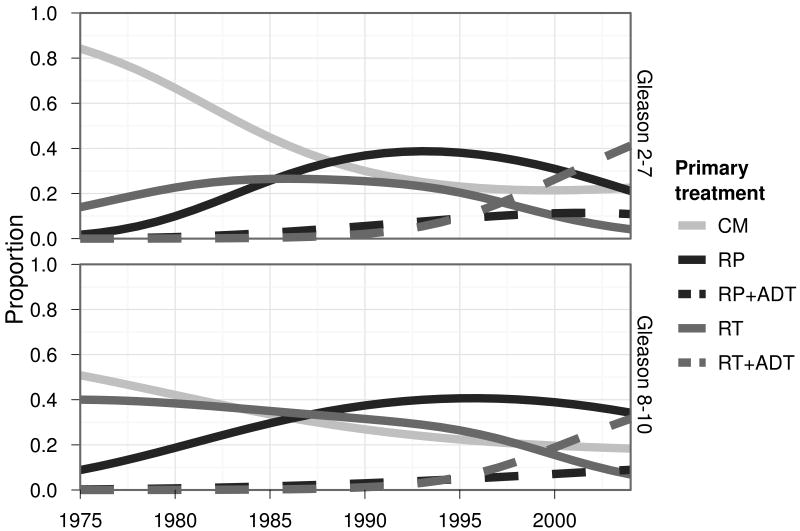
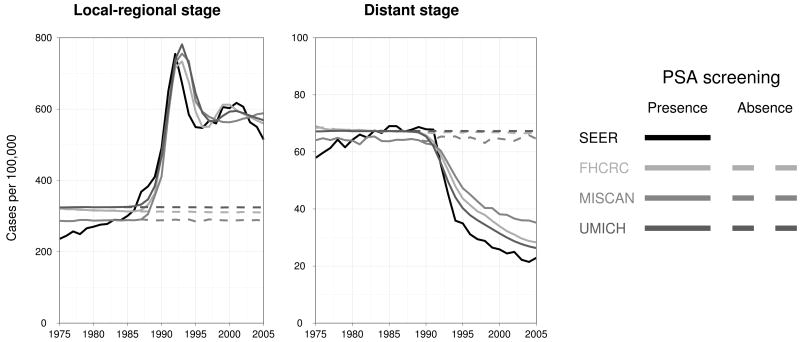
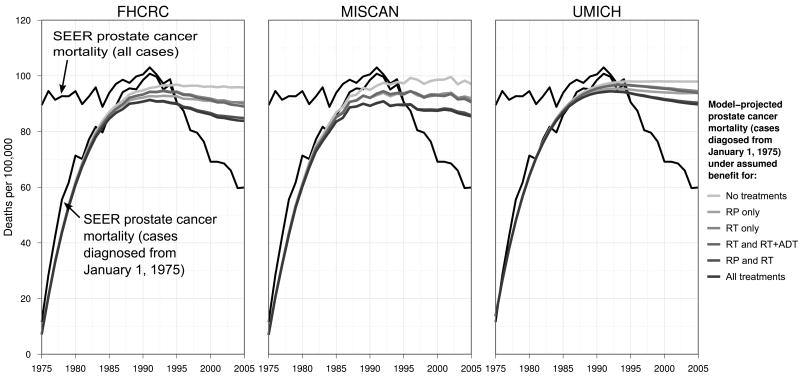
Methods: The authors applied 3 independently developed models of prostate cancer natural history and disease detection under common assumptions about treatment patterns, treatment efficacy, and survival in the population. Primary treatment patterns were derived from the Surveillance, Epidemiology, and End Results registry; data on the frequency of hormone therapy were obtained from the CaPSURE (Cancer of the Prostate Strategic Urologic Research Endeavor) database; and treatment efficacy was based on estimates from randomized trials and comparative effectiveness studies of treatment alternatives. The models projected prostate cancer mortality without prostate-specific antigen screening and in the presence and absence of treatment benefit. The impact of primary treatment was expressed as a fraction of the difference between observed mortality and projected mortality in the absence of treatment benefit.
Results: The 3 models projected that changes in treatment explained 22% to 33% of the mortality decline by 2005. These contributions were accounted for mostly by surgery and radiation therapy, which increased in frequency until the 1990s, whereas hormone therapies contributed little to the mortality decline by 2005. Assuming that treatment benefit was less for older men, changes in treatment explained only 16% to 23% of the mortality decline by 2005.
Conclusions: Changes in primary treatment explained a minority of the observed decline in prostate cancer mortality. The remainder of the decline probably was because of other interventions, such as prostate-specific antigen screening and advances in the treatment of recurrent and progressive disease.
Copyright © 2012 American Cancer Society.
Figures
Comment in
-
The prostate cancer conundrum revisited: further insights.Cancer. 2012 Dec 1;118(23):5724-7. doi: 10.1002/cncr.27718. Epub 2012 Jun 26. Cancer. 2012. PMID: 22736235 No abstract available.
References
-
- Albertsen PC. The prostate cancer conundrum. J Natl Cancer Inst. 2003;95(13):930–1. - PubMed
-
- Bill-Axelson A, Holmberg L, Ruutu M, et al. Radical prostatectomy versus watchful waiting in early prostate cancer. N Engl J Med. 2011;364(18):1708–17. - PubMed
-
- Hankey BF, Feuer EJ, Clegg LX, et al. Cancer surveillance series: interpreting trends in prostate cancer--part I: Evidence of the effects of screening in recent prostate cancer incidence, mortality, and survival rates. J Natl Cancer Inst. 1999;91(12):1017–24. - PubMed
-
- Schröder FH, Hugosson J, Roobol MJ, et al. Screening and prostate-cancer mortality in a randomized European study. N Engl J Med. 2009;360(13):1320–8. - PubMed
