


Research blogs and the discussion of scholarly information
- PMID: 22606239
- PMCID: PMC3350512
- DOI: 10.1371/journal.pone.0035869
Research blogs and the discussion of scholarly information
Abstract
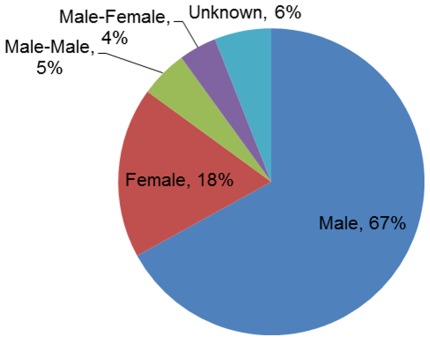
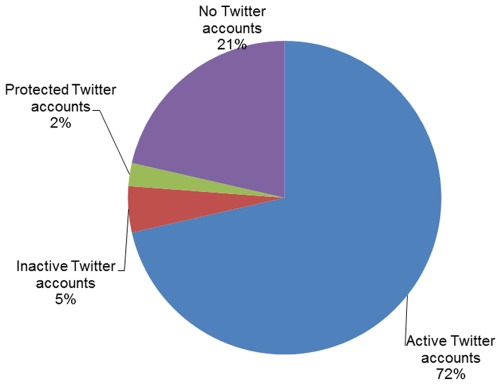
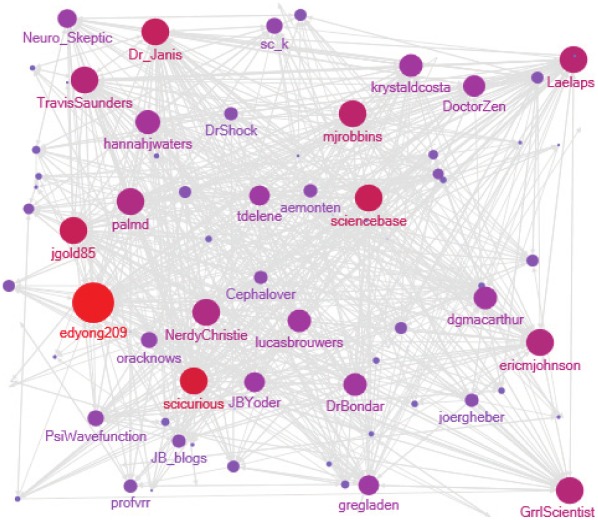
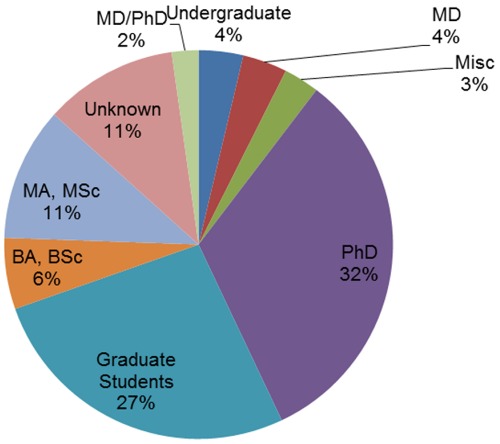
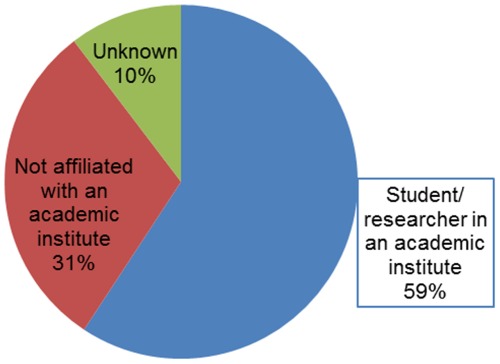
The research blog has become a popular mechanism for the quick discussion of scholarly information. However, unlike peer-reviewed journals, the characteristics of this form of scientific discourse are not well understood, for example in terms of the spread of blogger levels of education, gender and institutional affiliations. In this paper we fill this gap by analyzing a sample of blog posts discussing science via an aggregator called ResearchBlogging.org (RB). ResearchBlogging.org aggregates posts based on peer-reviewed research and allows bloggers to cite their sources in a scholarly manner. We studied the bloggers, blog posts and referenced journals of bloggers who posted at least 20 items. We found that RB bloggers show a preference for papers from high-impact journals and blog mostly about research in the life and behavioral sciences. The most frequently referenced journal sources in the sample were: Science, Nature, PNAS and PLoS One. Most of the bloggers in our sample had active Twitter accounts connected with their blogs, and at least 90% of these accounts connect to at least one other RB-related Twitter account. The average RB blogger in our sample is male, either a graduate student or has been awarded a PhD and blogs under his own name.
Conflict of interest statement
Figures
References
-
- Priem J, Taraborelli D, Groth P, Neylon C. Alt-metrics: a manifesto. 2010;10 Available: http://altmetrics.org/manifesto/. Accessed 2011 Sep.
-
- Blackwell PK, Kochtanek TR. An iterative technique for document-retrieval using descriptors and relations. Proceedings of the American Society for Information Science. 1981;18:215–217.
-
- Merton RK. Chicago: University of Chicago Press; 1973. The normative structure of science.
-
- Cronin B. The role and significance of citations in scientific communication. London: Taylor Graham; 1984. The citation process.
-
- Garfield E. New York: John Wiley & Sons; 1979. Citation indexing: its theory and application in science, Technology, and Humanities.
Publication types
MeSH terms
LinkOut - more resources
Full Text Sources
Miscellaneous
