


Importance of having low-density functional groups for generating high-performance semiconducting polymer dots
- PMID: 22607220
- PMCID: PMC3383935
- DOI: 10.1021/nn301308w
Importance of having low-density functional groups for generating high-performance semiconducting polymer dots
Abstract
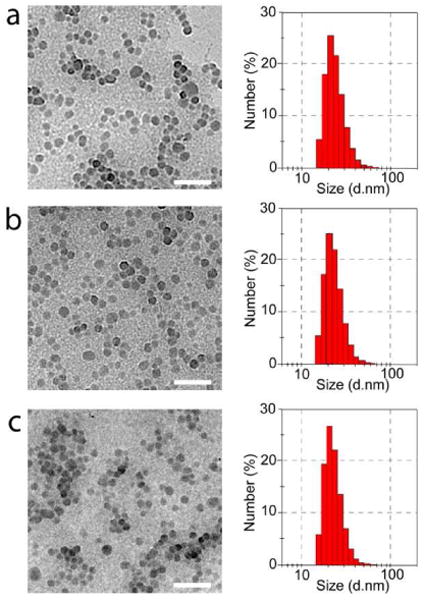
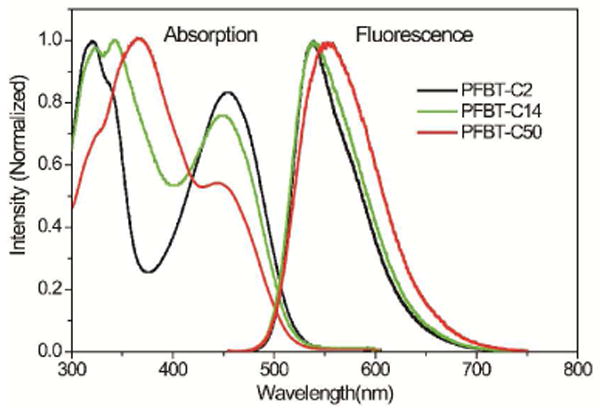
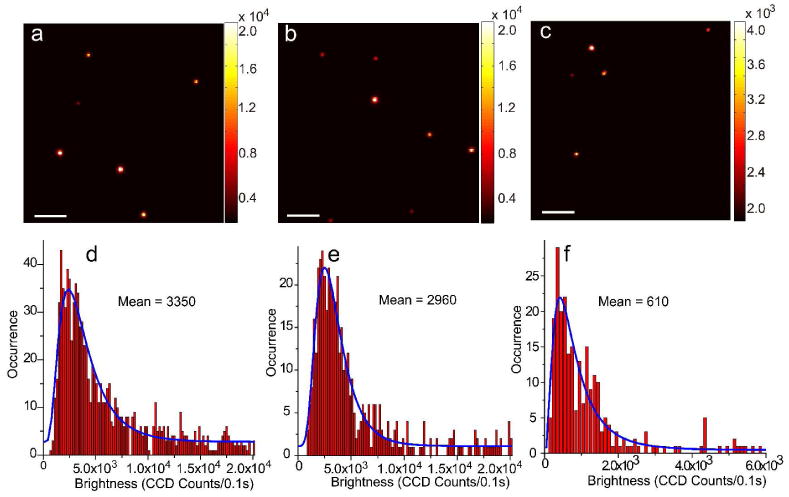
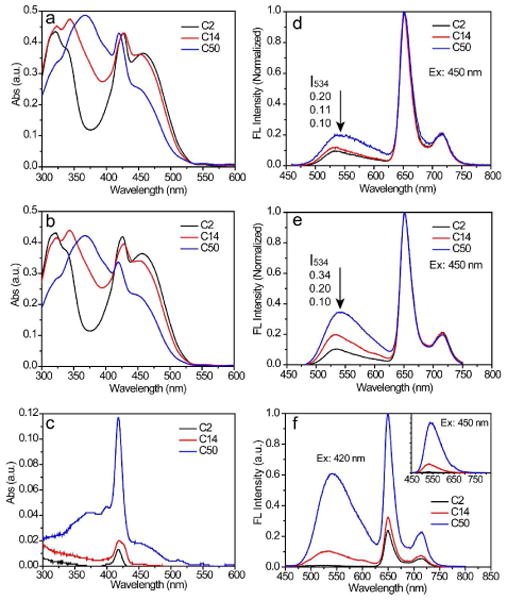
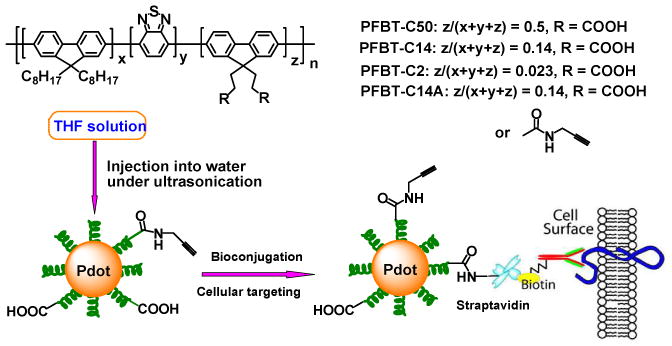
Semiconducting polymers with low-density side-chain carboxylic acid groups were synthesized to form stable, functionalized, and highly fluorescent polymer dots (Pdots). The influence of the molar fraction of hydrophilic side-chains on Pdot properties and performance was systematically investigated. Our results show that the density of side-chain carboxylic acid groups significantly affects Pdot stability, internal structure, fluorescence brightness, and nonspecific binding in cellular labeling. Fluorescence spectroscopy, single-particle imaging, and a dye-doping method were employed to investigate the fluorescence brightness and the internal structure of the Pdots. The results of these experiments indicate that semiconducting polymers with low density of side-chain functional groups can form stable, compact, and highly bright Pdots as compared to those with high density of hydrophilic side-chains. The functionalized polymer dots were conjugated to streptavidin (SA) by carbodiimide-catalyzed coupling and the Pdot-SA probes effectively and specifically labeled the cancer cell-surface marker Her2 in human breast cancer cells. The carboxylate-functionalized polymer could also be covalently modified with small functional molecules to generate Pdot probes for click chemistry-based bio-orthogonal labeling. This study presents a promising approach for further developing functional Pdot probes for biological applications.
Figures
References
-
- Resch-Genger U, Grabolle M, Cavaliere-Jaricot S, Nitschke R, Nann T. Quantum Dots Versus Organic Dyes as Fluorescent Labels. Nat Methods. 2008;5:763–775. - PubMed
-
- Pecher J, Mecking S. Nanoparticles of Conjugated Polymers. Chem Rev. 2010;110:6260–6279. - PubMed
-
- Kaeser A, Schenning APHJ. Fluorescent Nanoparticles Based on Self-Assembled π-Conjugated Systems. Adv Mater. 2010;22:2985–2997. - PubMed
-
- Tian Z, Yu J, Wu C, Szymanski C, McNeill J. Amplified Energy Transfer in Conjugated Polymer Nanoparticle Tags and Sensors. Nanoscale. 2010;2:1999–2011. - PubMed
Publication types
MeSH terms
Substances
Grants and funding
LinkOut - more resources
Full Text Sources
Other Literature Sources
Research Materials
Miscellaneous
