


doi: 10.3201/eid1806.120220.
Louping ill in goats, Spain, 2011
Affiliations
- PMID: 22607689
- PMCID: PMC3358175
- DOI: 10.3201/eid1806.120220
Item in Clipboard
Louping ill in goats, Spain, 2011
Emerg Infect Dis.
2012 Jun.
Abstract
Although louping ill affects mainly sheep, a 2011 outbreak in northern Spain occurred among goats. Histopathologic lesions and molecular genetics identified a new strain of louping ill virus, 94% identical to the strain from Britain. Surveillance is needed to minimize risk to domestic and wildlife species and humans.
Figures
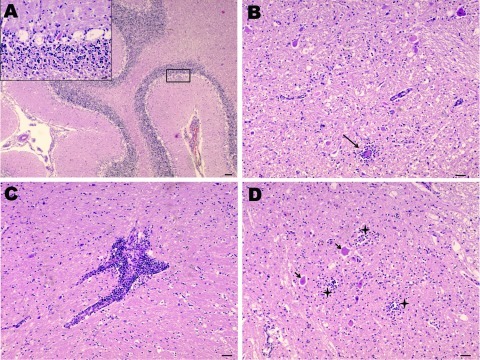
Nonsuppurative encephalitis in goat affected by louping ill. A) Cerebellum with necrosis of Purkinje cells. Hematoxylin and eosin (H&E) stain; scale bar = 100 µm. Inset: necrosis of Purkinje cells. H&E stain; scale bar = 20 µm. B) Midbrain. Area of neurophagia (arrow) surrounded by microglial cells. Necrosis of neurons can be also seen. H&E stain; scale bar = 50 µm. C) Lymphoid perivascular cuff in midbrain. H&E stain; scale bar = 50 µm. D) Spinal cord, gray matter. Focal microgliosis (crosses) and neurons undergoing necrosis (arrows). H&E stain; scale bar = 50 µm.
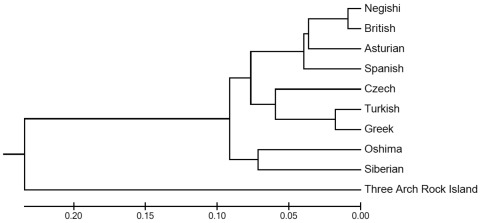
Phylogenetic relationships of the Asturian strain louping ill virus with representative tick-born encephalitis viruses. Phylogenetic and molecular evolutionary analyses of the virus were conducted using MEGA version 5 (9). Scale bar indicates branch length, proportional to the number of nucleotide substitutions. The Three Arch Rock Island virus was included as an outgroup.
References
Publication types
MeSH terms
Associated data
- Actions
LinkOut - more resources
Full Text Sources