


Comparative Study
doi: 10.3201/eid1806.111188.
Accuracy of ICD-10 codes for surveillance of Clostridium difficile infections, France
Affiliations
- PMID: 22607707
- PMCID: PMC3358151
- DOI: 10.3201/eid1806.111188
Item in Clipboard
Comparative Study
Accuracy of ICD-10 codes for surveillance of Clostridium difficile infections, France
Emerg Infect Dis.
2012 Jun.
Abstract
The sensitivity and specificity of surveillance for Clostridium difficile infections according to International Classification of Diseases, 10th revision, codes were compared with laboratory results as standard. Sensitivity was 35.6%; specificity was 99.9%. Concordance between the 2 methods was moderate. Surveillance based on ICD-10 codes underestimated the rate based on laboratory results.
Figures
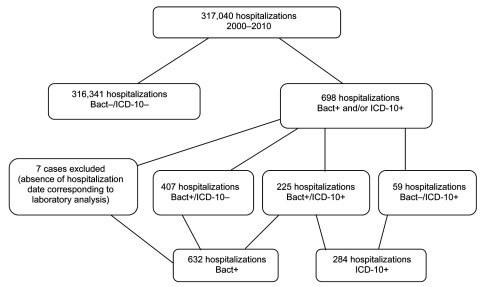
Flowchart of Clostridium difficile infections case classifications for patients admitted to Saint-Antoine Hospital, Paris, France, 2000–2010. Bact+, positive laboratory result for C. difficile; ICD10+, International Classification of Diseases, 10th Revision, discharge code for C. difficile infection, A04.7, as principal or associated diagnosis.
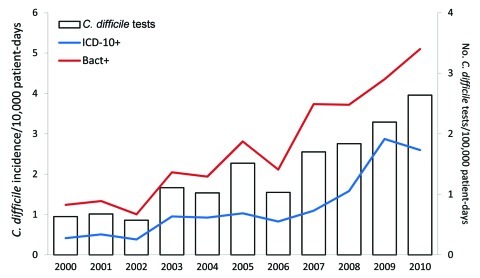
Incidence of Clostridium difficile infections by surveillance method and number of Clostridium difficile tests, Saint-Antoine Hospital, Paris, France, 2000–2010. Bact+, positive laboratory result for C. difficile; ICD10+, International Classification of Diseases, 10th Revision, discharge code for C. difficile infection, A04.7, as principal or associated diagnosis.
References
Publication types
MeSH terms
LinkOut - more resources
Full Text Sources