


Genome-wide ancestry association testing identifies a common European variant on 6q14.1 as a risk factor for asthma in African American subjects
- PMID: 22607992
- PMCID: PMC3503456
- DOI: 10.1016/j.jaci.2012.03.045
Genome-wide ancestry association testing identifies a common European variant on 6q14.1 as a risk factor for asthma in African American subjects
Abstract
Background: Genetic variants that contribute to asthma susceptibility might be present at varying frequencies in different populations, which is an important consideration and advantage for performing genetic association studies in admixed populations.
Objective: We sought to identify asthma-associated loci in African American subjects.
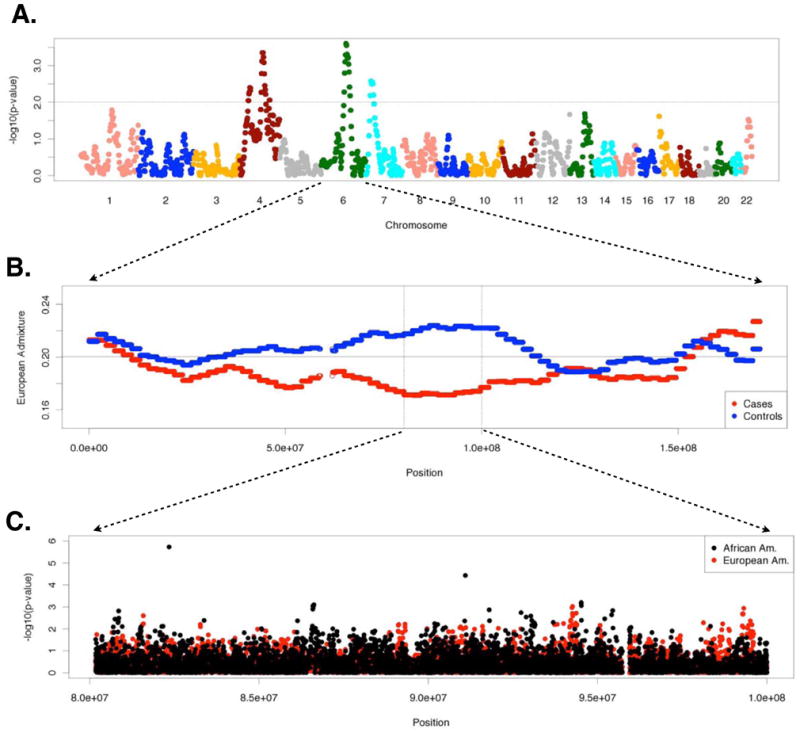
Methods: We compared local African and European ancestry estimated from dense single nucleotide polymorphism genotype data in African American adults with asthma and nonasthmatic control subjects. Allelic tests of association were performed within the candidate regions identified, correcting for local European admixture.
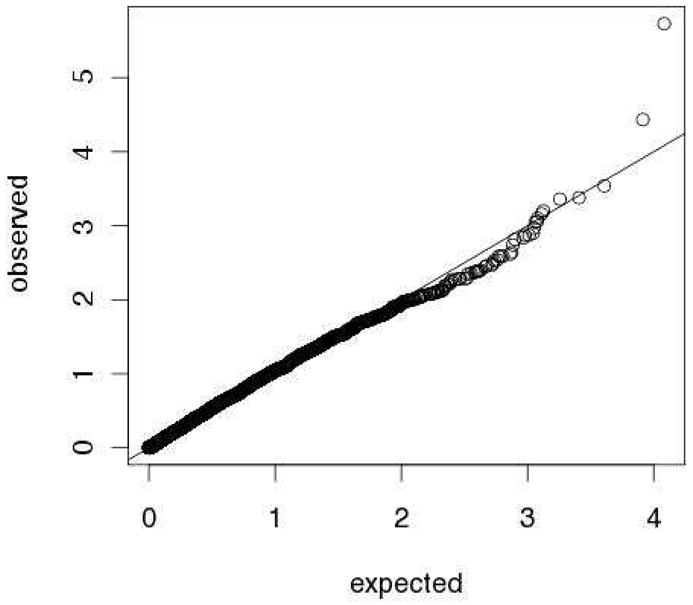
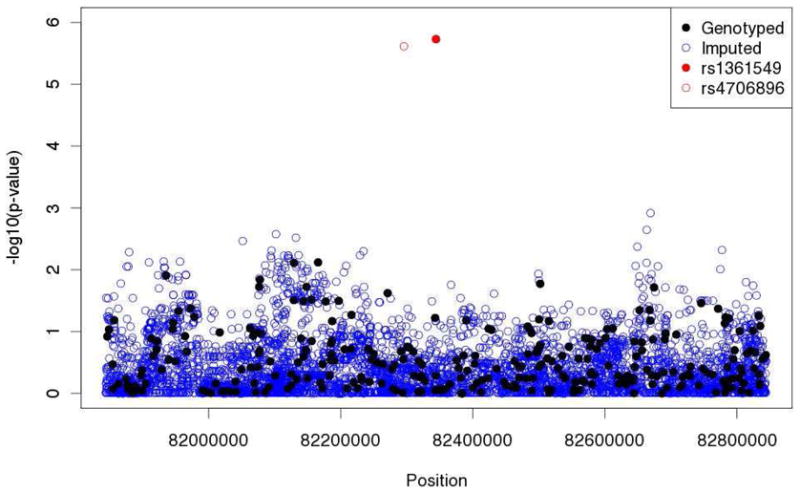
Results: We identified a significant ancestry association peak on chromosome 6q. Allelic tests for association within this region identified a single nucleotide polymorphism (rs1361549) on 6q14.1 that was associated with asthma exclusively in African American subjects with local European admixture (odds ratio, 2.2). The risk allele is common in Europe (42% in the HapMap population of Utah residents with Northern and Western European ancestry from the Centre d'Etude du Polymorphisme Humain collection) but absent in West Africa (0% in the HapMap population of Yorubans in Ibadan, Nigeria), suggesting the allele is present in African American subjects because of recent European admixture. We replicated our findings in Puerto Rican subjects and similarly found that the signal of association is largely specific to subjects who are heterozygous for African and non-African ancestry at 6q14.1. However, we found no evidence for association in European American or Puerto Rican subjects in the absence of local African ancestry, suggesting that the association with asthma at rs1361549 is due to an environmental or genetic interaction.
Conclusion: We identified a novel asthma-associated locus that is relevant to admixed populations with African ancestry and highlight the importance of considering local ancestry in genetic association studies of admixed populations.
Copyright © 2012 American Academy of Allergy, Asthma & Immunology. Published by Mosby, Inc. All rights reserved.
Figures
References
-
- Thomsen SF, van der Sluis S, Kyvik KO, Skytthe A, Backer V. Estimates of asthma heritability in a large twin sample. Clin Exp Allergy. 2010;40:1054–1061. - PubMed
-
- Willemsen G, van Beijsterveldt TC, van Baal CG, Postma D, Boomsma DI. Heritability of self-reported asthma and allergy: a study in adult Dutch twins, siblings and parents. Twin Res Hum Genet. 2008;11:132–142. - PubMed
-
- Ober C, Hoffjan S. Asthma genetics 2006: the long and winding road to gene discovery. Genes Immun. 2006;7:95–100. - PubMed
-
- Hancock DB, Romieu I, Shi M, Sienra-Monge JJ, Wu H, Chiu GY, Li H, del Rio-Navarro BE, Willis-Owen SA, Weiss ST, Raby BA, Gao H, Eng C, Chapela R, Burchard EG, Tang H, Sullivan PF, London SJ. Genome-wide association study implicates chromosome 9q21. 31 as a susceptibility locus for asthma in mexican children. PLoS Genet. 2009;5:e1000623. - PMC - PubMed
Publication types
MeSH terms
Grants and funding
- R01 ES015794/ES/NIEHS NIH HHS/United States
- UL1 TR000005/TR/NCATS NIH HHS/United States
- 2T32GM007546/GM/NIGMS NIH HHS/United States
- UL1 RR024153/RR/NCRR NIH HHS/United States
- HL078885/HL/NHLBI NIH HHS/United States
- U19 AI077439/AI/NIAID NIH HHS/United States
- U01 HL049596/HL/NHLBI NIH HHS/United States
- R01 HL072414/HL/NHLBI NIH HHS/United States
- R01 HL088133/HL/NHLBI NIH HHS/United States
- 1RC2 HL101651/HL/NHLBI NIH HHS/United States
- HL088133/HL/NHLBI NIH HHS/United States
- ES015794/ES/NIEHS NIH HHS/United States
- R01 HL087665/HL/NHLBI NIH HHS/United States
- U01 HL49596/HL/NHLBI NIH HHS/United States
- R01 HL078885/HL/NHLBI NIH HHS/United States
- RC2 HL101651/HL/NHLBI NIH HHS/United States
- T32 GM007546/GM/NIGMS NIH HHS/United States
LinkOut - more resources
Full Text Sources
Medical
Molecular Biology Databases
