


Outcomes and practice patterns in patients undergoing lower extremity bypass
- PMID: 22608039
- PMCID: PMC3387533
- DOI: 10.1016/j.jvs.2011.12.043
Outcomes and practice patterns in patients undergoing lower extremity bypass
Abstract
Background: The appropriate application of endovascular intervention vs bypass for both critical limb ischemia (CLI) and intermittent claudication (IC) remains controversial, and outcomes from large, contemporary series are critical to help inform treatment decisions. Therefore, we sought to define the early and 1-year outcomes of lower extremity bypass (LEB) in a large, multicenter regional cohort, and analyze trends in the use of LEB with or without prior endovascular interventions.
Methods: The Vascular Study Group of New England database was used to identify all infrainguinal LEB procedures performed between 2003 and 2009. The primary study endpoint was 1-year amputation-free survival (AFS). Secondary endpoints included in-hospital mortality and morbidity, including major adverse cardiac events. Trend analyses were conducted to identify annual trends in the proportion of LEBs performed for an indication of IC, in-hospital outcomes, including mortality and morbidity, and 1-year outcomes, including AFS. Analyses were performed on the entire cohort and then stratified by indication.
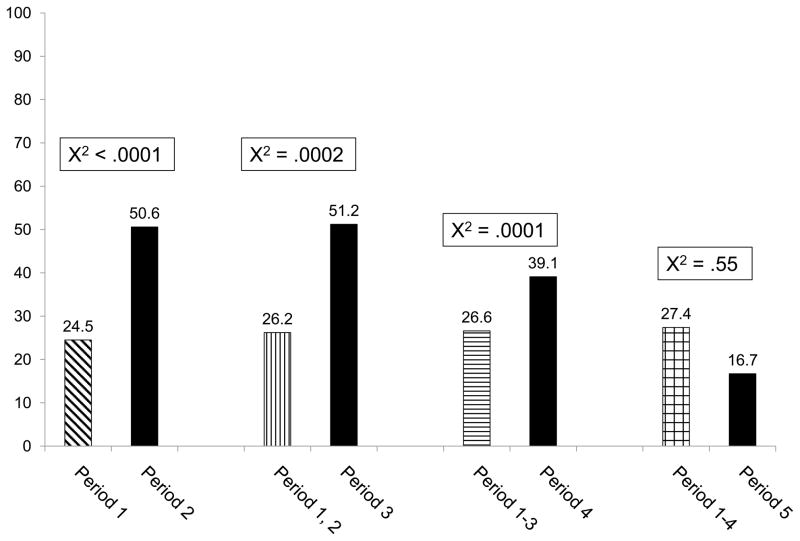
Results: Between 2003 and 2009, 2907 patients were identified who underwent LEBs (72% for CLI; 28% for IC). The proportion that underwent LEB for IC increased significantly over the study period (from 19% to 31%; P < .0001). There was a significant increase over time in the proportion of LEBs performed after a previous endovascular intervention among both CLIs (from 11% to 24%; P < .0001) and ICs (from 13% to 23%; P = .02). Neither in-hospital mortality nor cardiac event rates changed significantly among either group. There was no significant change in 1-year AFS in patients with IC (97% in 2003 and 98% in 2008; P for trend .63) or in patients with CLI (73% in 2003 and 81% in 2008; P = .10).
Conclusions: Over the last 7 years, significant changes in patient selection for LEBs have occurred in New England. The proportion of LEBs performed for ICs as opposed to CLIs has increased. Patients are much more likely to have undergone prior endovascular interventions before undergoing a bypass. In-hospital and 1-year outcomes after LEB for both IC and CLI have remained excellent with no significant changes in AFS.
Copyright © 2012 Society for Vascular Surgery. Published by Mosby, Inc. All rights reserved.
Figures




Comment in
-
Regarding "outcomes and practice patterns in patients undergoing lower extremity bypass".J Vasc Surg. 2012 Oct;56(4):1199; author reply 1200. doi: 10.1016/j.jvs.2012.06.094. J Vasc Surg. 2012. PMID: 23026433 No abstract available.
References
-
- Conte MS, Bandyk DF, Clowes AW, Moneta GL, Seely L, Lorenz TJ, et al. Results of PREVENT III: a multicenter, randomized trial of edifoligide for the prevention of vein graft failure in lower extremity bypass surgery. Journal of vascular surgery : official publication, the Society for Vascular Surgery [and] International Society for Cardiovascular Surgery, North American Chapter. 2006;43(4):742–51. - PubMed
-
- Adam DJ, Beard JD, Cleveland T, Bell J, Bradbury AW, Forbes JF, et al. Bypass versus angioplasty in severe ischaemia of the leg (BASIL): multicentre, randomised controlled trial. Lancet. 2005;366(9501):1925–34. - PubMed
-
- Taylor LM, Jr, Edwards JM, Porter JM. Present status of reversed vein bypass grafting: five-year results of a modern series. Journal of vascular surgery : official publication, the Society for Vascular Surgery [and] International Society for Cardiovascular Surgery, North American Chapter. 1990;11(2):193–205. - PubMed
-
- Harris EJ, Jr, Taylor LM, Jr, Moneta GL, Porter JM. Outcome of infrainguinal arterial reconstruction in women. Journal of vascular surgery : official publication, the Society for Vascular Surgery [and] International Society for Cardiovascular Surgery, North American Chapter. 1993;18(4):627–34. - PubMed
-
- Cronenwett JL, Likosky DS, Russell MT, Eldrup-Jorgensen J, Stanley AC, Nolan BW. A regional registry for quality assurance and improvement: the Vascular Study Group of Northern New England (VSGNNE) Journal of vascular surgery : official publication, the Society for Vascular Surgery [and] International Society for Cardiovascular Surgery, North American Chapter. 2007;46(6):1093–101. - PubMed
Publication types
MeSH terms
Grants and funding
LinkOut - more resources
Full Text Sources
Research Materials
Miscellaneous
