


The Walking Impairment Questionnaire stair-climbing score predicts mortality in men and women with peripheral arterial disease
- PMID: 22608041
- PMCID: PMC3963605
- DOI: 10.1016/j.jvs.2011.12.010
The Walking Impairment Questionnaire stair-climbing score predicts mortality in men and women with peripheral arterial disease
Abstract
Objective: The Walking Impairment Questionnaire (WIQ) measures self-reported walking distance, walking speed, and stair-climbing ability in men and women with lower extremity peripheral arterial disease (PAD). We determined whether poorer WIQ scores are associated with higher all-cause and cardiovascular disease (CVD) mortality in individuals with and without PAD.
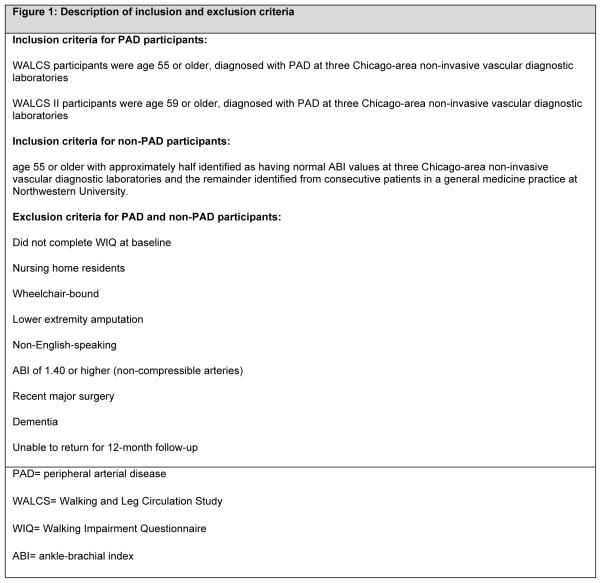
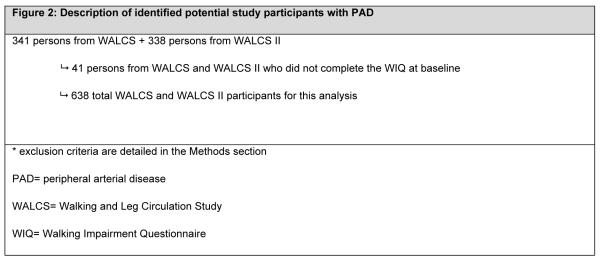
Methods: We identified 1048 men and women with and without PAD from Chicago-area medical centers. Participants completed the WIQ at baseline and were monitored for a median of 4.5 years. Cox proportional hazards models were used to relate baseline WIQ scores with death, adjusting for age, sex, race, the ankle-brachial index (ABI), comorbidities, and other covariates.
Results: During follow-up, 461 participants (44.0%) died, including 158 deaths from CVD. PAD participants in the lowest baseline quartile of the WIQ stair-climbing scores had higher all-cause mortality (hazard ratio, 1.70; 95% confidence interval, 1.08-2.66, P = .02) and higher CVD mortality (hazard ratio, 3.11; 95% confidence interval, 1.30-7.47, P = .01) compared with those with the highest baseline WIQ stair-climbing score. Among PAD participants, there were no significant associations of lower baseline WIQ distance or speed scores with rates of all-cause mortality (P = .20 and P = .07 for trend, respectively) or CVD mortality (P = .51 and P = .33 for trend, respectively). Among non-PAD participants there were no significant associations of lower baseline WIQ stair-climbing, distance, or speed score with rates of all-cause mortality (P = .94, P = .69, and P = .26, for trend, respectively) or CVD mortality (P = .28, P = .68, and P = .78, for trend, respectively).
Conclusions: Among participants with PAD, lower WIQ stair-climbing scores are associated with higher all-cause and CVD mortality, independently of the ABI and other covariates.
Copyright © 2012 Society for Vascular Surgery. Published by Mosby, Inc. All rights reserved.
Figures
References
-
- Lloyd-Jones D, Adams RJ, Brown TM, Carnethon M, Dai S, De Simone G, et al. Heart disease and stroke statistics--2010 update: a report from the American Heart Association. Circulation. 2010;121(7):e46–e215. - PubMed
-
- Heald CL, Fowkes FGR, Murray GD, Price JF, Collaborat ABI Risk of mortality and cardiovascular disease associated with the ankle-brachial index: Systematic review. Atherosclerosis. 2006;189(1):61–9. - PubMed
-
- Sikkink CJ, van Asten WN, van ’t Hof MA, van Langen H, van der Vliet JA. Decreased ankle/brachial indices in relation to morbidity and mortality in patients with peripheral arterial disease. Vasc Med. 1997;2(3):169–73. - PubMed
-
- Issa SM, Hoeks SE, Scholte op, Reimer WJ, Van Gestel YR, Lenzen MJ, Verhagen HJ, et al. Health-related quality of life predicts long-term survival in patients with peripheral artery disease. Vasc Med. 2010;15(3):163–9. - PubMed
Publication types
MeSH terms
Grants and funding
LinkOut - more resources
Full Text Sources
Medical
