


An evidence integration triangle for aligning science with policy and practice
- PMID: 22608384
- PMCID: PMC4457385
- DOI: 10.1016/j.amepre.2012.02.016
An evidence integration triangle for aligning science with policy and practice
Abstract
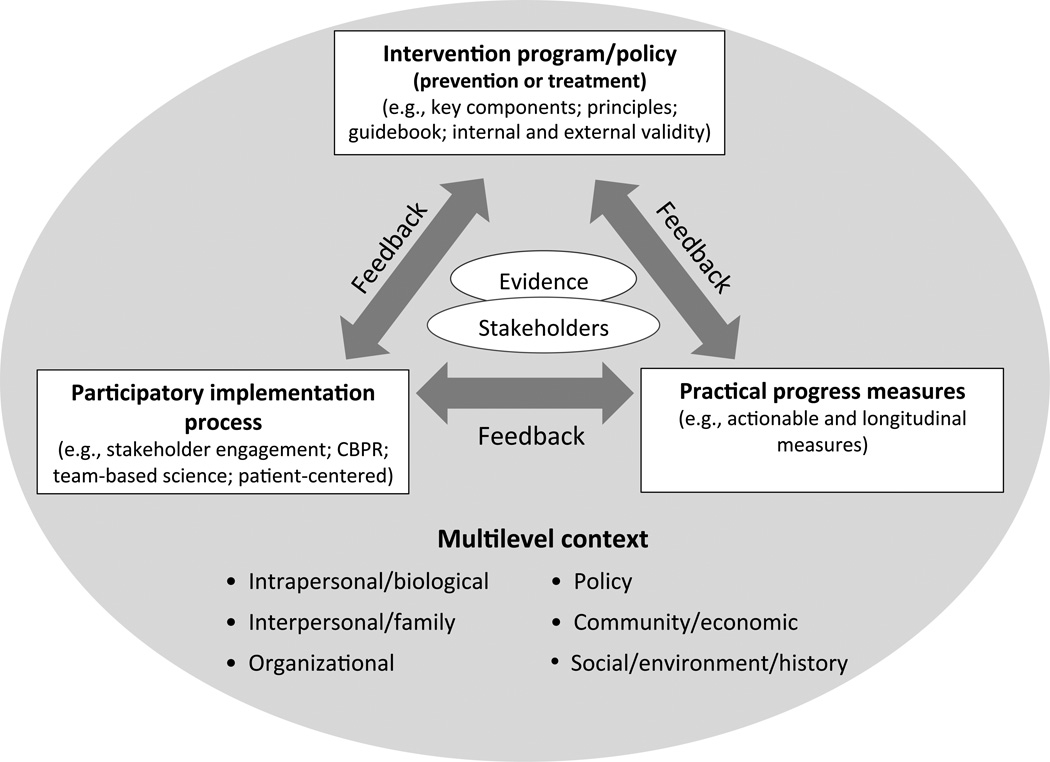
Over-reliance on decontextualized, standardized implementation of efficacy evidence has contributed to slow integration of evidence-based interventions into health policy and practice. This article describes an "evidence integration triangle" (EIT) to guide translation, implementation, prevention efforts, comparative effectiveness research, funding, and policymaking. The EIT emphasizes interactions among three related components needed for effective evidence implementation: (1) practical evidence-based interventions; (2) pragmatic, longitudinal measures of progress; and (3) participatory implementation processes. At the center of the EIT is active engagement of key stakeholders and scientific evidence and attention to the context in which a program is implemented. The EIT model is a straightforward framework to guide practice, research, and policy toward greater effectiveness and is designed to be applicable across multiple levels-from individual-focused and patient-provider interventions, to health systems and policy-level change initiatives.
Copyright © 2012 Elsevier Inc. All rights reserved.
Figures
References
-
- IOM, Committee on Quality Health Care in America. Crossing the quality chasm: A new health system for the 21st century. Washington, DC: National Academies Press; 2003.
-
- McGlynn EA, Asch SM, Adams J, et al. The quality of health care delivered to adults in the U.S. N Eng J Med. 2003;348(26):2635–2645. - PubMed
-
- Green LW. From research to “best practices” in other settings and populations. Am J Health Behav. 2001;25:165–178. - PubMed
-
- NIH Common Fund. About the NIH Roadmap. commonfund.nih.gov/aboutroadmap.aspx.
Publication types
MeSH terms
Grants and funding
LinkOut - more resources
Full Text Sources
Medical
