


Increased risk for persistent intestinal metaplasia in patients with Barrett's esophagus and uncontrolled reflux exposure before radiofrequency ablation
- PMID: 22609385
- PMCID: PMC3429717
- DOI: 10.1053/j.gastro.2012.05.005
Increased risk for persistent intestinal metaplasia in patients with Barrett's esophagus and uncontrolled reflux exposure before radiofrequency ablation
Abstract
Background & aims: Radiofrequency ablation (RFA) is a safe alternative to esophagectomy for patients with dysplastic Barrett's esophagus (BE). Although some studies have indicated that RFA is effective at eradicating dysplasia, most have found that RFA is not as effective in eradicating intestinal metaplasia. We investigated whether uncontrolled reflux is associated with persistent intestinal metaplasia after RFA.
Methods: Thirty-seven patients with BE underwent RFA, high-resolution manometry, and 24-hour impedance-pH testing; they received proton pump inhibitors twice daily. Patients returned every 2 months for repeat treatment or standard surveillance. Patients were classified as complete responders (CRs) if all intestinal metaplasia was eradicated in fewer than 3 ablation sessions. We analyzed clinical parameters to identify factors associated with a CR or incomplete responder (ICR).
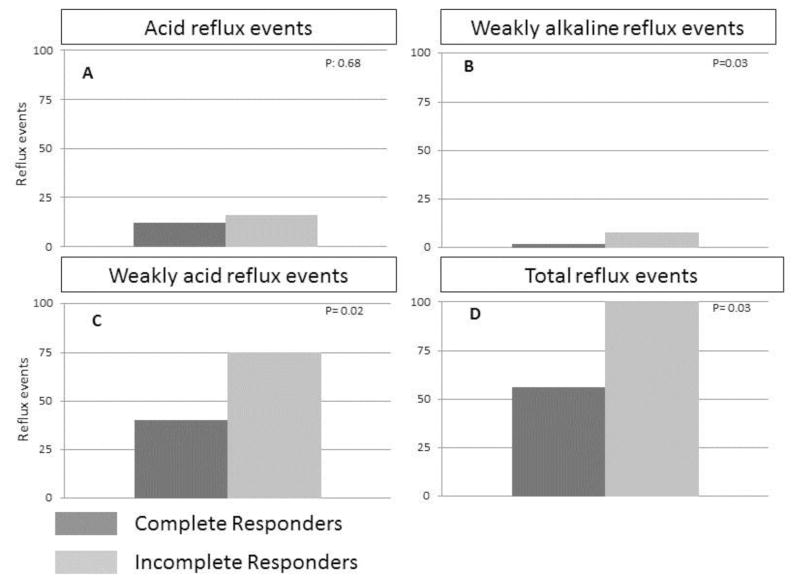
Results: Among the 37 patients, 22 had a CR and 15 had an ICR. Mann-Whitney U tests revealed that length of BE, size of hiatal hernia, and frequency of reflux, but not acid reflux, differed between CRs and ICRs. CRs had fewer weakly acidic events than ICRs (29.5 vs 52; P < .05) and total reflux events (33.5 vs 60; P < .05), and a trend toward fewer weakly alkaline events (1.0 vs 5.0; P = .06). No other clinical or manometric features differed between groups.
Conclusions: Uncontrolled, predominantly weakly acidic reflux despite twice-daily proton pump inhibitor therapy before RFA increases the incidence of persistent intestinal metaplasia after ablation in patients with BE. Length of BE and size of hiatal hernia also were associated with persistent intestinal metaplasia after RFA.
Copyright © 2012 AGA Institute. Published by Elsevier Inc. All rights reserved.
Figures
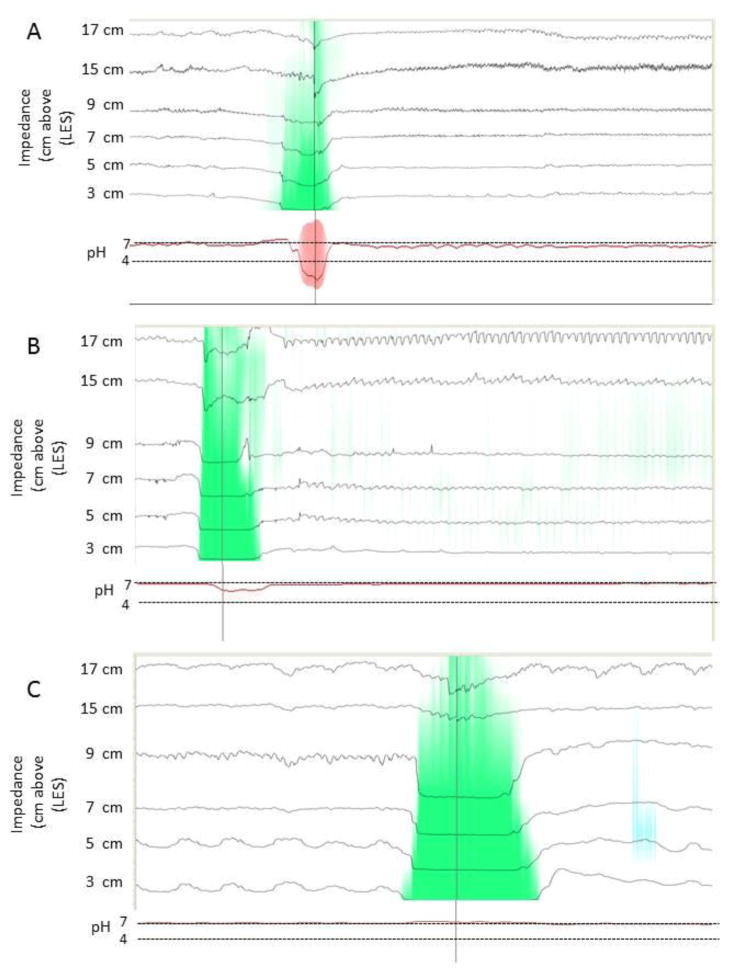
Comment in
-
Barrett's esophagus: who should receive ablation and how can we get the best results?Gastroenterology. 2012 Sep;143(3):524-526. doi: 10.1053/j.gastro.2012.07.094. Epub 2012 Jul 25. Gastroenterology. 2012. PMID: 22841734 No abstract available.
-
The relevance of weakly acidic reflux in patients with Barrett's esophagus.Gastroenterology. 2012 Oct;143(4):e21-2; author reply e22-3. doi: 10.1053/j.gastro.2012.07.119. Epub 2012 Aug 22. Gastroenterology. 2012. PMID: 22921670 No abstract available.
Similar articles
-
Effect of hiatal hernia size and columnar segment length on the success of radiofrequency ablation for Barrett's esophagus: a single-center, phase II clinical trial.J Thorac Cardiovasc Surg. 2011 Nov;142(5):1168-73. doi: 10.1016/j.jtcvs.2011.07.037. Epub 2011 Aug 15. J Thorac Cardiovasc Surg. 2011. PMID: 21840549 Clinical Trial.
-
Esophageal motility and impedance characteristics in patients with Barrett's esophagus before and after radiofrequency ablation.Eur J Gastroenterol Hepatol. 2013 Sep;25(9):1024-32. doi: 10.1097/MEG.0b013e32836283dc. Eur J Gastroenterol Hepatol. 2013. PMID: 23708277
-
Effects of Nissen fundoplication on endoscopic endoluminal radiofrequency ablation of Barrett's esophagus.Surg Endosc. 2011 Mar;25(3):830-4. doi: 10.1007/s00464-010-1270-0. Epub 2010 Jul 30. Surg Endosc. 2011. PMID: 20676687
-
Diagnosis and Management of Low-Grade Dysplasia in Barrett's Esophagus: Expert Review From the Clinical Practice Updates Committee of the American Gastroenterological Association.Gastroenterology. 2016 Nov;151(5):822-835. doi: 10.1053/j.gastro.2016.09.040. Epub 2016 Oct 1. Gastroenterology. 2016. PMID: 27702561 Review.
-
The diagnosis and management of Barrett's esophagus.Adv Surg. 1999;33:29-68. Adv Surg. 1999. PMID: 10572561 Review.
Cited by
-
Recurrence of cancer after endoscopic ablation of Barrett's esophagus: is the elephant in the room...persistent ongoing reflux?Dig Dis Sci. 2014 Jul;59(7):1354-5. doi: 10.1007/s10620-014-3110-x. Dig Dis Sci. 2014. PMID: 24659237 No abstract available.
-
Treatment of dysplasia in barrett esophagus.Clin Endosc. 2014 Jan;47(1):55-64. doi: 10.5946/ce.2014.47.1.55. Epub 2014 Jan 24. Clin Endosc. 2014. PMID: 24570884 Free PMC article. Review.
-
Emerging Concepts for the Endoscopic Management of Superficial Esophageal Adenocarcinoma.J Gastrointest Surg. 2016 Apr;20(4):851-60. doi: 10.1007/s11605-015-3056-0. Epub 2015 Dec 21. J Gastrointest Surg. 2016. PMID: 26691147 Review.
-
Post-ablation surveillance in Barrett's esophagus: A review of the literature.World J Gastroenterol. 2016 May 7;22(17):4297-306. doi: 10.3748/wjg.v22.i17.4297. World J Gastroenterol. 2016. PMID: 27158198 Free PMC article. Review.
-
Managing Barrett's esophagus with radiofrequency ablation.Gastroenterol Rep (Oxf). 2013 Sep;1(2):95-104. doi: 10.1093/gastro/got009. Epub 2013 Mar 26. Gastroenterol Rep (Oxf). 2013. PMID: 24759814 Free PMC article.
References
-
- O'Connor JB, Falk GW, Richter JE. The incidence of adenocarcinoma and dysplasia in Barrett's esophagus: report on the Cleveland Clinic Barrett's Esophagus Registry. Am J Gastroenterol. 1999 Aug;94(8):2037–2042. - PubMed
-
- Shaheen NJ, Sharma P, Overholt BF, et al. Radiofrequency ablation in Barrett's esophagus with dysplasia. N Engl J Med. 2009 May 28;360(22):2277–2288. - PubMed
-
- Fleischer DE, Overholt BF, Sharma VK, et al. Endoscopic radiofrequency ablation for Barrett's esophagus: 5-year outcomes from a prospective multicenter trial. Endoscopy. 2010 Oct;42(10):781–789. - PubMed
-
- Ganz RA, Overholt BF, Sharma VK, et al. Circumferential ablation of Barrett's esophagus that contains high-grade dysplasia: a U.S. Multicenter Registry. Gastrointest Endosc. 2008 Jul;68(1):35–40. - PubMed
-
- Gondrie JJ, Pouw RE, Sondermeijer CM, et al. Stepwise circumferential and focal ablation of Barrett's esophagus with high-grade dysplasia: results of the first prospective series of 11 patients. Endoscopy. 2008 May;40(5):359–369. - PubMed
Publication types
MeSH terms
Substances
Grants and funding
LinkOut - more resources
Full Text Sources
Medical
