


Preparation of curcumin-loaded liposomes and evaluation of their skin permeation and pharmacodynamics
- PMID: 22609787
- PMCID: PMC6268695
- DOI: 10.3390/molecules17055972
Preparation of curcumin-loaded liposomes and evaluation of their skin permeation and pharmacodynamics
Abstract
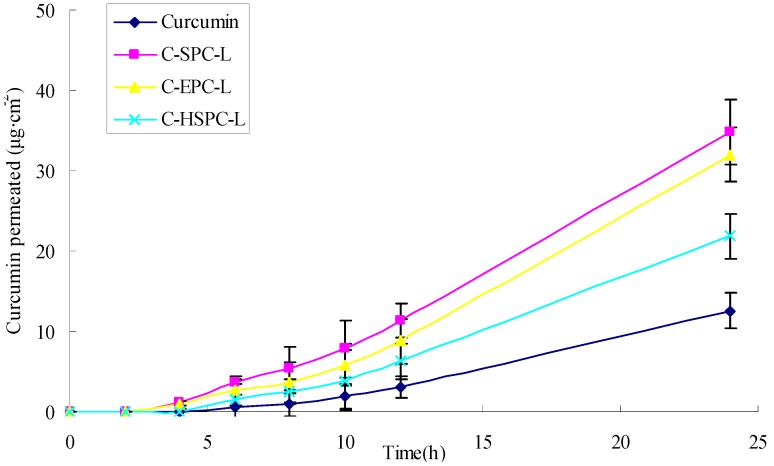
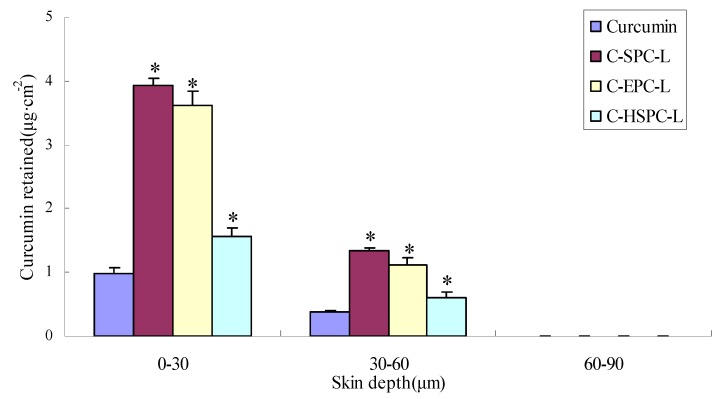
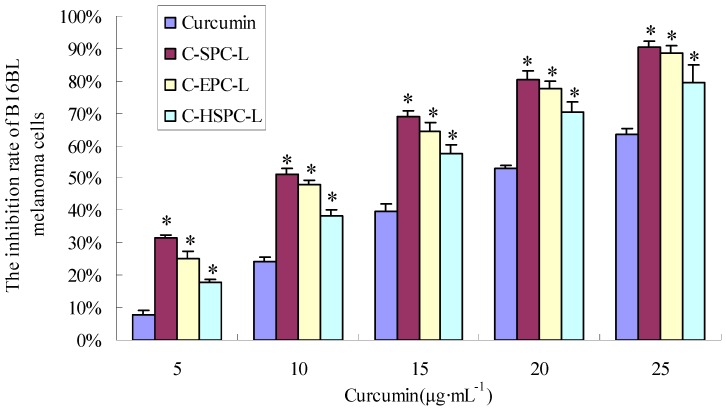
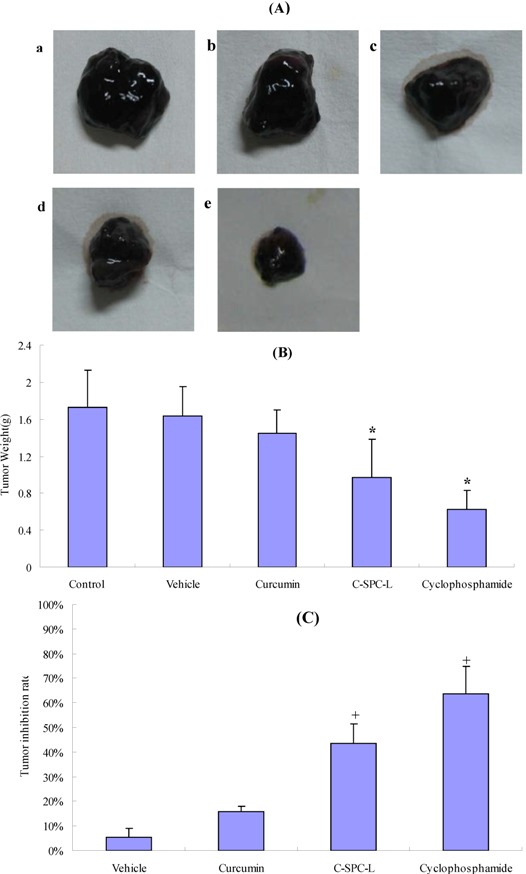
This study aimed to investigate the in vitro skin permeation and in vivo antineoplastic effect of curcumin by using liposomes as the transdermal drug-delivery system. Soybean phospholipids (SPC), egg yolk phospholipids (EPC), and hydrogenated soybean phospholipids (HSPC) were selected for the preparation of different kinds of phospholipids composed of curcumin-loaded liposomes: C-SPC-L (curcumin-loaded SPC liposomes), C-EPC-L (curcumin-loaded EPC liposomes), and C-HSPC-L (curcumin-loaded HSPC liposomes). The physical properties of different lipsomes were investigated as follows: photon correlation spectroscopy revealed that the average particle sizes of the three types of curcumin-loaded liposomes were 82.37 ± 2.19 nm (C-SPC-L), 83.13 ± 4.89 nm (C-EPC-L), and 92.42 ± 4.56 nm (C-HSPC-L), respectively. The encapsulation efficiency values were found to be 82.32 ± 3.91%, 81.59 ± 2.38%, and 80.77 ± 4.12%, respectively. An in vitro skin penetration study indicated that C-SPC-L most significantly promoted drug permeation and deposition followed by C-EPC-L, C-HSPC-L, and curcumin solution. Moreover, C-SPC-L displayed the greatest ability of all loaded liposomes to inhibit the growth of B16BL6 melanoma cells. Therefore, the C-SPC-L were chosen for further pharmacodynamic evaluation. A significant effect on antimelanoma activity was observed with C-SPC-L, as compared to treatment with curcumin solution in vivo. These results suggest that C-SPC-L would be a promising transdermal carrier for curcumin in cancer treatment.
Figures
References
-
- Shang Y.J., Jin X.L., Shang X.L., Tang J.J., Liu G.Y., Dai F., Qian Y.P., Fan G.J., Liu Q., Zhou B. Antioxidant capacity of curcumin-directed analogues: Structure-activity relationship and influence of microenvironment. Food Chem. 2010;119:1435–1442.
-
- Lee K.H., Aziz F.H.A., Syahida A., Abas F., Shaari K., Israf D.A., Lajis N.H. Synthesis and biological evaluation of curcumin-like diarylpentanoid analogues for anti-inflammatory, antioxidant and anti-tyrosinase activities. Eur. J. Med. Chem. 2009;44:3195–3200. doi: 10.1016/j.ejmech.2009.03.020. - DOI - PubMed
-
- Tang H.D., Murphy C.J., Zhang B., Shen Y.Q., van Kirk E.A., Murdoch W.J., Radosz M. Curcumin polymers as anticancer conjugates. Biomaterials. 2010;31:7139–7149. - PubMed
-
- Lekha Nair K., Thulasidasan A.K.T., Deepa G., Anto R.J., Vinod Kumar G.S. Purely aqueous PLGA nanoparticulate formulations of curcumin exhibit enhanced anticancer activity with dependence on the combination of the carrier original. Int. J. Pharm. 2012;425:44–52. doi: 10.1016/j.ijpharm.2012.01.003. - DOI - PubMed
Publication types
MeSH terms
Substances
LinkOut - more resources
Full Text Sources
Other Literature Sources
