


Clinical approach for the classification of congenital uterine malformations
- PMID: 22611348
- PMCID: PMC3338910
- DOI: 10.1007/s10397-011-0724-2
Clinical approach for the classification of congenital uterine malformations
Abstract
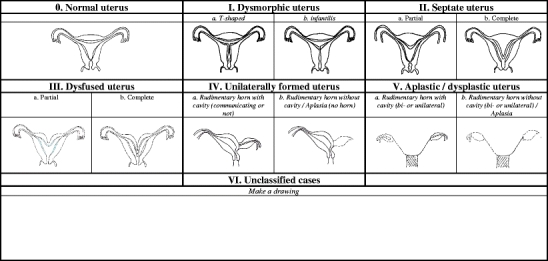
A more objective, accurate and non-invasive estimation of uterine morphology is nowadays feasible based on the use of modern imaging techniques. The validity of the current classification systems in effective categorization of the female genital malformations has been already challenged. A new clinical approach for the classification of uterine anomalies is proposed. Deviation from normal uterine anatomy is the basic characteristic used in analogy to the American Fertility Society classification. The embryological origin of the anomalies is used as a secondary parameter. Uterine anomalies are classified into the following classes: 0, normal uterus; I, dysmorphic uterus; II, septate uterus (absorption defect); III, dysfused uterus (fusion defect); IV, unilateral formed uterus (formation defect); V, aplastic or dysplastic uterus (formation defect); VI, for still unclassified cases. A subdivision of these main classes to further anatomical varieties with clinical significance is also presented. The new proposal has been designed taking into account the experience gained from the use of the currently available classification systems and intending to be as simple as possible, clear enough and accurate as well as open for further development. This proposal could be used as a starting point for a working group of experts in the field.
Figures
References
-
- Acien P. Reproductive performance of women with uterine malformations. Hum Reprod. 1993;8:122–126. - PubMed
LinkOut - more resources
Full Text Sources