


Male infertility after endoscopic Totally Extraperitoneal (Tep) hernia repair (Main): rationale and design of a prospective observational cohort study
- PMID: 22612995
- PMCID: PMC3414734
- DOI: 10.1186/1471-2482-12-7
Male infertility after endoscopic Totally Extraperitoneal (Tep) hernia repair (Main): rationale and design of a prospective observational cohort study
Abstract
Background: To describe the rationale and design of an observational cohort study analyzing the effects of endoscopic Totally Extraperitoneal (TEP) hernia repair on male fertility (MAIN study).
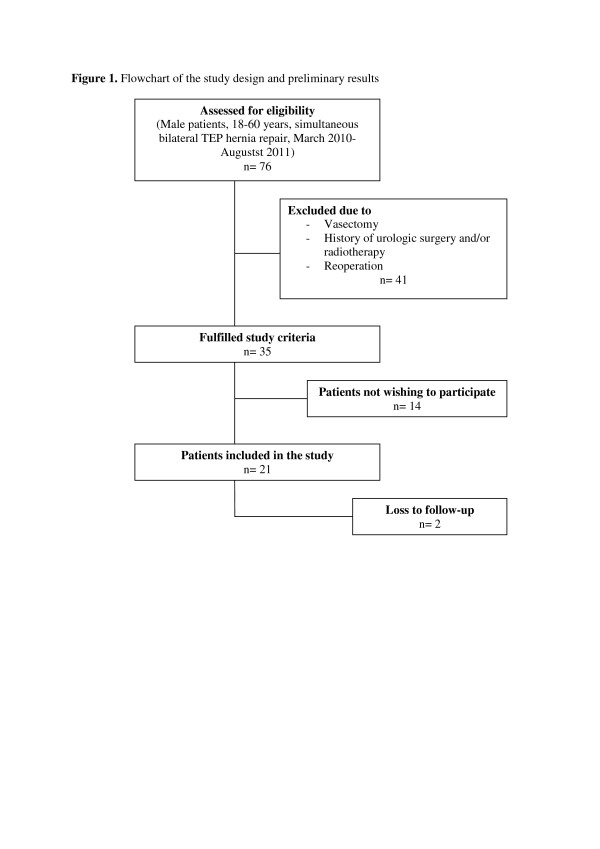
Methods and design: The MAIN study is an observational cohort study designed to assess fertility after endoscopic TEP hernia repair. The setting is a high-volume single center hospital, specialized in TEP hernia repair. Male patients of 18-60 years of age, with primary, reducible, bilateral inguinal hernias and no contraindications for endoscopic TEP repair are eligible for inclusion in this study. Patients with an ASA-classification≥III and patients with recurrent and/or scrotal hernias and/or a medical history of pelvic surgery and/or radiotherapy, known fertility problems, diabetes and/or other diseases associated with a risk of fertility problems, will be excluded. The primary outcome is the testicular perfusion before and 6 months after TEP hernia repair (assessed by means of a scrotal ultrasonography). Secondary endpoints are the testicular volume (Ultrasound), semen quality and quantity and the endocrinological status, based on serum levels of the sexual hormones follicle-stimulating hormone (FSH), luteinizing hormone (LSH), testosterone and inhibin B before and 6 months after TEP hernia repair.
Discussion: The use of polypropylene mesh is associated with a strong foreign body reaction which could play a role in chronic groin pain development. Since the mesh in (endoscopic) inguinal hernia repair is placed in close contact to the vas deferens and spermatic vessels, the mesh-induced inflammatory reaction could lead to a dysfunction of these structures. Relevant large and prospective clinical studies on the problem are limited. This study will provide a complete assessment of fertility in male patients who undergo simultaneous bilateral endoscopic TEP hernia repair, by analyzing testicular perfusion and volume, semen quantity and quality and endocrinological status before and 6 months after TEP repair.
Trial registration: The MAIN study is registered in the Dutch Trial Register (NTR2208).
Figures
References
-
- Awad SS, Fagan SP. Current approaches to inguinal hernia repair. Am J Surg. 2004;188(Suppl. 6A):9S–16S. - PubMed
-
- Simons MP, Aufenacker T, Bay-Nielsen M, Bouillot JL, Campanelli G, Conze J, De Lange D, Fortelny R, Heikkinen T, Kingsnorth A, Kukleta J, Morales-Conde S, Nordin P, Schumpelick V, Smedberg S, Smietanski M, Weber G, Miserez M. European Hernia Society guidelines on the treatment of inguinal hernia in adult patients. Hernia. 2009;13:343–403. doi: 10.1007/s10029-009-0529-7. - DOI - PMC - PubMed
-
- Eklund A, Rudberg C, Smedberg S, Enander LK, Leijonmarck CE, Osterberg J, Montgomery A. Short term results of a randomized clinical trial comparing Lichtenstein open repair with totally extraperitoneal laparoscopic inguinal hernia repair. Br J Surg. 2006;93:1060–1068. doi: 10.1002/bjs.5405. - DOI - PubMed
Publication types
MeSH terms
LinkOut - more resources
Full Text Sources
Medical
